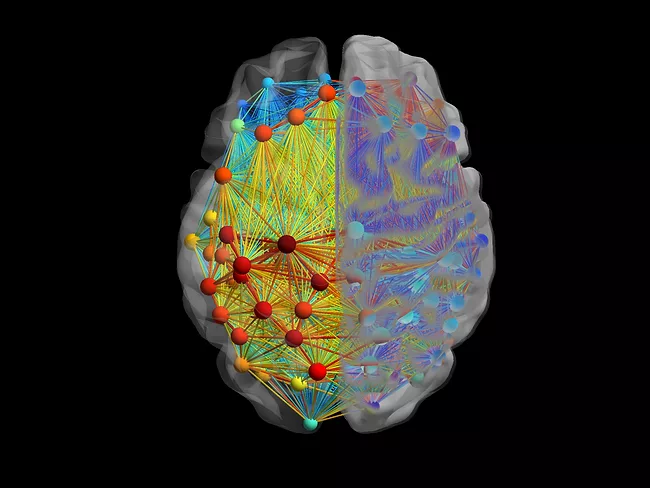
Understanding neurological disease requires several things, including a clear view of the connectome, and the U.S. National Institutes of Health may have a solution in the form of a new MRI system that allows the user to examine neural connections at the mesoscopic and microscopic scales.
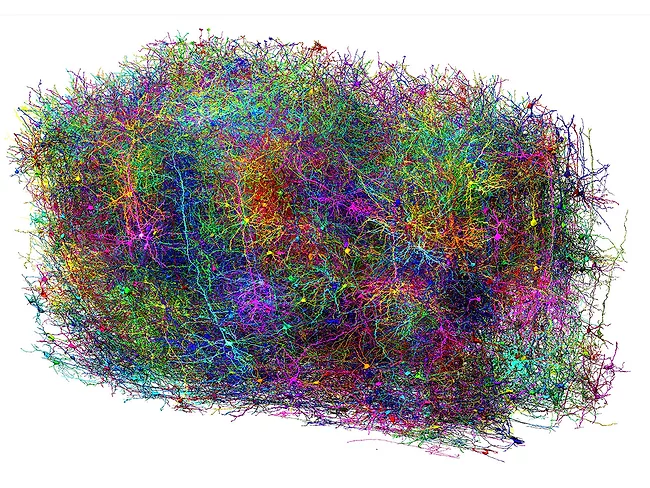
Scientists from the Machine Intelligence from Cortical Networks (MICRONS) consortium have published the microconnectome of a cubic millimeter of the mouse brain. This is the most complete map of this organ to date at nanometer resolution for a mammal. It not only contains the structure and connections of each and every cell in that volume of tissue, but is also linked to the neuronal activity of that portion of the CNS, linking anatomy and function in the same cells.
In the 1970s, scientists from several countries proposed to reconstruct, one by one, all the neurons in the brain as they appear under an electron microscope. They started with a small worm. Caenorhabditis elegans has only 302 neurons. It took 16 years. How much time would be required to repeat this arduous task for the 100 billion neurons in the human brain?
In the 1970s, scientists from several countries proposed to reconstruct, one by one, all the neurons in the brain as they appear under an electron microscope. They started with a small worm. Caenorhabditis elegans has only 302 neurons. It took 16 years. How much time would be required to repeat this arduous task for the 100 billion neurons in the human brain?
In the 1970s, scientists from several countries proposed to reconstruct, one by one, all the neurons in the brain as they appear under an electron microscope. They started with a small worm. Caenorhabditis elegans has only 302 neurons. It took 16 years. How much time would be required to repeat this arduous task for the 100 billion neurons in the human brain?
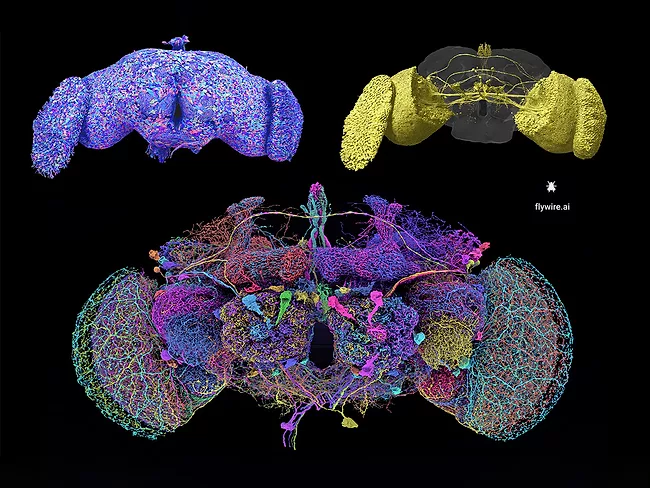
A collaboration led by the Flywire Consortium and comprising hundreds of scientists has completed a whole map of the adult fruit fly brain after several decades of collaborative work.
A collaboration led by the Flywire Consortium and comprising hundreds of scientists has completed a whole map of the adult fruit fly brain after several decades of collaborative work. By using electron microscopy and three-dimensional reconstruction supported by AI tools, the researchers have revealed the neural wiring of the Drosophila melanogaster brain, a connectome of 140,000 neurons with 50 million synaptic connections. In the future, researchers could possibly use this map as an artificial in silico model to study the brain as a simulator through its connections, though a lot of work remains to be done for this.
A group of scientists from Harvard University have observed and reconstructed the human brain at the resolution of the electron microscope, with all its cells, following all the connections between its neurons around a cubic millimeter of a tissue sample. They took 10 years and the data occupies 1.4 petabytes (1,400 terabytes). However, they are already planning a bigger project.
2021 was the year Aduhelm (aducanumab, Biogen Inc.) was approved as the first amyloid-β-busting drug for Alzheimer’s disease. And in 2022, there was as much need for an effective AD drug as ever. Aduhelm’s commercial fate was sealed with the decision of the Center for Medicare & Medicaid Services (CMS) that the drug would only be reimbursed in clinical trials approved by the CMS or the NIH.
Researchers have identified a link between amyloid plaques and dysfunctional neuronal conduction in animal models of Alzheimer’s disease (AD). Their study, which was published in the Dec. 1, 2022, issue of Nature, suggests new ways to think about AD, as well as badly needed potential alternatives to plaque removal to fight the disease.



-neurons-colored-by-size.webp?height=488&t=1715956099&width=650 "Excitatory (pyramidal) neurons colored by size.")