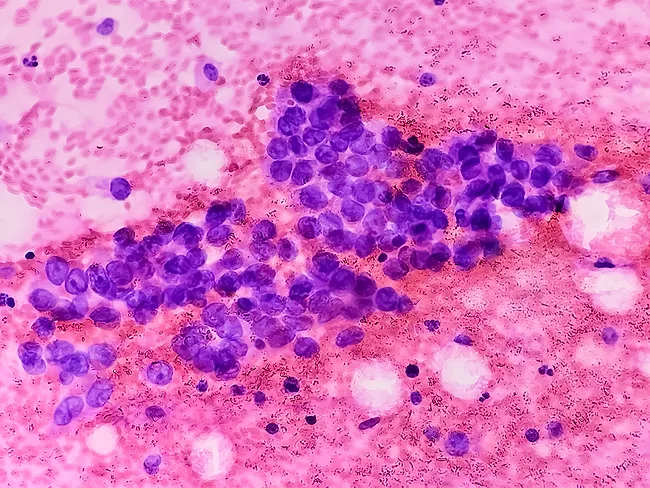
Researchers at Jilin University and collaborators combed through data in the public Cancer Genome Atlas and identified a potential target for lung adenocarcinoma.
KAT6A and its paralogue KAT6B are histone acetyltransferases whose overexpression is linked to poor prognosis in ER+/HER2- breast cancer and other types of tumors.
A recent study explored the therapeutic potential of hu128.1, a humanized antibody targeting transferrin receptor 1 (TfR1), in treating erythroleukemia using xenograft mouse models. The results demonstrate that hu128.1 exerts strong antitumor activity against human erythroleukemic (ERY-1) cells, highlighting its promise as a candidate for managing this aggressive cancer.
Northridge Health Group (Hong Kong) Co. Ltd. has divulged proteolysis targeting chimera (PROTAC) compounds comprising an E3 ubiquitin ligase binding moiety covalently linked to a tyrosine-protein phosphatase non-receptor type 2 (PTPN2; TCPTP)/PTP1B-targeting moiety via a linker.
Neuboron Medtech Research Institute Ltd. has disclosed boron-containing lipoic acid derivatives and vesicle forms acting as boron neutron capture therapy (BNCT) agents reported to be useful for the treatment of cancer.
Folate receptor α (FOLR1) is highly expressed in the surface of tumoral cells in several cancer types, while it shows limited expression in normal tissues. CSPC Pharmaceutical Group Ltd. has developed a next-generation antibody-drug conjugate (ADC) targeting FOLR1 – SYS-6041 – for the treatment of mid-to-low FOLR1-expressing tumors.
Drug resistance to epidermal growth factor receptor (EGFR) tyrosine kinase inhibitors, occurring via secondary mutations or bypass pathways, is frequent among non-small-cell lung cancer patients.
Claudin-6 (CLDN6) is a protein found in the tight junctions of epithelial cells to modulate their permeability and barrier function, among other actions.
Aptevo Therapeutics Inc. is advancing APVO-711, its bispecific antibody targeting PD-L1 x CD40 that combines checkpoint inhibition with immune activation in a single molecule.
The KRAS G12D mutation is the most common oncogenic KRAS variant, identified in approximately 34% of pancreatic ductal adenocarcinoma cases, 12% of colorectal cancers and 4% of lung adenocarcinomas.
 RSS
RSS