
BBI Contributing Editor
IRVINE, California – The 2000 Health Care Forecast Conference, held last month at the University of California, Irvine (UCI; Irvine, California), provided a forum for some of the leading experts in the health care industry to discuss their views on current and future trends in health care politics, policies, and market trends. While the overall health care market is unquestionably improving, mainly because robust performance of the economy is enabling more money to flow into health care, a number of issues remain to be resolved. At the same time, many experts believe that health care delivery is in the process of being fundamentally transformed by e-commerce, the Internet, and consumerism. Those factors will not only create a new landscape for health care, but may, in concert with new medical technologies, represent the only solution to maintaining and improving access to care as the populace continues to age in countries worldwide. Political factors will also play a major role in determining the path of evolution of health care, as the government continues to expand its role in the U.S., and while private insurance becomes more important in Europe.
Economic trends are of fundamental importance in determining the growth of the health care market, since as income increases individuals tend to devote a greater proportion of income to health care. According to Jim Glassman of Chase Securities (New York), a presenter at the UCI conference, the U.S. economy is continuing to astonish forecasters, with the longest-ever expansion, a continued low rate of inflation, and close to full employment. Many economists are now becoming convinced that the economy has entered a new era, where many of the old rules no longer apply. For example, recent statistics suggest that a 4% unemployment rate may now be sustainable, whereas 6% was historically considered to be the minimum. Likewise, economists now believe 3.5% gross domestic product growth may be sustainable, vs. 2% in the past, and that productivity can continue to increase at a 2.5% rate vs. the 1% rate that conventional economic theory stipulates. Those concepts are offered as a rationale for forecasting continued strong economic growth, rather than a bursting of the bubble as some have predicted. The factors responsible for high growth, many of which are now beginning to play a role in the health care market, include an older, more stable and conservative labor force; the growing use of variable pay such as stock options; deregulation of many of the major industries in the U.S.; financial innovation; globalization; the peace dividend; and e-power, the impact of computing technology on economic productivity. The success of managed care in reducing health care cost inflation is also viewed as a key factor contributing to economic growth in the U.S. Finally, Federal Reserve policy, when viewed in retrospect, has been close to ideal over the past several years.
In spite of the positive outlook for the economy, however, most economists are predicting a slowdown. An economic slowdown will certainly impact the health care market, although the predicted Federal budget surplus for Medicare and Medicaid is expected to continue to grow through 2010, thus cushioning any slowdown in the private sector. As shown in Table 1, combined spending for Medicare, Medicaid, and SCHIP (the State Children's Health Insurance Program) is expected to grow about 1% from 2000 to 2001, and spending will continue to increase thereafter, with over $5 trillion in expected expenditures over the next 10 years.

In addition to the strong economy, the surplus in the Medicare and Medicaid programs can be traced to a slowdown in spending resulting from the Balanced Budget Act, implemented in 1998. Other factors that have decreased spending on federal health programs include efforts by the Health Care Financing Administration (HCFA; Baltimore, Maryland) to eliminate fraud and abuse among providers; less-aggressive billing practices; and lags in processing of claims. Fraud and abuse programs in particular were more effective than anticipated, according to Joseph Antos of the Congressional Budget Office (Washington). Those programs not only eliminated a considerable number of providers who were engaging in fraudulent billing, but also caused many legitimate providers to code more conservatively. While the impact of such factors will be temporary, they have helped to extend the date when Medicare and Medicaid will become insolvent to at least 2015. Recent budget proposals by President Bill Clinton may extend the date to at least 2025.
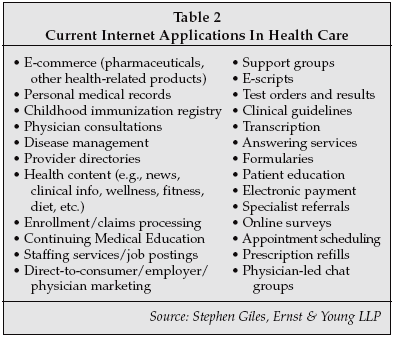
However, the biggest impact on the health care system is expected to come not from federal budget trends, but rather from the expansion of electronic commerce and medical applications of the Internet, or e-health. In just one year, between 1998 and 1999, the number of individuals seeking health-related information on the Internet increased from 23 million to 30 million, according to Stephen Giles of Ernst and Young (Los Angeles, California). Eighty percent of those information seekers are over the age of 65. Although most activity at present involves building of web sites, companies are rapidly expanding into direct marketing of health care products and services to consumers over the Internet. Other emerging applications include medical billing, medical records management, remote management of chronic disease patients including patients with heart failure and diabetes, cancer patient follow-up, physician and insurance plan selection, and pharmaceutical sales. A list of current health care applications of the Internet is shown in Table 2.
As the U.S. health care system undergoes a transformation driven by the emergence of e-health, suppliers, providers, and payers will face a number of issues. These issues include Medicare reform, to improve the efficiency of the Medicare system; prescription drug benefits for Medicare patients; the privacy of medical records, especially web-based records; patient safety issues; dealing with the growing number of uninsured persons; and Patient Bill of Rights legislation. While most of those issues will not affect manufacturers of medical products directly, helping hospitals, physicians, and other providers to deal with such issues will be important. Many suppliers are not well positioned, at least at present, to influence the impact such changes will have on the industry. Existing health care information system suppliers, for example, are being bypassed in the evolution of the market to Internet-based data systems.
Forecasters at the UCI conference predicted that, in addition to e-health, consumerism will be a major force reshaping the market. Genomics is also expected to have a major impact on disease management, allowing improved understanding of disease processes and elucidating more effective targets for new drugs. As populations age worldwide, certain groups of patients will become increasingly important, such as those with osteoporosis, Alzheimer's disease, and arthritis, and lifestyle treatments such as memory enhancement drugs may emerge as major markets. With the advent of e-health, the location and setting of health care service delivery will change, and more communication between physicians and patients is anticipated.
Key technologies in the health care market of the future, according to presenters at the UCI conference, include secure systems for handling web-based medical records and patient encounters; smart cards for storing medical information, genomics and related drug discovery technologies, and telemedicine. New tools for clinical decision support also will be important.
Market trends linked to overall economy
Although the health care industry has historically been considered to be recession-proof, the economy still plays an important role in determining the willingness of payers, including individuals, to allocate funds for health care. Employers, for example, are now using enhanced health care benefits as tools to help recruit employees in today's tight labor market. Workers are opting for more expensive health care plans as their financial status improves. The provisions of the Balanced Budget Act, which in their original form caused extreme financial hardships for many hospitals, were almost immediately relaxed by refinements implemented by Congress, primarily due to the unexpected budget surplus resulting from the strong economy.
In the new economy, a much higher proportion of corporate funds are being invested in high technology as opposed to brick and mortar assets, and the overall level of investment in durable equipment as a percentage of GDP is approaching 12%, double the rate recorded as recently as 1997. The trend is leading to productivity improvements in all sectors, including health care, although the health care industry lags behind many other sectors in implementing productivity enhancement tools. The economic boom could be stifled by inflation, but for now there are few signs that critical inflationary pressures are building. Nevertheless, price increases are clearly beginning to escalate in the health care services market, as indicated by rising insurance premiums. According to forecasters, there is little likelihood that the general rate of inflation will escalate dramatically, in part because of the heightened trend of price competition that has resulted from the implementation of e-commerce. The globalization of trade has also been an overall favorable development for the U.S. economy, in spite of some of the disruptions that have resulted, because of the dampening effect on inflation.
In the U.S., productivity growth is at its highest level in the past 40 years, and labor force participation is at a record high. Forecasters are now predicting that the U.S. economy will grow at a 3.7% rate in 2000, vs. 4% in 1999. Growth is expected to accelerate, however, in Europe and Asia, such that global GDP will increase from 2.6% in 1999 to 3.2% in 2000. Global inflation is forecast to decline, to 2.3% from 2.6%, remaining stable at 2.2% in the U.S. The combination is expected to allow continued strong economic performance to continue.
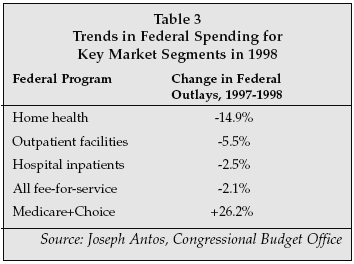
Forecasters are unanimous in predicting that health care spending will continue to rise, and at a rate in excess of the overall rate of inflation. In part, the increases reflect a backlash from the severe cuts in spending that occurred in prior years. As shown in Table 3, federal government expenditures for some segments of the health care provider market dropped substantially as recently as 1998, with home health spending showing a particularly severe drop. That trend is now ending, however, to be replaced by increases in spending as the BBA refinements are implemented. In addition, the temporary effects of HCFA's campaign to eliminate fraud and abuse, as well as processing lags in payments, will cease to be a factor. As a result, some of the sectors shown in Table 2 may exhibit some recovery going forward in 2000 and beyond.
The decline of the health care market due to spending constraints imposed by managed care is also expected to diminish, although managed care in some form is likely to remain the dominant structure for health care coverage for at least the next few years. As discussed by Walter Zelman, PhD, of the California Association of Health Plans (Sacramento, California), spending for health care dropped 25% in California when managed care was implemented in place of fee-for-service. The spending reductions were mainly absorbed by hospitals and specialists, sectors that experienced declines of 38% and 50% respectively, while the percentage of spending for administration along with profits stayed constant. Spending for primary care physician services in California increased about 50%, although spending in that category comprised only 10% of the total under fee-for-service. The savings flowed directly to consumers, who reaped the benefit in lower premiums. Meanwhile, 60% of hospitals in California operated in the red in 1999.
Another trend in health care over the past year is the dramatic increase in the number of uninsured individuals in the U.S., who now number an estimated 45 million, up from 30 million only two years ago. In part, this disturbing trend is due to the success of welfare-to-work programs that have caused many who were previously unemployed to become ineligible for Medicaid. Such workers typically do not subscribe to employer-provided health plans since few employers now offer fully paid coverage. Most experts think it highly likely that some form of legislation will be enacted this year to deal with the growing problem of the uninsured.
E-health, consumerism in key roles
The most profound change in the health care system, however, is not being driven by government legislation, but rather by the rapid emergence of e-health, or web-based medicine. Increased importance of the consumer in the selection of both the type of treatment employed as well as products used is also a major trend. e-health, defined as the delivery of health care information, products and services via the Internet, has only recently emerged as a major new segment, but growth, at least for some companies, has been very rapid. As described by Stephen Giles of Ernst & Young (Los Angeles, California), companies in this new sector are competing for market space, rather than for position in the marketplace, as in the conventional health care products market.
The e-health segment also is continuing to evolve as it expands from the static web sites of a few years ago accessed by general-purpose PCs to integrated web-based workstations. e-health systems are already being integrated with non-web legacy systems to bring existing operations on-line. One important application is searching for a specialist who can provide the desired care. Such searches can now be performed using the web in hours, rather than the weeks required for a traditional search. In some cases, such as in Massachusetts, web sites have been established that provide information on all practicing physicians, including data on procedure volume, credentials, pending lawsuits, and other information useful in physician selection. Conversely, physicians are now advertising their services on the web, with cosmetic surgeons having the largest presence. As the Internet becomes increasingly easy to use, aided by the introduction of cable access devices and simpler interfaces, the available population will expand, increasing the opportunity for providers and suppliers to reach patients via the web.
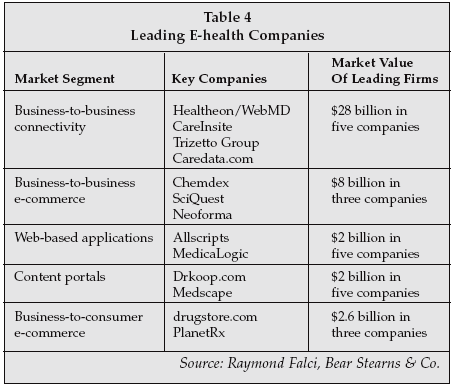
Key companies in the e-health market are described in Table 4. Healtheon/WebMD (Atlanta, Georgia), which reported net revenues of $68.9 million in the nine months ended September 1999 vs. $33.2 million in the year-earlier period, is the largest of the e-health companies, with a market value of approximately $20 billion. That figure represents about half of the market value of all e-health companies combined. The average e-health stock has increased in value by 260% in the past 12 months. The market is responding to expectations that e-health will provide solutions to many of the problems facing the health care system today, including inefficient data management practices, wide variability in practice patterns, high supply and procurement costs, and medical errors that represent the fourth leading cause of death in the U.S. Certainly, there is the potential to eliminate some administrative cost using e-commerce technology, and to eliminate waste in supply chain management. Conventional applications such as filling prescriptions for medications and processing insurance claims can also be done more efficiently via e-commerce.
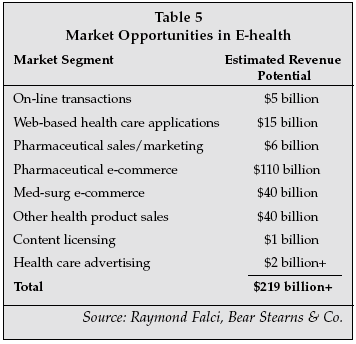
However, the e-health industry is likely to have a difficult time in living up to the market's expectations. The average e-health company is projecting revenue growth exceeding 100%, and the likelihood that all of the current market players will be able to achieve such performance is low. Furthermore, the industry is generating significant losses, and prospects for profitability appear slim at present for most e-health companies. Nevertheless, there undoubtedly will be a number of winners in the e-health industry, and the size of the potential market opportunity, while the topic of some debate, is considerable by any measure. As shown in Table 5, estimates developed by Bear Stearns & Co. indicate a combined market opportunity for e-health totaling over $200 billion. The uncertainty surrounding the size and scope of the market is indicated by the widely disparate estimate of another presenter at the UCI conference, Peter Brumleve of Drkroop.com (Austin, Texas), who quotes a total 2000 market opportunity for e-health of about $5 billion, including $1.1 billion for web-based automation of insurance transactions, $3 billion for pharmaceutical e-commerce, $500 million for content syndication, and $270 million for web-based recruiting of patients for clinical trials and related pharmaceutical research applications. Although there is clearly considerable diversity of opinion on the size of the market opportunity in e-health, the opportunity is large by any standard. In part, the different estimates may be the result of the nascent state of e-commerce itself, and the fact that many of the business models employed by e-commerce companies are new and untested, causing difficulties in arriving at a widely accepted definition of revenues.
Many of the identified opportunities in e-health are real and concrete, though. For example, recruiting of patients for clinical trials via the Internet is attracting considerable attention in both the e-health and the pharmaceutical industry. It costs approximately $1,200 to recruit a patient for a clinical trial using existing approaches that include newspaper and radio advertising, according to Drkroop.com's Brumleve, and recruitment of the more than 4,000 patients that an average drug trial requires can take many months. In contrast, recruitment via the Internet costs pennies, and can be accomplished in a few weeks. So far the companies that are addressing this opportunity, including CenterWatch (Boston, Massachusetts) and Drkroop.com in association with Quintiles Transnational (Durham, North Carolina), have had limited success. But initial results for a new entrant in this segment, Harris Interactive (Rochester, New York), in partnership with Medici Group (Wayne, Pennsylvania), are promising.
Traditional health care information system companies, such as Cerner (Kansas City, Missouri), CPSI (Mobile, Alabama), Meditech (Westwood, Massachusetts), SMS (Malvern, Pennsylvania), and Sunquest Information Systems (Tucson, Arizona), have not taken a leadership role in the transformation of the health care information industry to Internet-based technology. Some have established alliances to enter the field, such as Cerner's partnership with CareInsite (Elmwood Park, New Jersey), which will build on Cerner's established position in health care information systems, including an installed base of more than 1,000 health care organizations who currently use Cerner's clinical management and information system. In addition, Cerner will provide systems architecture and engineering personnel and expertise to accelerate the deployment of CareInsite's web-based technology, and will provide ongoing technical support and future enhancements to the CareInsite system. In spite of such efforts, however, traditional HCIS companies are viewed by investors as having missed the e-health opportunity. Stock prices for the traditional health care information system sector are down 45%, and the current combined market value of companies in e-health is approximately twice that of existing HCIS companies. Traditional suppliers are likely to find it necessary to establish partnerships with e-health companies, or develop e-health capabilities of their own, in order to survive in the health care market of the future.
Many speakers at the UCI conference noted the analogy between the health care industry and the banking industry in terms of the technology-driven structural transformations impacting both industries. The banking system has undergone revolutionary changes because of electronic data transfer and the introduction of automated teller machines. Banks readily adopted the new technology because of its greater efficiency and cost savings, and consumers were receptive to the change because of the greater convenience it offered. However, as opposed to the health care industry, the banking system abides by industrywide standards including data security standards, is regulated by a single body (the Federal Reserve), provides widespread access to data repositories, and is characterized by a modest degree of consumer movement between banks, a limited amount of relevant data, and an all-inclusive data repository. The health care system has none of those features, making the task of implementing system-wide electronic data management and transaction processing considerably more difficult. While the task may be doable, it will require considerable time and effort, and will also require most hospitals, physicians, and other providers to significantly alter their existing systems and procedures. However, consumer/patient demand for improved efficiency and quality will represent an irresistible force driving the transformation. As described by Sheryl Skolnick of BancBoston Robertson Stephens (New York), the Internet has shifted the balance of power from health care providers and payers to the consumer. Most physicians do not welcome the change, but as some began to adopt consumer-focused practices, the rest will likely be forced to follow suit.
In order to succeed in e-health, companies involved in the business-to-business sector must be able to integrate web-based technologies with existing processes, requiring an in-depth knowledge of health care. However, successful companies must also be able to put aside legacy systems and outmoded technologies that will be too inefficient and costly in the web-based environment. The focus must be on workflow improvement, employing easy-to-use platforms that leverage Internet connectivity. For companies involved in the business-to-consumer sector, brand name dominance will be an important success factor, as will applications that deliver personalized information and services that are relevant to consumer and patient needs. Connectivity to other segments of the health care system will also be critical, to allow patients to move between providers and between different facilities operated by the same provider without the need for time- and resource-consuming physical transfer and re-creation of records. Improved ability to track patients will be mandatory in order to effectively implement disease management programs that most providers are now beginning to develop. In the past, many attempts at disease management failed because of the inability to track patients. The Internet has now made such tracking possible.
Technology key to expanding access
Transforming the health care system to meet the demands of today's consumers will rely heavily on the use of new technologies, including not only the Internet but also more cost-effective products for diagnosis and treatment, as well as technologies that provide improved quality of care. Some of the key new technologies that will play a role in the health care system in the future include genomics, electronic medical records, web-based patient monitoring, and telemedicine. A survey conducted by PricewaterhouseCoopers and presented at the UCI conference, the "HealthCast 2010" survey, confirmed that most experts believe advances in technology, along with the growing dominance of the health care system by consumers, will be the primary factors shaping change in the industry. The survey polled some 430 thought leaders and health care experts, including hospital executives, medical company executives, and physicians in the U.S. and Europe. Thirty-seven percent of respondents in the U.S. and 41% of respondents in Europe believe that medical technology will have the most impact on health care by 2010. About 34% of executives in both regions believe consumerism will have the greatest impact. A substantially lower percentage, fewer than 10% in most cases, voted for genomics, e-business, and the labor market as the most important factors.
Another finding of the survey was that certain technology-based services are likely to be outsourced by health care organizations by 2010, including information technology, medical records, and laboratory services. In addition, 70% of respondents believe that the quality of health care and patient confidence would benefit from physicians' consulting decision-support software. This is consistent with recent findings that medication errors are responsible for an estimated 106,000 deaths each year in the U.S., and other studies by U.S. hospitals that have recently used bedside terminals to collect patient information and found reductions of up to 80% in medication errors. Finally, the survey found that most experts believe hospitals, provider networks, and Internet portal services are the most likely entities to serve as the primary medical records warehouse in 2010, with hospitals and provider networks having a slight edge.
Genomics will have a major impact on health care in two ways. First, new genomics-based technologies allow a tenfold increase in the number of potential new drugs that can be identified and screened, by increasing the number of possible targets that can be identified. Although gene therapy may be slow to develop, due to cost issues and safety concerns, many new targets identified using genomics can be attacked with more conventional types of drugs, such as antibody-based agents. In addition, genomics will allow fundamental improvements in diagnosis, leading to the ability to practice true preventive medicine, as opposed to today's emphasis on curing disease after it has developed to a crisis level. The advent of genomics will not necessarily reduce the cost of health care, however, as indicated by responses to the HealthCast 2010 survey showing that 65% believe overall health care costs will increase as a result of genetic mapping. However, the respondents also believe genomics will drive providers to focus more on prevention, and that more care will be delivered on an outpatient basis, presumably because diseases will be detected at an earlier, more easily treatable stage. There may be a gap between the ability to diagnose disease and the development of methods of treatment, which will create a problem with patient expectations.
Another emerging approach that employs new Internet-based technologies along with advanced patient monitoring techniques is exemplified by the recently announced alliance between Medtronic (Minneapolis, Minnesota), and Healtheon/WebMD. The four-year exclusive alliance calls for Medtronic to sponsor advertising of medical technology by Healtheon/WebMD in the U.S. and Europe, and to create on-line health information channels targeted at specific disease-focused patient groups. Medtronic also has announced partnerships with Microsoft (Redmond, Washington) and IBM (Armonk, New York) to develop patient management systems. The Healtheon/WebMD web site will serve as the Internet portal for Medtronic's Patient Management System. Additional alliances of this type are likely to be announced as other medical device and pharmaceutical suppliers begin to implement their strategies to take full advantage of e-health market opportunities.
This year's presidential election in the U.S. will serve as an important indicator of the future of the health care system, not only in the U.S. but probably in other developed countries as well. The possible scenarios for health care range from the adoption of a national health insurance program that would guarantee a basic level of health care for all and address the growing problem of the uninsured, to a voucher system under which employers would provide employees with funds to purchase the health care policy of their choice, to a technology-driven system that would employ new approaches such as pharmacogenomics, bioengineered devices, and integrated electronic data systems to bring a new level of cost-effectiveness and quality to health care. Economics will play an important role in determining which scenario prevails, as will consumers. And finally, suppliers of health care products can expect to see continued changes in their markets as e-health and advanced technologies exert an increasingly strong influence.