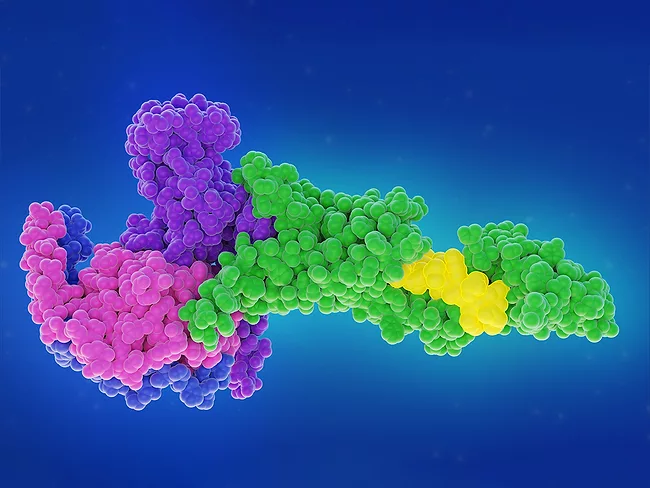
A new molecule combines the action of two incretins, GLP-1 and GIP, hormones that regulate glucose and appetite, with lanifibranor, a triple agonist of peroxisome proliferator activated receptors (PPAR α/γ/δ). GLP-1–GIP–Lani enables targeted delivery of the PPAR agonist to cells that express incretin receptors, enhancing weight loss, improving glucose control and reducing inflammation in obese mice. In these models, it surpassed the effects of GLP-1 receptor agonists such as semaglutide and GLP-1–GIP co-agonists such as tirzepatide in reducing body weight, improving glycemic control and enhancing metabolic outcomes during active treatment.
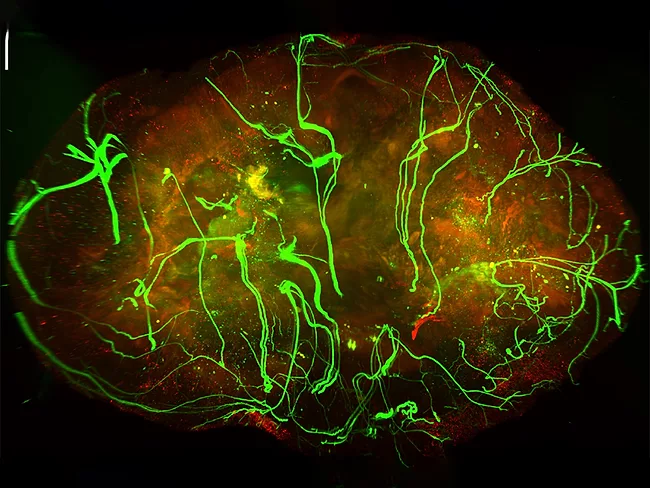
Innervation by the sympathetic nervous system is typically a boon to tumors. But researchers from Weill Cornell Medicine and colleagues have shown that in some cases, the relationship between tumors and the nervous system is more complex. Depending on context, innervation can either assist or obstruct tumor growth. “The nervous system typically has been considered as a driver of cancer growth, but here we’ve found that it can be a brake on cancer growth in some contexts,” said David Simon, an assistant professor of biochemistry and biophysics at Weill Cornell Medicine.
An alleged coverup of NIH-funded gain-of-function research at China’s Wuhan Institute of Virology has led to criminal charges against a former career scientist and top aide to Tony Fauci, the head of the National Institute of Allergy and Infectious Diseases in the time of the COVID-19 pandemic.
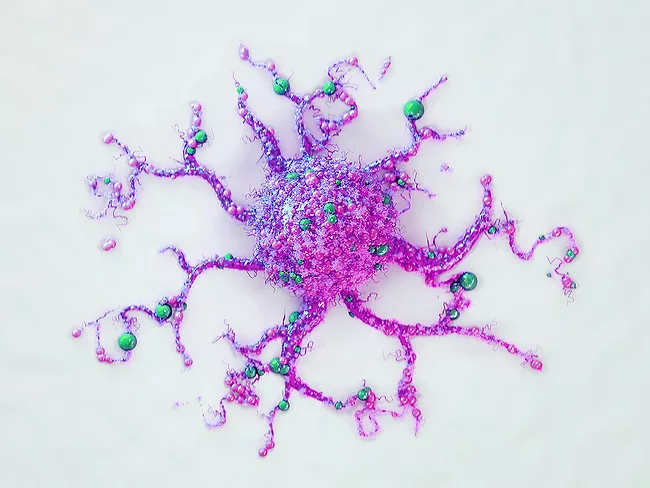
If Benjamin Braddock, of The Graduate fame, were a young neuroscientist in the 21st century instead of a liberal arts graduate in 1967, the advice he received from his parents’ neighbor might not have been “One word: plastics!” but “One word: plasticity!” Plasticity is a hot concept in neuropsychiatric disorders. New and old treatment modalities, these days, are said to work as psychoplastogens or neuroplastogens.
Artificial intelligence tools are springing up at multiple points along drug discovery and development, but despite the hype, as yet there is minimal return on investment (ROI). “I would say a lot of companies sort of get this big excitement about AI, but then when you look at how much ROI they get, it’s actually very little. And that’s because the workflow and the process, end-to-end, isn’t mapped to really understand where AI can truly make an impact,” said Laura Matz, chief science and technology officer at Merck KGaA.
Researchers in the U.K. have developed an AI-driven method of identifying viruses in wild animals with the potential to spillover into humans. The technique makes it possible to use the genome sequences of the spike proteins by which viruses enter host cells to assess the potential to infect humans without having to isolate an individual virus and tests its infectivity in the lab.
When a tumor migrates and colonizes another tissue or organ, it can be identified as a metastasis, but its origin is not always clear. Now, a study based on machine learning has identified DNA-methylation patterns that reveal the type of tissue a cancer comes from when the primary tumor cannot be found. This technique could help guide more specific treatments for patients with cancers of unknown primary, who today often receive broad, nontargeted chemotherapy.
A new study tracking the genomic evolution of chronic myeloproliferative neoplasms has shown that progression to myelofibrosis or acute myeloid leukemia is encoded in mutations that occur years before the transformation is clinically evident.
Genes that are switched on or off in the human brain differ between men and women. Moreover, these differences are not uniform. They vary across cortical regions and cell types. Scientists at the National Institute of Mental Health (NIMH) and the National Institute on Aging (NIA) used single-cell sequencing and unveiled distinct gene expression patterns regulated by hormones and sex chromosomes. This detailed map of the brain’s molecular biology shows how women and men switch on and off more than 3,000 brain genes differently and expands the catalogue of X chromosome genes that escape inactivation.
A new metasurface design strategy that replaces rigid order with “engineered disorder” could significantly increase how many optical functions can be integrated into a single ultra-thin device without increasing size or complexity, according to a study published in Nature Communications. The study challenges a longstanding assumption in optical engineering that highly ordered, periodic structures are required to precisely control light.
 RSS
RSS