Radiopharmaceuticals require sophisticated infrastructure, with just-in-time radioactives delivered to patients who must isolate while receiving the therapy. Quality control and numerous layers of regulation makes for a daunting space to enter.
Radiopharmaceuticals require sophisticated infrastructure, with just-in-time radioactives delivered to patients who must isolate while receiving the therapy. Quality control and numerous layers of regulation makes for a daunting space to enter. Although the demand for medical isotopes is growing, the facilities that can make these products are aging, and one of the major facilities globally has already come offline. Next steps for the industry will be to solve supply and regulatory challenges as clinical trial data start to differentiate therapies in the pipeline.
The radiopharma field has garnered increasing attention in recent years due to big-ticket deals like Bayer AG's $2.9 billion acquisition of Algeta ASA and Novartis AG's nearly $6 billion spent on buying Advanced Accelerator Applications SA and Endocyte Inc. As a result, competition is ratcheting up and pipelines are exploding with new combinations of different drugs. The global radiopharmaceuticals market was estimated to be valued at $6.7 billion in 2020, a number expected to reach $11.5 billion by 2027, according to a 2022 William Blair report.
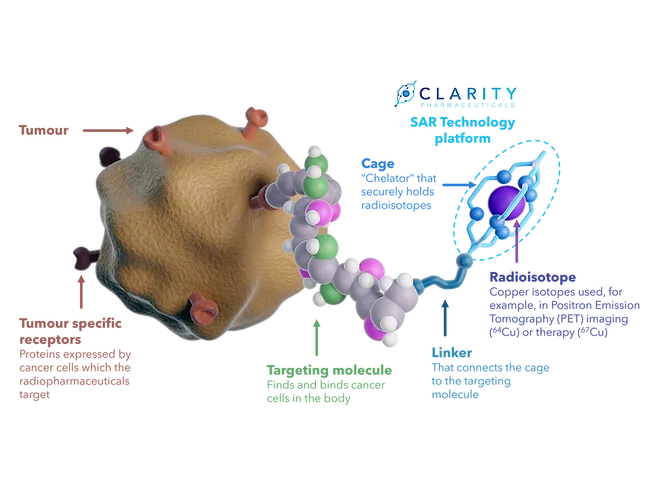
Clarity Pharmaceuticals Ltd. is progressing three of its targeted copper theranostics through the clinic that are based on its sarcophagine technology that securely holds copper isotopes inside a cage-like structure, called a chelator. The SAR technology allows a unique pairing of copper isotopes, copper-64 and copper-67, for both cancer diagnosis and therapy.
Clarity Pharmaceuticals Ltd. is progressing three of its targeted copper theranostics through the clinic that are based on its sarcophagine technology that securely holds copper isotopes inside a cage-like structure, called a chelator. The SAR technology allows a unique pairing of copper isotopes, copper-64 and copper-67, for both cancer diagnosis and therapy.