A research team from the Technical University of Munich (TUM) in Germany has for the first time managed to integrate the dark-field X-ray technique into a CT scanner suitable for clinical application. They have just published an article describing how they integrated this technology, in the journal Proceedings of the National Academy of Sciences.
The FDA has granted clearance of Siemens Medical Solutions Inc.’s photon-counting computed tomography (CT) scanner, Naeotom Alpha. The new diagnostic imaging device uses a photon-counting detector that measures individual X-rays that pass through a patient's body, as opposed to current systems that use detectors that measure the total energy contained in X-rays at once. The scanner then transforms the information from the X-ray photons into a detailed three-dimensional image, which can be used by physicians to assist diagnosis or treatment preparation planning.
The U.S. Preventive Services Task Force (USPSTF) may recommend a fairly dramatic expansion of the populations that would be eligible for coverage for lung cancer screening, a bit of news that might be expected to cheer makers of CT imaging systems. However, compliance with the existing recommendations is already quite low, suggesting that an expansion of eligibility is likely to exert a negligible effect at best on utilization.
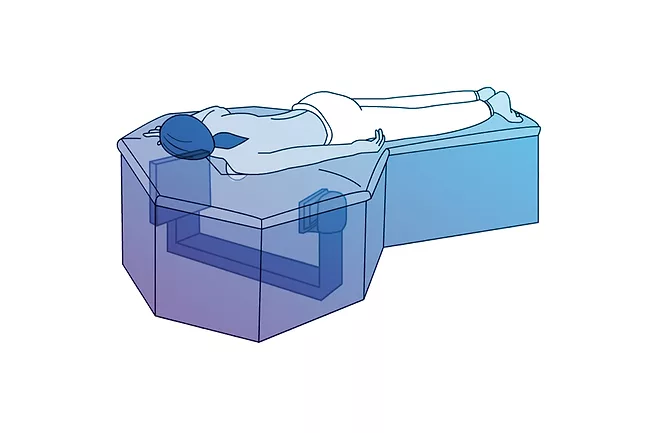
TORONTO – Vancouver, British Columbia-based Izotropic Corp. has inked a deal with Victoria, British Columbia-based based Starfish Medical Inc. to commercialize a CT scanner Izotropic CEO Robert Thast said will be a major disruptor of the breast imaging industry. Izotropic has spent approximately $20 million over the past 15 years to develop the system and is counting on Starfish to help translate this into a market-ready 3D breast CT imager by the end of 2020.
Hafnium nanoparticles that home onto microfractures in bone make the tiny cracks visible in spectral or color computed tomography (CT) imaging. Researchers at the University of Illinois at Urbana-Champaign and the University of Maryland created the nanotechnology to work in conjunction with spectral molecular imaging developed by New Zealand-based MARS Bioimaging Ltd. (MBI). The research appeared in Advanced Functional Materials.