Glucagon-like peptide-1 (GLP-1) receptor agonists clearly help patients shed pounds, but many regain all - or more - of the weight once they discontinue the medications. Fractyl Health Inc. could offer an enduring solution with its Revita procedure. Six-month results from its open-label REVEAL-1 cohort of individuals with obesity who lost 15% or more of their total body weight on a GLP-1 therapy maintained that loss after discontinuing the drugs and undergoing the Revita procedure.
At the American Diabetes Association 85th Scientific Sessions in Chicago June 20-23, Fractyl Health Inc. presented results from two studies evaluating very different approaches to treating – and possibly curing – type 2 diabetes.
Far from eliminating the need for weight-loss procedures, glucagon-like peptide-1 receptor agonists could drive more people to seek them out. At least that’s what Fractyl Health Inc. and Bariendo Inc. hope, and they have strong evidence to support their case with a recent meta-analysis showing that individuals discontinuing the popular weight loss medications regain all their weight and more within two years.
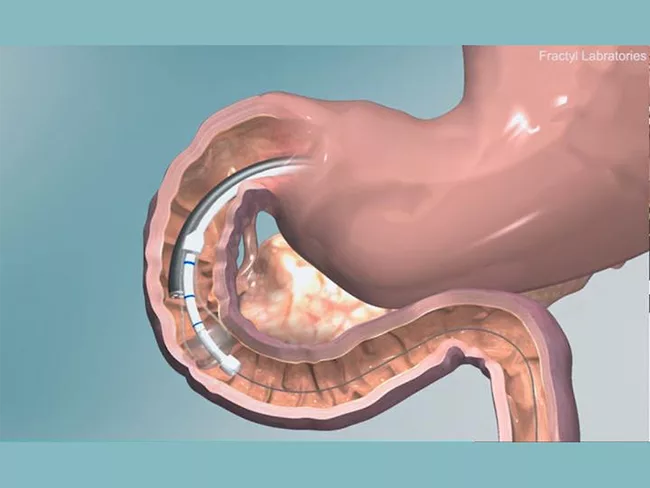
Twelve-month results from Fractyl Health Inc.’s real-world registry show sustained, significant weight loss following treatment with its Revita procedure, which uses ablation to resurface the mucosal lining of the duodenum.
Stimlabs LLC has taken a new view of wound healing by developing a fenestrated dehydrated complete human placental membrane allograft for chronic and acute wounds. The fenestration in the Release product allows fluids to drain away from the wound, promoting faster healing, while the tissue provides protection.
Fractyl Health Inc. reported clinical updates on the Revita real world registry in Germany which has demonstrated clinical remission from type 2 diabetes (T2D) employing a device that resurfaces the duodenal mucosa, the innermost layer of the first portion of the small intestine, and a potential root cause of T2D.
Two companies presented highlights of studies that demonstrated outstanding results for novel devices at last weekend’s American Diabetes Association’s (ADA) 83rd Scientific Sessions, while Embecta Corp. and Senseonics Holdings Inc. provided updates that position them well for long-term performance. Glyconics Ltd. revealed a fingernail scanning device that simplifies screening for diabetes and Fractyl Health Inc. showed that its Revita procedure reduced blood glucose levels and promoted weight loss.
Fractyl Health Inc. closed $100 million in new financing Wednesday to expand and accelerate clinical development efforts to reduce dependence on insulin among type 2 diabetes patients. The startup, which changed its name from Fractyl Laboratories Inc., will use the financing to support additional late-stage clinical studies for determining the potential of its Revita DMR.
The FDA has granted breakthrough device designation to Fractyl Laboratories Inc. for Revita DMR, a duodenal mucosal resurfacing treatment for patients with type 2 diabetes. The company recently launched the pivotal REVITA-T2Di clinical trial to evaluate the treatment in this population, in hopes it will offer a new option for people with the metabolic disease.
Improving metabolic disorders without major changes in diet and exercise is typically seen as impossible, unless bariatric surgery is involved. But that’s precisely what Fractyl Laboratories Inc. aims to do. It plans to start a pivotal trial of its duodenal mucosal resurfacing system, Revita DMR, before year end.