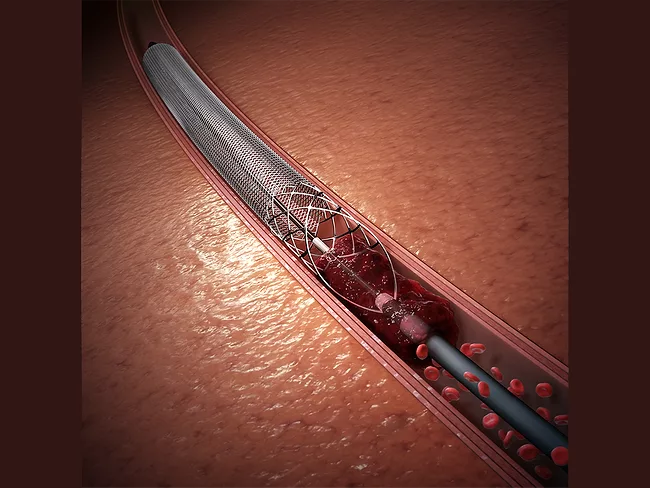
Penumbra Inc.’s 'resoundingly positive' results from its STORM-PE trial could see current guidelines for anticoagulant use in pulmonary embolism swept away in favor of mechanical thrombectomy. A deluge of favorable comments by experts and analysts followed the presentation during a late-breaking session at Transcatheter Cardiovascular Therapeutics, the annual scientific symposium of the Cardiovascular Research Foundation, which showed more than 50% improvement in treatment effect from Penumbra’s computer-assisted vacuum thrombectomy system plus anticoagulation compared to anticoagulation alone within two days with no increase in major adverse events.
A late-breaking study presented at the PERT Consortium 2025 Pulmonary Embolism Scientific Symposium in San Diego showed marked clot-burden reduction with no device-related serious adverse events for Imperative Care Inc.’s Symphony thrombectomy system, though other companies have a head start. Circulation: Cardiovascular Interventions simultaneously published the study in an article titled “A Prospective Multicenter IDE Study of the Next-Generation Precision Aspiration Thrombectomy System for Intermediate-Risk Pulmonary Embolism: The SYMPHONY-PE Trial.”
In the first quarter of 2025, the med-tech sector saw a total of $149.08 million raised through 475 deals. This marked a significant decline from the $519.14 million raised in Q4 2024, representing the smallest quarterly total recorded by BioWorld MedTech since 2018.
The med tech patent wars conscripted another two companies via a patent infringement lawsuit between Inari Medical Inc. and Imperative Care Inc. — a struggle that is playing out in a California district court.
With multiple large M&A deals already announced in January, CEOs of major med-tech companies outlining acquisition plans for 2025 and declining interest rates, the stage is set for a significantly more active year of M&A. Financings, too, have ticked up and analysts expect the trend to continue, offering hope for a positive year for the med-tech industry.
With more than 60 acquisitions completed in the last decade, Stryker Corp. shows little fear in committing to offers that allow it to obtain the companies and technologies that have driven its impressive growth in stock price – up from $92 in Jan. 2015 to $356.70 in Jan. 2025. Still, the definitive agreement to buy Inari Medical Inc. for $4.9 billion comes in at the upper range, along with the $4 billion acquisition of Wright Medical Group NV in 2020 ($5.4 billion with debt included), $3 billion for Vocera Communications in 2022, and $2.8 billion for Sage Products in 2016.
The U.S. FDA recently announced that Inari Medical Inc. issued a recall that corrects the instructions for use for roughly 2,500 units of the Clottriever XL catheter due to reports of device entrapment in the lung.
The U.K. National Institute for Health and Care Excellence is not utterly opposed to the use of mechanical thrombectomy as a treatment for pulmonary embolism, but the agency believes that the outcomes data for high-risk patients are lacking.
Just weeks after securing U.S. FDA approval for its flagship system to treat chronic limb-threatening ischemia (CLTI), Limflow SA kept the good news flowing to investors with the announcement of an agreement to be acquired by Inari Medical Inc. in a deal valued at up to $415 million. Inari will pay $250 million in cash at closing with up to $165 million in additional payments going to Limflow based on achievement of specified commercial and reimbursement milestones starting in 2025. The companies expect the deal to close by the end of the year.
An analysis of real-world data pulled from Truveta’s electronic health records of 30 U.S. health care systems found that patients treated for pulmonary embolism (PE) using Boston Scientific Corp.’s Ekos endovascular system had lower rates of adverse events, particularly intracerebral hemorrhage, than those treated with Inari Medical Inc.’s Flowtriever system.