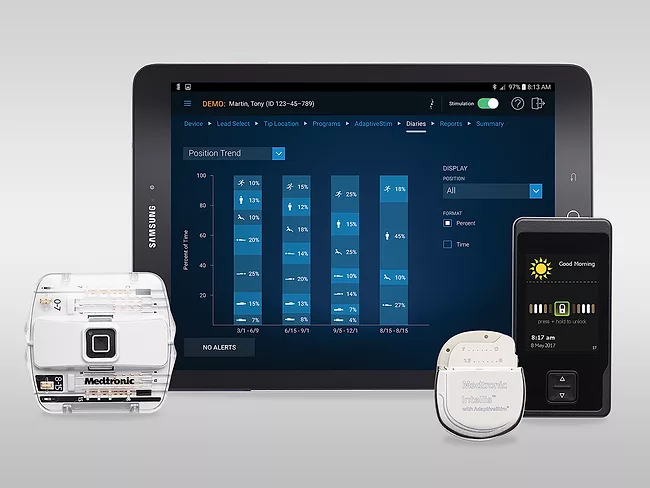
The Vanta device by Medtronic plc, provides relief from pain for thousands of patients, but the Vanta might also feel the pain when the patient is undergoing cardioversion. According to a field safety notice from Dublin-based Medtronic, two patients in Europe have undergone explant procedures for the device due to damage sustained during cardioversion, but the company urges physicians to pay heed to the labeled indication, which recommends that the device be temporarily reprogrammed to reduce the risk of damage to the device, an action that Medtronic indicated should ward off any such issues.
Medtronic plc released initial results showing meaningful pain relief using differential target multiplexed (DTM) spinal cord stimulation (SCS) endurance therapy, a lower-energy form of its DTM SCS treatment for overall, back or leg pain. At three months, patients in the on-label, prospective, multicenter study reported that their overall pain was about half what it was at the start of the study, measured by a 3.9 cm reduction on the 10 cm Visual Analog Scale (VAS) vs. 7.8 cm at baseline. Patients in the study also reported an average decrease in back and leg pain or 4.3 cm and 5.0 cm, respectively. Medtronic plans to offer the DTM SCS endurance therapy on its rechargeable Intellis and primary cell Vanta platforms.
Medtronic plc snagged FDA premarket approval for its recharge-free implantable neurostimulator (INS), Vanta, for patients with intractable pain. The spinal cord stimulator offers up to 11 years of device life, with optimal programming. That represents a 10% improvement on the Dublin-based company’s previous longest-lasting INS, Primeadvanced, and a near doubling of device life compared to Abbott Laboratories’ Proclaim and Boston Scientific Corp.’s Wavewriter Alpha, using the settings recommended in the clinician manuals.