The U.S. Centers for Medicare & Medicaid Services (CMS) finalized the Medicare inpatient prospective payment system for fiscal year 2024 with a number of new and renewed new technology add-on payments (NTAPs) for the coming fiscal year. Controversially, however, the agency retained a proposal from the draft that requires that a product have received market authorization from the FDA by no later than May 1 of the prior fiscal year to qualify for NTAP payment, a provision that industry has blasted as exclusionary of products that merit an NTAP payment.
The U.S. Centers for Medicare & Medicaid Services (CMS) has wrapped up its rulemaking for the next Medicare inpatient prospective payment system, and several companies managed to score important rate-setting wins for their devices. Microtransponder Inc., of Dallas, won a new technology add-on payment (NTAP) for its Vivistim device for treatment of stroke, as did W.L. Gore & Associates Inc. for its TAG thoracic branch endoprosthesis (TBE), just two among several winner in the Medicare inpatient final rule for fiscal 2023.
The U.S. CMS released the draft Medicare hospital outpatient rule for calendar year 2023, a document that is replete with information on pass-through payment data for drugs and devices. However, the agency said that the Supreme Court’s ruling regarding rates for drugs covered under the 340B drug pricing program came too late in the annual cycle to be fully accounted for in the outpatient rule for 2023, and thus any such permanent adjustments will have to wait until the outpatient rule for 2024.
Microtransponder Inc. raked in $53 million in an oversubscribed series E round that exceeded its best previous fundraising by nearly 500% and brought the company’s total funds raised to date to $93 million. The new money will be used to commercialize the Vivistim paired VNS system, which received premarket approval in 2021 as what the FDA called the “first stroke rehabilitation option using vagus nerve stimulation.”
The Medicare new technology add-on (NTAP) program is a vital source of reimbursement rates for novel technologies, and several NTAP applications were extended by a year in 2021 because of the COVID-19 pandemic. That extension is set to expire for several key products, including the Eluvia drug eluting stent by Boston Scientific Corp., of Marlborough, Mass., and the Spinejack system by Stryker Corp., of Kalamazoo, Mich., forcing these companies to amortize their R&D costs at a more conventional pace.
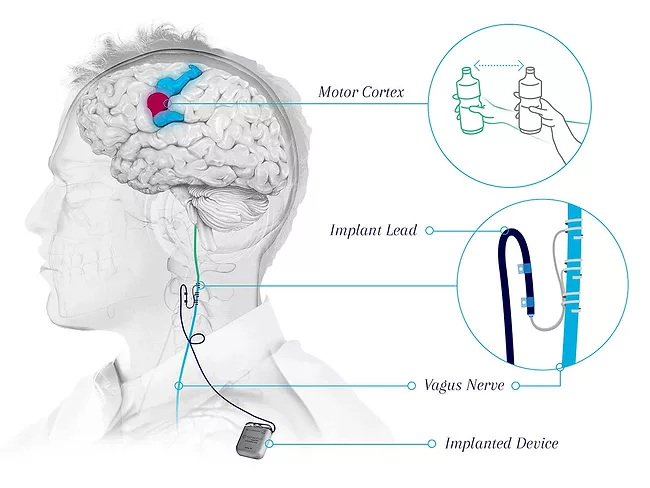
Vagus nerve stimulation (VNS) researchers notched another success with FDA approval of a drug-free rehabilitation system that uses the technology to help patients who have lost mobility in their hands and arms as a result of ischemic stroke regain function. Microtransponder Inc.’s Vivistim pairs rehabilitation exercises with VNS to enhance their impact. The clinical study evaluated by the FDA for the system's approval showed that Vivistim doubled the improvement in upper extremity motor function compared to supervised rehabilitative exercises alone at six weeks and 90 days.