
BB&T Executive Editor
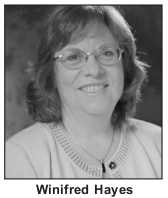
Winifred Hayes, PhD, RN, is president and CEO of Hayes Inc. (Lansdale, Pennsylvania). She founded the company in 1989 in response to a growing need in the healthcare industry for evidence-based assessments of health technologies.
 |
Under her leadership, Hayes Inc. has become an international leader in providing unbiased, clinically focused, evidence-based reports to health plans, hospitals, managed care organizations, government agencies, and healthcare systems.
Dr. Hayes lectures and publishes as an advocate for the role that evidence-based decision-making plays in improving patient outcomes and healthcare resource allocation. She has served as an associate professor and program director for the Occupational Health Nursing Graduate Program at the University of Pennsylvania School of Nursing and on the faculties of Emory University and the University of Maryland, and currently is affiliated with the Senior Scholars Program in the Department of Health Policy at Jefferson Medical College in Philadelphia.
BB&T: "Evidence-based medicine" (EBM) has become something of a catchword in healthcare circles – especially on the policy side of things. What's a good, working man's definition?
Hayes: There are a lot of definitions out there. The way I would define it is, evidence-based medicine really is talking about healthcare decisions and practices, whether they're patient-specific or they're population-based, that are based or founded on the best available scientific evidence. The way I define it, scientific evidence is evidence that comes through formal research, including clinical trials. And "best available evidence" means it's considering the entire body of research around this particular technology and its uses – not just referencing research that supports a particular viewpoint. So "best available" means looking at the whole body of research and looking at research design and execution – what is the strongest, most robust, research available? It's about decisions and practices, and its focus is people, individuals and populations.
The term "evidence-based medicine" really is misused today. Often we hear, "Well, we looked in the peer-reviewed literature and we quoted somebody." That's not evidence-based medicine. Evidence-based medicine really is a comprehensive look at all the evidence and then focusing in on the best available evidence. It's not just that you've referenced somebody – it's really that you're looking at the body of evidence as derived from scientific study.
BB&T: Right, it's more of a meta-analysis of all that's available.
Hayes: I don't like to use the term meta-analysis because meta-analysis is a formal research term that means you have used well-defined methods to pool research data across a number of studies.
BB&T: Your background is as a clinical nurse who, it is said, "became fed up with how she saw technology being used in the clinical environment." Tell me what that means, and how it brought you to what you're doing today.
Hayes: My firm is a health technology research and consulting firm. What that means is, we work with our clients in their evaluation of new and evolving and controversial medical technologies. We help to answer questions about the health technology's safety and effectiveness, and its clinical indications and contraindications, and its comparative worth: How does it stack up compared to other health technologies, and what we know at this time about its cost benefit or cost-effectiveness. We help clients use that kind of objective evidence-based analysis in the decisions that they make.
We've been doing this for about 20 years now. I'm a nurse by training. I have a PhD in the field of public health. I basically got into this business because we saw tremendous need for this kind of analysis in the healthcare industry. We have 60 employees, including 35 full-time analysts, who have a clinical or medical or biomedical background – a PhD, for example, in epidemiology or microbiology or some related field. In addition, many of our analysts are clinicians with advanced training, like nurses with master's degrees who are information specialists and have a lot of training in how to search the biomedical literature and how to analyze that information.
We operate as a virtual company, which allows us to hire the best, no matter where they're located. Our analysts are throughout the United States, Canada, Europe, Asia and New Zealand. We're among the largest technology-assessment groups in the world. At any point in time, we have about 800 technologies that we are analyzing.
BB&T: Could you elaborate a little on who your clients are, as well as on those whom you feel should be on that list but aren't. Not looking for names here, just types of business.
Hayes: Our clients fall into three categories: payers, providers and consumers. We initially worked with payers, including commercial insurance companies, not-for-profit as well as for-profit payers, and also government agencies that are responsible for funding healthcare and paying claims.
A second market we work in, the provider market, includes hospitals, hospital systems, integrated delivery systems and group purchasing organizations that serve those entities.
The third market is consumers, through their employer. We're providing evidence-based support to consumers who have catastrophic health events either for themselves or their families, and for whom the kind of information we can gather is critically important. They're trying to weigh their options, they're interested in knowing what the evidence says about those options, and then can we point them to centers of excellence or providers of excellence – physicians who are highly skilled?
We do not serve manufacturers of devices or pharmaceuticals. We're very independent and we're very careful to make sure that we don't create any conflict of interest or even the appearance of it. We will let manufacturers read the reports that we've written by request, because we have to be transparent, but we do not let them have input into our assessments.
You wanted to know who we feel should be on the list. What I'd like to see happen is that the use of evidence-based assessments like ours become a common tool used by physicians in practice. That's not the case right now, but I'd like to see that happen.
For instance, we do work with independent practice associations. IPAs tend to use our research only when they have some kind of at-risk contact with a payer. In other words, when they're on the hook financially, that tends to make them more focused on evidence. But we would like to see more widespread adoption of evidence-based decision-making, in order to drive clinical decisions for better patient outcomes.
I'd also like to see hospitals more uniformly value this kind of content when making technology acquisition questions. There are a lot of hospitals that make technology decisions, not based on evidence, but rather on a whole host of other reasons, including physician preference. For instance, they're trying to recruit a surgeon, but he won't come unless he gets this new widget. Or a surgeon is threatening to go down the street to another hospital unless the hospital gets the new widget. Or hospitals are trying to maintain or achieve a certain image and will buy and advertise new technology for marketing reasons.
Those are not the best reasons for making technology investment decisions that often cost millions of dollars, and also have a direct impact on patients' care quality and safety. So I'd like to see this kind of content used much more in the provider setting than it is today.
It's becoming more compelling because there's more and more pushback from different sectors, like the employer sector, around costs. It's becoming increasingly clear that we can't continue to support the continued rise in healthcare costs that we've been experiencing. Healthcare costs already consume 17% of U.S. gross domestic product today – the highest of any industrialized nation – and is expected to increase to 20% over the next couple of years. That's horrendous.
BB&T: How can your services impact today's clinical environment, and will those services change as EBM makes more and more of an impact in the way medicine is practiced?
Hayes: First of all, our services are fueling a major shift in how health technology acquisition and utilization decisions are made. It's really taking a look at what the evidence says about clinical benefits as compared to what Dr. Smith wants because he's heard about it at the latest conference. That's a different basis for decision-making.
The second thing is that I think the work we're doing will empower consumers to understand the strengths and limitations of new health technologies. It will help them define the questions they need to ask and better differentiate hype from evidence. And consequently they will be able to better judge what the best treatment options, and distinguish evidence from advertising, basically.
The final thing that I think our work does is it fuels better-quality research. We're really defining what is lacking sometimes in published research. And that stimulates manufacturers to do better research. Because our work impacts purchases, and also impacts coverage and reimbursement, it is a mechanism that really does help to drive better research.
If the government follows through with enhanced funding for comparative-effectiveness research, we will increasingly focus on that body of research and hopefully also on cost-effectiveness. Right now the research available for many technologies does not provide head-to-head comparisons between competing products. For example, drugs are compared to a placebo. Or a new technology is compared to an old technology, but not necessarily to other new and "innovative" technologies that are entering the marketplace along with this particular technology.
The industry throughout, whether a provider or a payer, is desperately interested in having good evidence that helps them evaluate Widget A versus Widget B. If the federal government follows through on that funding, that will help.
BB&T: In a recent New York Times op-ed piece, former Congressman Newt Gingrich, ex-U.S. Sen. (and former presidential candidate) John Kerry and baseball executive Billy Beane argued that the federal government and the private sector should create a new institute for evidence-based medicine. Is there truly a need for such a new organization, or can healthcare policymakers "make it happen" within existing frameworks?
Hayes: I do not see the need for a new institute. I think that would be more bureaucracy. We have existing framework structures such as the National Institutes of Health and the Agency for Healthcare Research & Quality. I think government's role should be 1) to guide the research agenda, 2) to fund comparative-effectiveness research, and 3) to fund cost-effectiveness analysis.
I think the private sector's role is to conduct research, to evaluate research, and to use research. So I think there are two very different roles, if you will, for the government and private sector, and I don't think we need a new institute that will slow the process and add more layers of government. That money could be used to fund research. We have mechanisms in place right now to review research proposals and award grants and monitor those grants.
A shift in focus will help: right now, NIH is primarily focused on basic research. There's nothing wrong with that; what we've recognized is that we need government funding for comparative-effectiveness research too. We desperately need it, but that doesn't mean we need a new institute. There are a number of organizations that do healthcare technology assessments; ours being one. It's not that there's not enough technology assessment, it's that the quality of evidence to assess is lacking.
BB&T: Where does Congress fit into this whole thing? Is it kind of a silent partner, or does the fact that it has supported CMS's pay-for-performance efforts indicate that the legislators really do "get it"?
Hayes: I think they get some of it. I would still say we're at a simmer; we're not at a boil yet in terms of a revolution. Here's why: Just take a look at practices within hospitals to confirm that though there's a lot of rhetoric around evidence-based medicine, most hospitals' fundamental decisions around new technologies are not primarily driven by evidence – they are driven by physician preference, marketing or other factors. Another indication is that you don't see evidence-based decision-making embedded in Joint Commission standards yet.
I think Pay for Performance is a step in the right direction, but it's focus is really on driving quality and reducing unnecessary costs – really doesn't impact technology acquisition and dissemination. It's picking low-hanging fruit, where there's common agreement around evidence-based treatment protocols and the outcomes that we should be looking at – the process pieces that indicate good practices are being employed.
But it hasn't really addressed what is the leading driver of healthcare cost increases today, which is the spiraling cost of new medical technology. I do think that Congress has a better understanding today than say five years ago, but I think there's a ways to go. Congress has some understanding, but not a great understanding.
BB&T: Are docs still pretty much the drivers of the ship, or is their ability to be the primary influence on new technology waning a bit?
Hayes: Maybe a little bit, but I think they're still the primary drivers. There are others involved. One of the pieces they can't ignore is when a new technology is not covered and not reimbursed. That has an obvious impact on its dissemination and use. I still think they're the primary drivers. There are too many physicians who have relationships with manufacturers, and there's no question that it does cloud their decisions.
BB&T: I want to ask about healthcare information technology. Offer some observations on what's happening in that area.
Hayes: I think electronic health records and the digitalization of the information systems that support providers' systems – both hospitals and physicians – is critical. It is one of the most important things we can do to help fix what's wrong. I think it will absolutely help to facilitate the engagement of individuals in managing their own healthcare. What has to happen is that it has to provide a vehicle for both patients and providers to interact with this data.
The data can reflect healthcare history, it can reflect different services and the results of those services, such as laboratory tests, but it also can be how we can integrate the best available evidence at the time decisions are made. How do we make that available?
I think it has the potential to really empower patients and to help them really become more effective consumers of healthcare. It also will help the people who work in the field to be more effective.
BB&T: Is there a question I haven't asked that you wish I had?
Hayes: There are two. The first is, "Does our current system of healthcare reimbursement contribute to overuse, underuse and misuse of clinical services or technologies, and drive healthcare costs up?" The second is, "Why does it take evidence so long to be integrated into practice – the average time is about 17 years, and I think that's deplorable?"
On the second question, I think part of it is that it goes back to how physicians are trained. I don't think the current climate makes it easy for physicians to keep up with the latest evidence. There is a lot of information, and we don't disseminate the conclusions of that research in a very user-friendly format.
We don't give it to people at the time of need and in a way that's easy to digest. And I think also, along with that, physicians learn in part by having a great memory.
We're still largely a memory-based healthcare system instead of a system that's really driven by formal inquiry and research. We drive innovation by research, but we still don't disseminate it very well. Physicians also to some extent lack the tools and background to really evaluate that data in a really effective way. Also, change is hard. People learn to practice in a certain way, and it's very difficult for them to change that practice.
The distribution of specialists across the country is a big driver for technology utilization. Research has shown that in areas that have a high concentration of specialists, we have overuse of technology without any improvement in health outcomes. The cost of care doesn't correlate with the quality of care. You can have an area where there are high costs, but no improvement in outcomes.
Instead of continuing to just focus on generating more evidence, we need to focus on how to get the evidence into practice. It doesn't do much good to have a lot of information if it's not being used.
On the first question, I think our current system of product reimbursement is not helpful. It really does encourage overutilization.