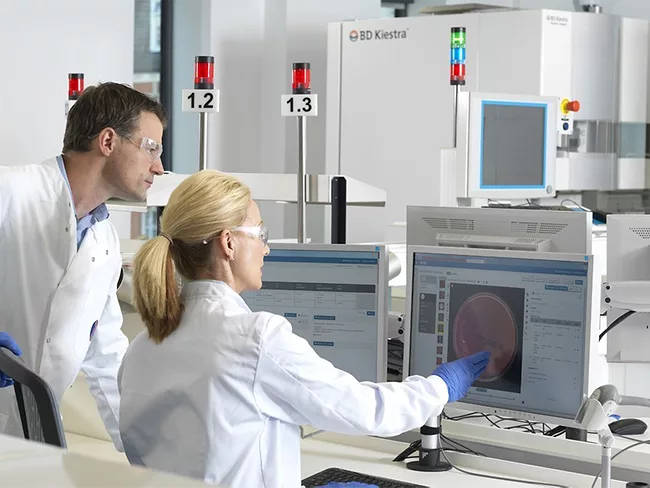
Becton, Dickinson & Co. (BD) is looking to ease the burden on microbiology labs with the U.S. launch of its urine culture analysis imaging application by automating microbiology processes. Powered by artificial intelligence (AI), the app is intended for use on the device manufacturer’s Kiestra lab automation incubation and imaging system.
Becton, Dickinson and Co. (BD) has decided to spin off its diabetes care business, after nearly a century growing a broad portfolio of insulin injection devices. The transaction, which will result in a publicly traded company, tentatively dubbed Newco, is expected to be completed in the first half of 2022.
The latest global regulatory news, changes and updates affecting medical devices and technologies, including: BD Alaris pumps recalled over keypad problems.
The latest global regulatory news, changes and updates affecting medical devices and technologies, including: OIG hits Mississippi hospital for polysomnography claims; BD expands Chloraprep recall to all 50 states.
The latest global regulatory news, changes and updates affecting medical devices and technologies, including: BD offers little detail in reaction to advisory hearing; FDA invites stakeholders to user fee negotiations; MHRA wary of paclitaxel.
A U.S. FDA advisory committee voted 14 nays to three ayes that the benefits of the Lutonix 014 drug-coated balloon (DCB) do not outweigh the risks in a panel proceeding peppered by problems with missing data and a lack of operator blinding. The panel widely saw the use of paclitaxel-eluting technologies in other areas of the vasculature as a reassurance that this device might perform as promised, but the outcome nonetheless leaves the sponsor with a new round of negotiations with the FDA as to how to move forward.
The latest global regulatory news, changes and updates affecting medical devices and technologies, including: FDA cites pivotal study failure for Lutonix 014; HHS adds to PREP Act immunity; Dermal fillers on tap at FDA advisory; GAO urges a pause in VA EHR deployment.
Becton, Dickinson and Co. (BD) reported revenue of $4.32 billion for the first quarter of fiscal year 2021, up 25.8% on a reported basis and 24.3% on a currency neutral basis. COVID-19 testing contributed 20.5% of that growth, totaling $867 million for the period, including $688 million in Veritor Plus system sales.
Becton, Dickinson and Co. (BD) reported good news Thursday, as it saw quarterly revenues of $4.784 billion for its fourth fiscal quarter, an increase of 4.4% over the prior-year period. Of note, the company’s life sciences segment saw worldwide revenues of $1.488 billion, representing an increase of 31.2% over the prior-year period as reported, or 31.4% on a currency-neutral basis.
Becton, Dickinson and Co. (BD) has received a green light for a premarket approval supplement from the U.S. FDA for an expanded version of its BD Onclarity HPV assay. It includes the expansion for genotype reporting beyond human papilloma virus (HPV) genotypes 16, 18, and 45.