The U.S. FDA approved 18 drugs in November, down from 20 in October, bringing the total number of clearances to 199 through the first 11 months of the year. The number is about 5% lower than the 209 approvals recorded over the same period in 2024 but more than every prior year.
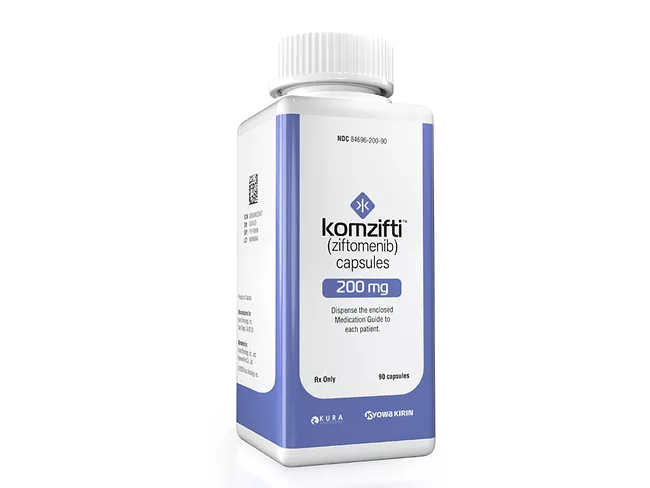
The U.S. FDA gave the thumbs up to Kura Oncology Inc./Kyowa Kirin Co. Ltd.’s selective oral menin inhibitor, ziftomenib, to treat relapsed, refractory (r/r) nucleophosmin1 (NMP1)-mutant acute myeloid leukemia (AML). The approval of the drug, branded Komzifti, came more than two weeks ahead of the Nov. 30 PDUFA date.
The U.S. FDA gave the thumbs up to Kura Oncology Inc./Kyowa Kirin Co. Ltd.’s selective oral menin inhibitor, ziftomenib, to treat relapsed, refractory (r/r) nucleophosmin1 (NMP1)-mutant acute myeloid leukemia (AML). The approval of the drug, branded Komzifti, came more than two weeks ahead of the Nov. 30 PDUFA date.
Kura Oncology, Inc. and Kyowa Kirin Co. Ltd.’s selective oral menin inhibitor ziftomenib showed encouraging data across multiple studies, the most encouraging of which were in combination with other standard of care therapies in patients with NPM1-mutant and KMT2A-rearranged acute myeloid leukemia.
Kura Oncology, Inc. and Kyowa Kirin Co. Ltd.’s selective oral menin inhibitor ziftomenib showed encouraging data across multiple studies, the most encouraging of which were in combination with other standard of care therapies in patients with NPM1-mutant and KMT2A-rearranged acute myeloid leukemia.
Kura Oncology Inc. and Kyowa Kirin Co. Ltd. have joined hands in a global strategic collaboration worth $1.49 billion to develop and commercialize ziftomenib, Kura’s selective oral menin inhibitor for treating patients with acute myeloid leukemia (AML) and other hematologic malignancies.
Kura Oncology Inc. and Kyowa Kirin Co. Ltd. have joined hands in a global strategic collaboration worth $1.49 billion to develop and commercialize ziftomenib, Kura’s selective oral menin inhibitor for treating patients with acute myeloid leukemia (AML) and other hematologic malignancies.
The next-generation farnesyl transferase inhibitor KO-2806 is currently in phase I clinical development at Kura Oncology Inc. for the treatment of patients with solid tumors, including non-small-cell lung cancer (NSCLC) and colorectal cancer (CRC).
The competitive menin-inhibitor space chalked further data from Syndax Pharmaceuticals Inc., which disclosed positive top-line results from the pivotal phase II portion of the Augment-101 study, designed to test oral small-molecule revumenib for safety and efficacy. But shares of the firm (NASDAQ:SNDX) closed Nov. 12 at $16.21, down $5.57, or 26%, after the Augment-101 numbers were disclosed.

.webp?height=488&t=1670008838&width=650 "Acute myeloid leukemia")