Innovent Biologics Inc. announced June 27 that it gained National Medical Products Administration’s (NMPA) approval of mazdutide as a new weight loss therapy for obese or overweight patients in China. Mazdutide is a dual glucagon/glucagon-like peptide-1 (GCG/GLP-1) receptor agonist originally discovered by Eli Lilly and Co., of Indianapolis.
Innovent Biologics Inc. announced June 27 that it gained National Medical Products Administration’s (NMPA) approval of mazdutide as a new weight loss therapy for obese or overweight patients in China. Mazdutide is a dual glucagon/glucagon-like peptide-1 (GCG/GLP-1) receptor agonist originally discovered by Eli Lilly and Co., of Indianapolis.
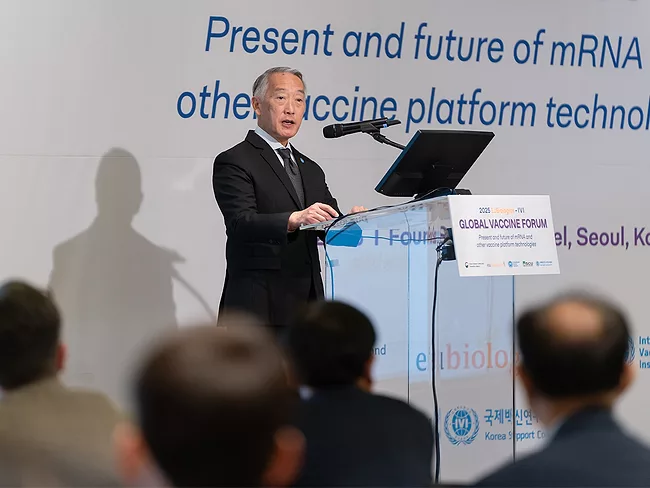
Experts in mRNA convened at the Global Vaccine Forum (GVF) 2025 to weigh the present and future of vaccine technology, including emerging innovations in self-amplifying mRNA (sa-mRNA) and drug delivery platforms. “Breakthroughs in mRNA and next-generation vaccine platforms are revolutionizing how we prepare for and respond to global health challenges,” Jerome H. Kim, International Vaccine Institute (IVI) director general, told the audience in Seoul, South Korea, June 19.
China’s National Medical Products Administration (NMPA) has accepted for review Carsgen Therapeutics Holdings Ltd.’s NDA for satricabtagene autoleucel (satri-cel, CT-041), an autologous CAR T candidate targeting Claudin18.2 for treating Claudin18.2-positive advanced gastric/gastroesophageal junction adenocarcinoma (G/GEJA) in patients who have failed at least two prior lines of therapy. Just one day earlier, Carsgen announced that it had submitted the satri-cel NDA to the NMPA.
Abion Inc. signed a potential $1.315 billion deal with an anonymous partner June 22, granting the counterparty exclusive global rights to a preclinical claudin 3-targeting monoclonal antibody, ABN-501, and the potential to license four more protein targeting antibodies.
Innovent Biologics Inc. announced a HKD$4.3 billion (US$547 million) placement on the Hong Kong Stock Exchange to advance its R&D projects and to fund its global expansion.
Just a month after laying off 147 employees and announcing plans to mull “strategic alternatives,” Vor Biopharma Inc. reported raising $175 million in private placement in public equity financing and inking a new $4.23 billion license deal for Yantai Rongchang Biotechnologies (Remegen) Co. Ltd.’s telitacicept, a dual-target fusion protein drug approved in China for three autoimmune indications. The news was disclosed after U.S. market hours June 25. Vor’s shares (NASDAQ:VOR) gained 34 cents, or 60.5%, to close June 26 at 89 cents. The company’s shares had risen for eight consecutive trading days since June 17.
Abbott Laboratories grabbed attention in early June with its announcement of a partnership with Tandem Diabetes Care Inc. to develop a multianalyte sensor for people with diabetes that would measure ketones as well as glucose.
Australia’s largest health insurance company, Medibank Private Ltd., is the first to reimburse for psychedelic treatment in Australia, funding Emyria Ltd.’s MDMA (3,4-methylenedioxy-methamphetamine) program for post-traumatic stress disorder offered through the Perth Clinic.
Abion Inc. signed a potential $1.315 billion deal with an anonymous partner June 22, granting the counterparty exclusive global rights to a preclinical claudin 3-targeting monoclonal antibody, ABN-501, and the potential to license four more protein targeting antibodies.
 RSS
RSS