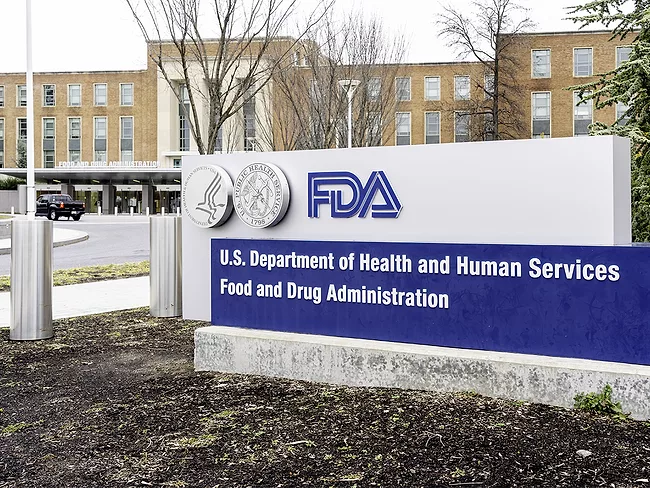
The U.S. FDA posted notice of a class I recall for two hemodialysis catheters made by Covidien Inc., the Palindrome and Mahurkar catheters, due to a catheter hub defect that could lead to mixing of venous and arterial blood. No deaths and only one injury have been reported in connection with the defect, but the recall affects more than 1 million devices that went into distribution starting in June 2017, one of the numerically larger recalls in recent years.
The U.S. FDA has proposed to down-classify optical diagnostic devices and electrical impedance spectrometers from class III to class II, but there was little support for such a change in the first day of a two-day advisory hearing. The panelists saw the risk of a false negative for melanoma as too high to allow such devices to go through the 510(k) program, and thus manufacturers of these devices may continue to be required to file PMAs, replete with costly studies and long timelines to approval.
Drug and device makers that offer health care professionals opportunities to earn continuing medical education (CME) points have a fine line to walk when sponsoring those programs, but a new advisory opinion by the Office of Inspector General (OIG) at the Department of Health and Human Services seems to draw a very clear line around those programs.
The FDA’s ability, or lack thereof, to churn out guidances is not always the stuff of industrial outrage, but manufacturers of laser-assisted in situ keratomileusis (LASIK) systems might find the timing of a new draft guidance on the procedure somewhat odd. The draft guidance arrives nearly a decade and a half after an April 2008 advisory hearing.
Med tech patents have been especially vulnerable to litigation in recent years, and a new decision by the Court of Appeals for the Federal Circuit affirms yet again the vulnerability of patents undergoing litigation. The Federal Circuit said nine claims found in two patents held by Becon Medical Ltd., of Batavia, Ill., were invalid due to obviousness, presenting the company a significant loss in its infringement litigation with Talexmedical LLC, of Malvern, Pa.
Drug and device makers that offer health care professionals opportunities to earn continuing medical education (CME) points have a fine line to walk when sponsoring those programs, but a new advisory opinion by the Office of Inspector General at the Department of Health and Human Services seems to draw a very clear line around those programs.
For companies in the life sciences, patent subject matter eligibility has acquired a bad reputation, but the U.S. Patent and Trademark Office (PTO) has attempted to provide administrative workarounds to the problem. PTO director Kathi Vidal said recently, however, that the agency intends to revisit its guidance, just one of several steps the PTO is taking to eliminate some of the drag on patent applications in the U.S.
The U.S. FDA’s guidance for unique device identifiers (UDIs) is heavily adjusted to account for a device’s inherent risk class, and many class I devices are now going to enjoy another reprieve from UDI requirements per an updated FDA guidance.
A committee of the U.S. House of Representatives is moving forward with a bill that would extend Medicare telehealth provisions for two years after the end of the COVID-19 public health emergency, but the legislation lacks features to deal with fraud and abuse.
For companies in the life sciences, patent subject matter eligibility has acquired a bad reputation, but the U.S. Patent and Trademark Office (PTO) has attempted to provide administrative workarounds to the problem. PTO director Kathi Vidal said recently, however, that the agency intends to revisit its guidance, just one of several steps the PTO is taking to eliminate some of the drag on patent applications in the U.S.