News of GSK plc’s decision to decline its option for MAT2A inhibitor IDE-397, the lead compound from a 2020 collaboration with Ideaya Biosciences Inc. sent the latter’s shares (NASDAQ:IDYA) slipping 35% to close Aug. 15 at $10.20. For Ideaya, however, which maintained that it has sufficient capital to see the program through phase II on its own, the move works out just fine.
As it moves into phase II testing with the lead candidate from its hematologic pipeline, privately held Disc Medicine Inc. is also moving to the public markets via a reverse merger agreement with struggling biotech Gemini Therapeutics Inc. Concurrent with a $53.5 million financing from investors, the deal is expected to provide Disc with a cash runway into 2025.
Mersana Therapeutics Inc. is getting $100 million up front in an option deal with GSK plc for preclinical-stage antibody-drug conjugate (ADC) XMT-2056, which could bring up to $1.36 billion more in an option exercise payment, development, regulatory and commercial milestones. It’s the second potential $1 billion-plus ADC deal for Cambridge, Mass.-based Mersana in 2022 and the first for its Immunosynthen platform, which uses a STING agonist payload specifically designed for ADCs.
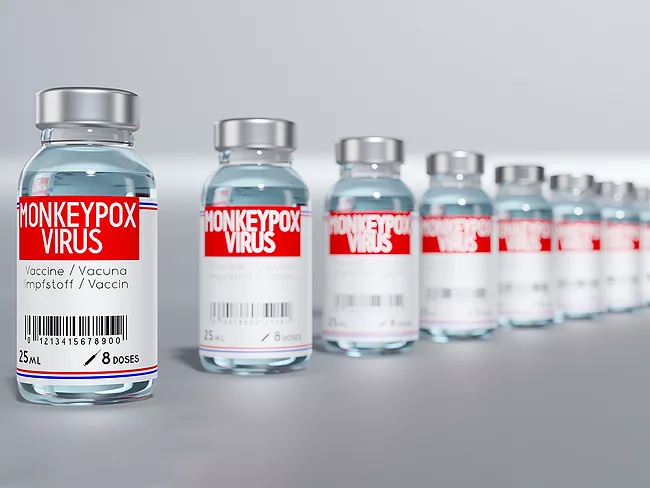
Now that the U.S. Department of Health and Human Services (HHS) has declared monkeypox a public health emergency, nearly two weeks after a similar declaration from the World Health Organization, the way is cleared for a coordinated response and emergency use authorizations to address supply challenges that could limit the availability of currently approved vaccines. It also has several companies ready to leap into the fray if their preclinical studies show a path to approval. HHS said it just shipped more than 602,000 doses of the Jynneos vaccine to states and jurisdictions, an increase of 266,000 in the past week.
As fellow gene editing firm Crispr Therapeutics AG hosted an innovation day in which it confirmed plans for regulatory filings by year-end for an ex vivo gene editing therapy in sickle cell disease and beta-thalassemia, Precision Biosciences Inc. announced plans to develop an in vivo gene editing approach through a collaboration with Novartis AG that brings Precision an initial $75 million with up to $1.4 billion in potential milestones.
Analysts have already started tagging Cogent Biosciences Inc.’s bezuclastinib as potentially best in class, after the company presented impressive, though early stage, data at the European Hematology Association Congress in Vienna demonstrating promising efficacy and a possibly differentiating safety profile for the selective KIT D816V inhibitor in advanced systemic mastocytosis.
Pointing to an anomalously high placebo response rate at eastern European trial sites in its Forward phase III trial testing fostamatinib in warm autoimmune hemolytic anemia (wAIHA), Rigel Pharmaceuticals Inc. executives remained confident there could be a path forward for the SYK inhibitor in treating the rare blood disorder. The disappointing top-line data, however, sent company shares (NASDAQ:RIGL) falling more than 60% June 8 to close at 70 cents, a penny above its same day 52-week low.
When he first stepped into the field of glycoproteomics, particularly the potential of truncated O-glycans as cancer targets, Constantine Theodoropulos, CEO of Go Therapeutics Inc., said the reaction from peers was less than encouraging.
Shares of Aeglea Biotherapeutics Inc. tumbled 51% June 2 on news that it received a refusal to file (RTF) letter from the U.S. FDA regarding the BLA for pegzilarginase for the treatment of arginase 1 deficiency, with the agency requesting additional efficacy data.
When he first stepped into the field of glycoproteomics, particularly the potential of truncated O-glycans as cancer targets, Constantine Theodoropulos, CEO of Go Therapeutics Inc., said the reaction from peers was less than encouraging. “They said, ‘You’re nuts, it’s too complicated.’” Now, however, the company he co-founded has landed a deal with Astellas Pharma Inc.’s immuno-oncology-focused subsidiary, Xyphos Biosciences Inc., that brings $20.5 million up front, with the potential for up to $763 million in milestone and contingency payments down the road.