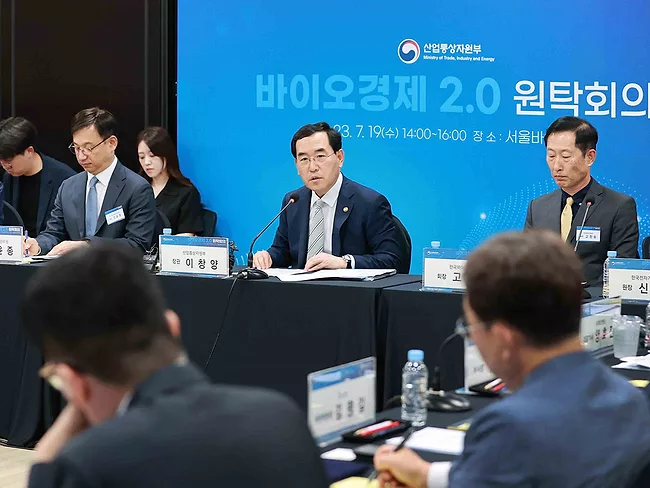
In July 2023, South Korea’s Ministry of Trade, Industry and Energy ramped up efforts to kickstart the so-called “Bio Economy 2.0,” the newfound initiative that banks on the biopharmaceutical industry to potentially revitalize the country’s slowing economic and social growth. Highlighting four major areas – biopharmaceuticals, biomaterials, bioenergy and digital technologies – as the four “wheels” to carry the biopharma industry, the new plan underscored the government’s unwavering support for the sector while highlighting its vision to become the “number one bioeconomy” worldwide.
In July 2023, South Korea’s Ministry of Trade, Industry and Energy ramped up efforts to kickstart the so-called “Bio Economy 2.0,” the newfound initiative that banks on the biopharmaceutical industry to potentially revitalize the country’s slowing economic and social growth. Highlighting four major areas – biopharmaceuticals, biomaterials, bioenergy and digital technologies – as the four “wheels” to carry the biopharma industry, the new plan underscored the government’s unwavering support for the sector while highlighting its vision to become the “number one bioeconomy” worldwide.
Acurastem Inc. said on Sept. 25 that it struck an out-licensing deal potentially worth $580 million with Takeda Pharmaceutical Co. Ltd. to develop drugs for amyotrophic lateral sclerosis (ALS) and other PIKfyve gene-targeting therapeutics. Under the terms, Tokyo-headquartered Takeda obtains exclusive worldwide rights to Acurastem’s PIKfyve-targeting therapeutics, including Acurastem’s lead AS-202 asset, an antisense oligonucleotide therapy to treat ALS.
Raising capital has always been a challenge for small to medium biotech firms worldwide, but the economic whiplash and the wider downturn across international markets post-pandemic have pushed Chinese biotechs to make-it-or-break-it scenarios for crossing the IPO threshold, speakers at the Chinabio Partnering Forum 2023 said in Shanghai.
“Why do the top 10 pharmaceutical companies remain in the top 10?” asked Li Chen, founder and CEO of Hua Medicine, to audience members at the Chinabio Partnering Forum in Shanghai on Sept. 20. “[It comes down to] their ability to innovate themselves, but also the capability to acquire technology from partnerships, [to] manufacture and sell in countries like the U.S."
Despite China’s near-frozen startup scene and increasingly cautious foreign investors following the COVID-19 pandemic, multinational pharmaceutical firms continued to scout for innovative up-and-coming Chinese biotechs in Shanghai at Chinabio Partnering Forum 2023 over its two-day run.
Despite China’s near-frozen startup scene and increasingly cautious foreign investors following the COVID-19 pandemic, multinational pharmaceutical firms continued to scout for innovative up-and-coming Chinese biotechs in Shanghai at Chinabio Partnering Forum 2023 over its two-day run.
Raising capital has always been a challenge for small to medium biotech firms worldwide, but the economic whiplash and the wider downturn across international markets post-pandemic have pushed Chinese biotechs to make-it-or-break-it scenarios for crossing the IPO threshold, speakers at the Chinabio Partnering Forum 2023 said in Shanghai.
“Why do the top 10 pharmaceutical companies remain in the top 10?” asked Li Chen, founder and CEO of Hua Medicine, to audience members at the Chinabio Partnering Forum in Shanghai on Sept. 20. “[It comes down to] their ability to innovate themselves, but also the capability to acquire technology from partnerships, [to] manufacture and sell in countries like the U.S."
Hanmi Science Co. Ltd. is rolling out a new obesity pipeline with five candidates under its relatively new leadership with Lim Ju-hyun, the eldest daughter of Hanmi Pharmaceutical Co. Ltd. founder Lim Sung-ki, who serves as president of Hanmi’s global strategy division. Songpa-gu, Seoul-based Hanmi Science is the holding group of its main drug development and production arm, Hanmi Pharmaceutical, and its wholesaler arm, Online Pharm.