The level of investment in Europe’s med-tech sector in 2025 did not materialize as many had hoped at the beginning of the year. Reciprocal tariffs introduced by the U.S. government created an uncertain macroeconomic environment, curtailing dealmaking and slowing financing activity. Nevertheless, amid uncertainty, there were some bright spots as medical devices remain essential, and investors know how to navigate market cycles.
The U.S. FDA’s clearance of Medtronic plc’s Hugo robotic-assisted surgery (RAS) system is certainly a boon for the company which is betting on the unit to be a key growth driver. While the soft tissue robotics market is dominated by Intuitive Surgical Inc.’s da Vinci system, the space is growing, and Medtronic has the scale, resources and market presence to make headway but there are also a plethora of smaller, versatile and cost-effective systems looking for a piece of the pie.
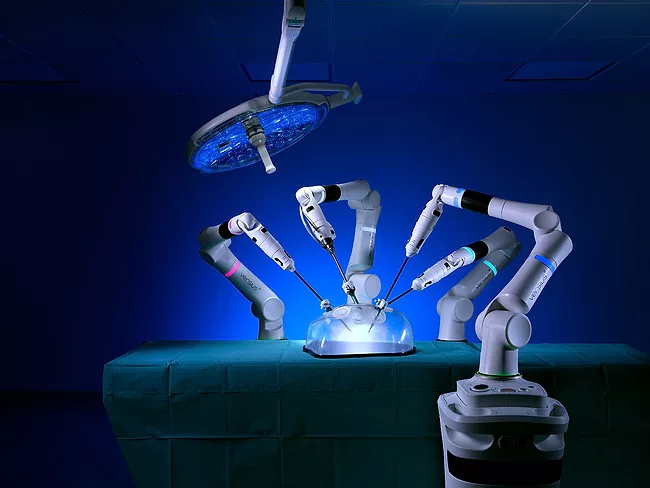
CMR Surgical Ltd. hopes to soon gain U.S. FDA 510(k) clearance for its Versius Plus surgical robotic system to bring it to the U.S. market amid rising demand for robotic surgery. Although the company’s original Versius system received FDA clearance in 2024 for use in cholecystectomy in adults, CMR waited to bring the enhanced Versius Plus model to market instead. “I have such a respect for the U.S. market that the last thing that I would do is to enter a market with a product that is outdated,” Massimiliano Colella, CMR CEO told BioWorld.
Med-tech companies raised $8.13 billion in the second quarter of 2025, a modest dip from the $8.32 billion recorded in Q1. While the quarterly total marks a continued improvement over 2023’s lower figures, it still lags behind pre-pandemic peaks and the $22.87 billion raised in 2Q20. Compared to 2Q24’s $7.49 billion, this year’s figure reflects a slight year-over-year gain.
Johnson & Johnson’s Medtech division reported the completion of the first cases in the clinical trial for the Ottava robotic surgical system. The cases mark the first clinical experience with the Ottava system, which has been a long time in development.
Med tech and diagnostic companies in Europe are considering strategies to navigate the U.S. market following President Trump’s introduction of reciprocal tariffs on imports. While some companies are more exposed than others, there’s no doubt that many will feel the pain.
CMR Surgical Ltd. secured more than $200 million in funding to bring its surgical robotic system, Versius, to the U.S. market and expand elsewhere. The financing, which came in the form of equity and debt, is “highly important” for the company and comes at the right time as it is “expanding and growing nicely,” company CEO Massimiliano Colella told BioWorld.
There is no doubt this year started with a boom for European med-tech companies. Public markets opened in the U.S. and cross-border investors are deploying capital. With many companies looking to conduct clinical trials, raising funds and bringing their devices to the market, 2025 is expected to be prosperous, mitigating the difficulties of the previous two to three years.
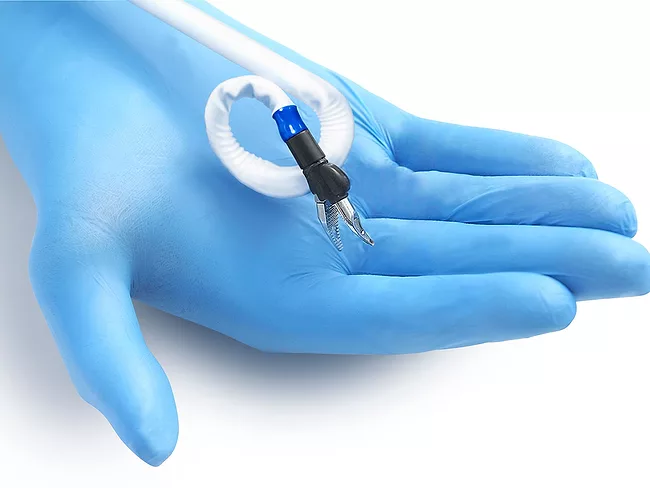
The U.S. FDA granted Momentis Surgical Ltd. 510(k) clearance for its Anovo robotic surgical platform for use in single site, abdominal access ventral hernia repairs. The U.S. regulatory agency also gave the greenlight to CMR Surgical Ltd.’s Versius system for use in cholecystectomy, in a sign of the growing market for smaller, more portable robotic devices to assist in minimally invasive procedures.
CMR Surgical Ltd. recently submitted its application to the U.S. FDA for approval for its Versius surgical system as it seeks to get more surgeons using the small, portable, robotic tool in laparoscopic procedures.