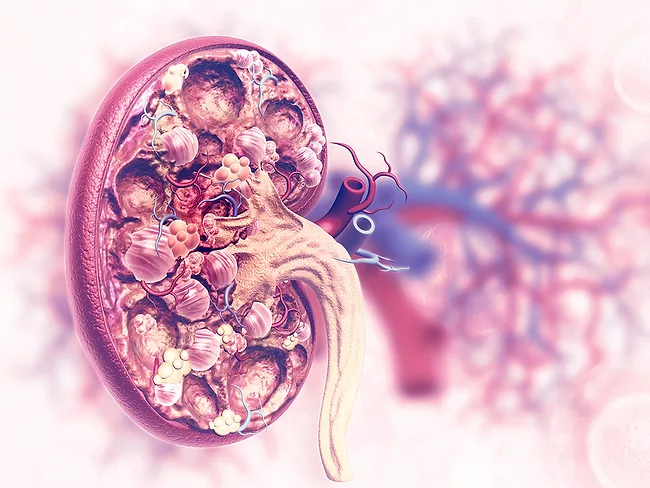
Developing new gene therapies for autosomal dominant polycystic kidney disease (ADPKD) is still a challenge to date. A group of researchers from the Johns Hopkins Medicine in Baltimore has presented results from evaluation of a new gene therapy for treating ADPKD, AAV1-CBdelta27-264CFTR, where they focused on the surface receptors expressed in cystic epithelia.
Autosomal dominant polycystic kidney disease (PKD) is a chronic and debilitating condition affecting over 12 million patients worldwide. PKD arises from mutations in the polycystin-1 (PC1) or PC2 genes. PKD is characterized by the formation of fluid-filled cysts in the kidneys, leading to inflammation, fibrosis and organ damage, ultimately resulting in renal failure.
Launched out of 5AM Ventures’ 4:59 Initiative, Renasant Bio Inc. has secured $54.5 million in seed funding to support development of treatments for autosomal dominant polycystic kidney disease (ADPKD), a genetic disease caused by mutations in the PKD1 and PKD2 genes, which encode polycystin proteins PC1 and PC2 that come together to form a calcium ion channel vital for kidney function.
Renasant Bio Inc. has launched to develop new disease-modifying treatments for autosomal dominant polycystic kidney disease (ADPKD), the primary genetic cause of end-stage renal failure. The $54.5 million in seed funding the company has secured will support advancement of its lead corrector program and ongoing discovery efforts for the company’s first-in-class potentiator program.
Vertex Pharmaceuticals Inc. has described polycystin-1 (PKD1) (mutant) correctors reported to be useful for the treatment of autosomal dominant polycystic kidney disease.
Regulus Therapeutics Inc. CEO Jay Hagan told investors in a January call the company had no interest in “simply out-licensing” rights to lead candidate farabursen, an oligonucleotide targeting autosomal dominant polycystic kidney disease set to start phase III testing on a path to a potential accelerated approval. And now, there’s no need to, as Regulus found a buyer for the whole company in a deal with Novartis AG valued at about $1.7 billion.
Crinetics Pharmaceuticals Inc. has disclosed somatostatin receptor type 3 (SSTR3) agonists reported to be useful for the treatment of autosomal dominant polycystic kidney disease.
In an indication that has proved difficult for biopharma to conquer, Regulus Therapeutics Inc. disclosed further positive data from its ongoing phase Ib study testing RGLS-8429 in autosomal dominant polycystic kidney disease and laid out its plans to move straight into a phase III trial later this year, with the potential for an accelerated U.S. approval.
Autosomal dominant polycystic kidney disease (ADPKD) is a severe genetic disorder primarily caused by mutations in the PKD1 or PKD2 genes, which encode polycystins 1 and 2, affecting over 12 million people globally.
Autosomal dominant polycystic kidney disease (ADPKD) is the most common monogenic cause of renal failure characterized by development of multiple fluid-filled cysts linked to increased cAMP levels and fibrosis in the kidneys leading to progressive renal failure and need for dialysis or renal transplant.