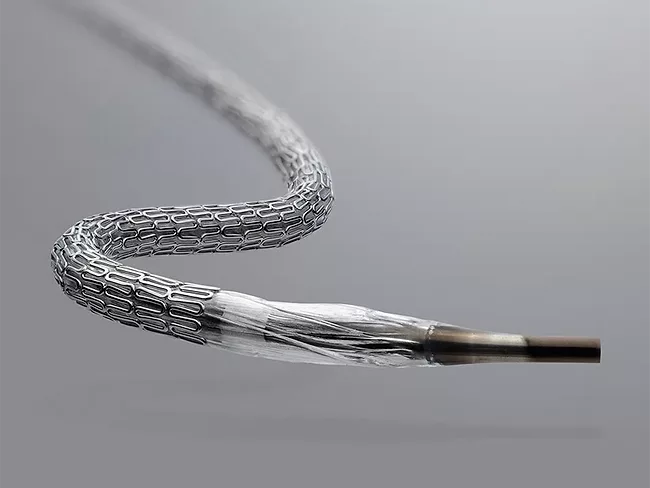
Three-year data from Elixir Medical Corp.’s Bioadaptor randomized controlled trial showed that patients with coronary artery disease treated with its Dynamx coronary drug-eluting bioadaptor system continued to see lower adverse events rates compared to those treated with Medtronic plc’s Resolute Onyx drug-eluting stent .
Elixir Medical Corp. reported positive 12-month data from the Infinity-Swedeheart trial that compared its Dynamx coronary bioadaptor system to Medtronic plc’s Resolute Onyx zotarolimus drug-eluting stent in patients requiring percutaneous coronary intervention with coronary artery disease.
Two-year data from Elixir Medical Corp.’s Bioadaptor randomized controlled trial showed that there is a significant clinical advantage in using its Dynamx coronary drug-eluting bioadaptor system over Medtronic plc’s Resolute Onyx drug-eluting stent in patients with coronary artery disease.
Elixir Medical Corp. reported that the Bioadaptor randomized controlled trial which compared its Dynamx coronary drug-eluting bioadaptor system to Dublin-based Medtronic plc’s Resolute Onyx drug-eluting stent (DES) in de novo native coronary arteries, met its primary endpoint of target lesion failure (TLF) non-inferiority at 12 months. The results were presented at a late-breaking clinical session during the EuroPCR 2023 conference in Paris.
It has become apparent that introducing two stents into the body to treat a patient with a bifurcation disease is not necessary and can be harmful, David Hildick-Smith, the lead investigator in a study, told delegates at the EuroPCR conference in Paris. Presenting late-breaking clinical data of three-year follow up results of different stenting strategies in patients with true left main stem bifurcation lesions, Hildick-Smith said that the results showed that only one in five patients needed a second stent.
Following last week’s FDA approval of its Onyx Frontier drug eluting stent (DES), Medtronic plc released results at EuroPCR from a real-world, multicenter prospective study using its Resolute Onyx platform for percutaneous coronary interventions (PCI) in the left main artery. Rehovot, Israel-based Pi-Cardia Ltd. also released early data for patients treated with its Short Cut transcatheter device for coronary obstruction prevention.
Medtronic plc received FDA premarket approval for its Onyx Frontier drug-eluting stent, an update to the company’s Resolute Onyx stent. The Frontier is designed for treatment of patients with coronary artery disease (CAD), a leading cause of death in the U.S. Medtronic expects the stent to receive CE mark shortly.
Despite the morbidity associated with coronary artery bypass graft, this procedure has never been entirely displaced by percutaneous coronary intervention. The results from the latest in a series of studies does not seem to help the case for drug-eluting stents (DES) for patients with three-vessel disease, as the data from this study failed to demonstrate non-inferiority for DES devices implanted with the help of fractional flow reserve measurement to ensure optimal stent placement.
Medtronic plc’s winning streak continued this week with the announcement that the U.S. FDA had given its nod for new one-month of dual-antiplatelet therapy (DAPT) labeling with an expanded indication for high bleeding risk (HBR) patients implanted with the Resolute Onyx drug-eluting stent (DES). The approval is based on results from the Onyx ONE Clear Study that evaluated about 1,500 complex HBR patients on one-month DAPT treated with Resolute Onyx.