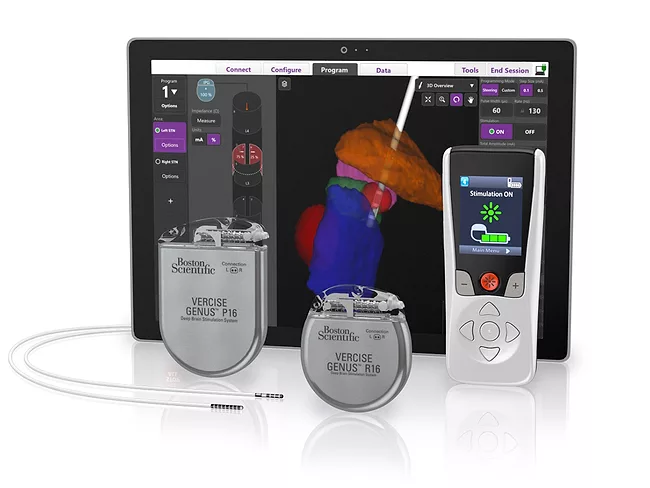
The U.S. FDA recently granted Medtronic plc approval for its deep brain stimulation (DBS) system to be used to treat Parkinson’s disease or essential tremor while a patient is asleep, under general anesthesia. The approval gives patients another option for DBS therapy which can transform their quality of life, Amaza Reitmeier, vice president and general manager for Medtronic brain modulation, told BioWorld in an interview.
As new treatment options are being continually investigated and trialed against Parkinson’s disease, the possibilities offered by deep brain stimulation (DBS) risk being overlooked. Though not a cure, the therapy could vastly improve the quality of life for patients with the disease.
Medtronic plc received the greenlight from the U.S. FDA for its latest deep brain stimulation system, the Percept RC. The rechargeable neurostimulator includes the company’s sensing technology which captures data from brain signals and allows for more personalized therapy.
Medtronic plc received CE mark for its Percept RC neurostimulator for deep brain stimulation, which the company hopes will transform brain modulation and empower patients in the E.U. with neurological indications. The device is designed to capture and record brain signals and provide clinicians with insights to enable them to adapt and personalize therapy for patients.
Insightec Ltd. broadened its CE mark approval for the Exablate Neuro, a focused ultrasound platform which treats essential tremors, to allow patients to have their second side treated. With some 60 million people estimated to be affected by essential tremor globally, Insightec hopes that with both sides treated, patients will have full body relief from tremor and therefore be able to resume everyday activities.
PARIS – Aleva Neurotherapeutics SA reported the first successful implantation of its Directstim directional deep brain stimulation (DBS) system into a patient suffering from Parkinson’s disease. The procedure involving this new generation of active brain device was performed by neurosurgeon Stephan Sobottka, from the Clinic for Neurosurgery at the University Hospital Carl Gustav Carus in Dresden, Germany.