Durable reprogramming of human T cells may now be possible thanks to a new technique based on the CRISPRoff and CRISPRon methodology. Researchers from the Arc Institute, Gladstone Institutes, and the University of California San Francisco have stably silenced or activated genes in this type of immune cell without cutting or altering its DNA, making T cells more resistant, active, and effective against tumors.
Durable reprogramming of human T cells may now be possible thanks to a new technique based on the CRISPRoff and CRISPRon methodology. Researchers from the Arc Institute, Gladstone Institutes, and the University of California San Francisco (UCSF) have stably silenced or activated genes in this type of immune cell without cutting or altering its DNA, making T cells more resistant, active, and effective against tumors.
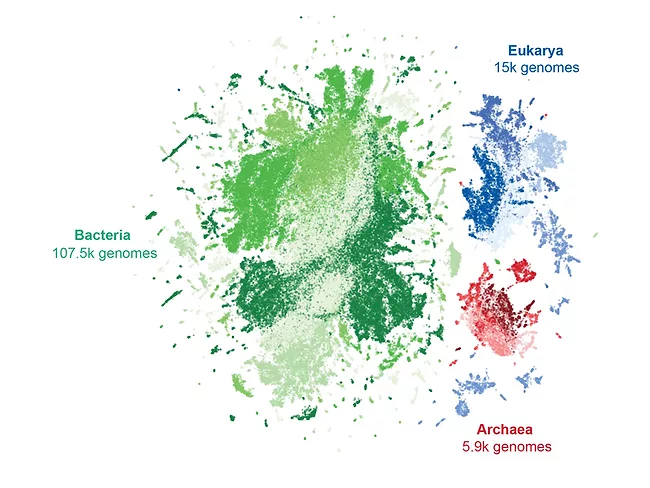
A new version of Evo, the AI developed at the Arc Institute that can be used to design genomes as long as that of a bacterium, has been retrained with the DNA sequences of three domains of life – viruses, bacteria and eukaryotes.
The development of new machine learning tools like Alphafold and Rfdiffusion has allowed scientists to predict the structure of proteins and design them for drug discovery purposes, among other uses. Now, scientists at the Arc Institute have created Evo, an AI model that generates DNA sequences and estimates their interaction with other molecules at single-nucleotide resolution, scalable to an entire genome.
The development of new machine learning tools like Alphafold and Rfdiffusion has allowed scientists to predict the structure of proteins and design them for drug discovery purposes, among other uses. Now, scientists at the Arc Institute have created Evo, an AI model that generates DNA sequences and estimates their interaction with other molecules at single-nucleotide resolution, scalable to an entire genome.
New single-step genome editing techniques that enable the insertion, inversion or deletion of long DNA sequences at specified genome positions have been demonstrated in bacteria.
New single-step genome editing techniques that enable the insertion, inversion or deletion of long DNA sequences at specified genome positions have been demonstrated in bacteria.
New single-step genome editing techniques that enable the insertion, inversion or deletion of long DNA sequences at specified genome positions have been demonstrated in bacteria. The advance opens the door to the development of programmable methods for rearranging DNA, using recombinase enzymes guided by RNA. The two different approaches to using insertion sequences (IS) – some of the simplest and most compact mobile genetic elements – are described in two papers published in Nature and Nature Communications.