
A new drug delivery device that stays in the stomach and slowly releases its contents could replace daily pills with weekly or even monthly ones.
"We developed, essentially, an orally delivered ultra-long-lasting capsule that is capable of residing in the stomach safely and at the same time, deliver the drug in a sustained, controlled fashion over the course of several weeks," Giovanni Traverso said.
Andrew Bellinger added, "there are drug delivery systems that can achieve long-lasting effects, but they're all injectable or implantable, or involve some other invasive procedure. This is the first time anyone's ever been able to make an oral pill or capsule which can be, to the patient, the same as the pill that they've always been taking, but which can prolong the efficacy out to a week or more."
Bellinger is a cardiologist at Brigham and Women's Hospital, and the co-founder and chief scientific officer of Lyndra Inc., a Massachusetts Institute of Technology spinout that is developing the technology. Traverso is an instructor in medicine and associate physician at Brigham and Women's Hospital, and another co-founder of Lyndra. They are co-authors on a paper describing the device, which was published in the Nov. 16, 2016, issue of Science Translational Medicine.
Currently, the maximal interval for taking oral medications is about a day, because that is the amount of time it takes from ingestion to excretion. Any orally taken medication would need to be delivered in a way that prevented its clearance for a specified time, but without impeding the passage of food through the digestive tract. It would also need to avoid being either digested or crushed by the stomach's digestive acids and contractions, respectively. Finally, the drug would need to be released slowly, and the delivery system would need to break down and be cleared eventually.
In their paper, the authors reported a system that fulfilled all these requirements, consisting of a star-shaped polymer in an oral capsule. Upon ingestion, the capsule dissolved and the star expanded "while assuming a geometry that prevents passage through the pylorus yet allows passage of food, enabling prolonged gastric residence," the authors wrote in their paper. "This gastric-resident, drug delivery dosage form releases small-molecule drugs for days to weeks and potentially longer." (See picture below.)
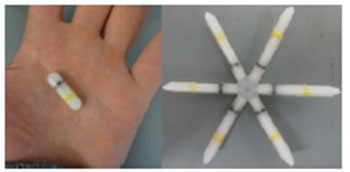
The work now presented in Science Translational Medicine was funded partly by the Bill and Melinda Gates Foundation, and in their paper, the authors tested their delivery system with ivermectin, a drug used to treat river blindness that could also help with malaria eradication efforts.
But the drug could also be used in the developed world to help improve medication adherence. According to a 2003 report by the World Health Organization, "increasing the effectiveness of adherence intervention may have a far greater impact on the health of the population than any improvement in specific medical treatments."
Taking one's pills as prescribed is the first step in deriving any benefit from them. And it is a first step that an astonishing number of patients fail to take. In chronic diseases, adherence is estimated to be below 50 percent.
Part of the lack of adherence is financial – in one 2010 study, a third of Americans reported not filling a prescription or reducing the dose on their own due to out-of-pocket costs.
But a 2011 paper in The New England Journal of Medicine also reported that though eliminating out-of-pocket costs for cardiovascular drugs did raise adherence rates by around 5 percent, those rates remained very low, hovering around 50 percent at best. Those data suggest that obstacles to adherence are not just financial.
Traverso said that with a sufficiently long interval between doses, reminding patients to take their drugs could be a routine part of health care. Infrequent dosing would make it "conceivable that you might call that patient once a month and say, Mr. Smith, just want to check in. Have you taken your medication? Whereas doing it twice a day is not feasible because of the tremendous burden to both sides."
Sometimes, patients don't take their medications because they don't like to think of themselves as sick. This can occur especially in "silent" conditions such as hypertension, as well as in stigmatized ones, such as addiction.
In addiction, not only does the need to take methadone provide a daily reminder of illness, but the daily need to get to a clinic to do so "has a real impact on how patients are able to live in the world and can impact their ability to hold down jobs and be real active members of their community," Bellinger said.
"When you do have less frequent dosing, patients adhere better. . . . There's a large literature on this," he added. "As you decrease the frequency of therapy, the adherence rates climb and can go from, say, 45 percent all the way up to 70 percent or above as you get out to less frequent dosing. So that's part of the advantage that we're looking at. This technology – and we've now been able to show this with several different drugs, in addition to ivermectin – offers the potential to make a real impact by improving the efficacy of some of the drugs that we know work."