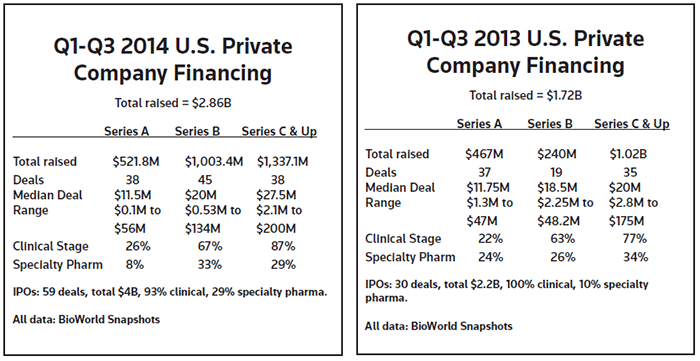
The third quarter typically sees fewer venture capital investments than the second quarter – not surprising since it covers prime vacation time. While I'm sure more than one deal has been consummated from the beach, VCs deserve their downtime, too.
But a 50 percent quarter-over-quarter drop, from $1.36 billion invested in the second quarter to just $688 million in the third quarter is a little alarming, especially since the third quarter total is even lower than the $815 million companies were able to raise in the first quarter, according to deals tracked by BioWorld Snapshots.
It's all relative, of course. We're still well ahead of where we were this time last year, having raised $2.86 billion in the first three quarters of 2014, compared to $1.72 billion through the third quarter of 2013.
Let's not panic just yet.
In fact, a deep dive of the data shows some good news and, perhaps, a simple explanation for the decline.
While the number of deals in the third quarter dropped substantially, from 50 in the second quarter to 35 in the third quarter, the number of seed and series A investments actually went up, increasing from 11 in the second quarter to 16 in the third quarter. VCs are still funding early stage companies – at least, after they got back from vacation. Ten of the 16 companies were funded in September.
And they're innovative companies, too. Just one of the 16 start-ups was classified as a specialty pharma, defined as a company in-licensing drugs or using a platform to reformulate drugs.
In dollar terms, the third quarter saw a 56 percent quarter-over-quarter increase in early stage investments from $130 million in the second quarter to $203 million in the third quarter, which even topped the first quarter's $189 million in early stage investments.
On the flip side, later-round investments fell substantially. While series B investments were down quarter over quarter, third quarter investments were still higher than the first quarter in both number of deals (14 vs. 11) and amount raised ($309 million vs. $143 million).
Given how strong the second quarter was, there doesn't seem to be too much to worry about for early stage start-ups seeking their next rounds of funding. (See BioWorld Today, July 2, 2014.)
The big culprit in the quarter-over-quarter decline came from the series C and later rounds. Just five late-stage companies were funded in the third quarter compared to 14 in the first quarter and 19 in the second quarter. The $176 million raised in series C and later third quarter investments is a drop-off of 63 percent and 74 percent from the first and second quarters, respectively.
Fortunately, those alarming numbers might be explained by one simple fact: Public companies don't need late-stage funding from VCs.
The large number of recent initial public offerings (IPOs) has decreased the pool of companies that would normally need late-stage funding.
After taking a breather – dropping from 26 IPOs on the U.S. markets in the first quarter to 12 in the second quarter – the IPO window swung back open with 21 companies going public in the third quarter. Add in 38 IPOs last year, and that's nearly 100 companies raising $6.8 billion in less than two years that VC funds didn't have to finance.
As long as the VCs continue to throw cash into early stage companies, I think we can all agree they've earned their vacations.