Management is beaming with delight at Heartbeam Inc. as the company's appeal strategy paid off with U.S. FDA clearance for its synthetic 12-lead electrocardiogram software for the assessment of arrhythmias. In November, the Santa Clara, Calif.-based company received a Not Substantially Equivalent determination from the agency on its 510(k) application, which could have substantially delayed commercialization. Following a plan disclosed Nov. 28, the company resolved the agency's issues through an appeal process and active engagement and obtained clearance much more quickly than expected.
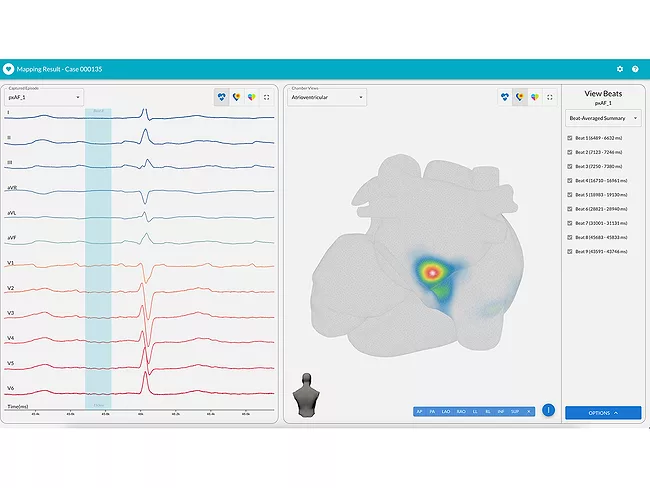
Vektor Medical Inc. recently secured CE mark for Vmap, its AI-powered electrocardiogram mapping system, marking a “major milestone” for the company, said CEO Rob Krummen. The regulatory approval from the EU authorities confirms that Vmap meets the stringent safety and performance requirements of the EU Medical Device Regulation, opening the door for clinical use in Europe, he told BioWorld.
Heartbeam Inc.'s algorithms performed as well on a standard 12-lead electrocardiography (ECG) as on its 3D ECG system in the detection of atrial fibrillation, atrial flutter and sinus rhythm, based on a study presented by Joshua Lampert, cardiac electrophysiologist and medical director of machine learning at HRX Live 2025 in Atlanta.
Solid Biosciences Inc. has announced approvals of its IND application and CTA by the U.S. FDA and Health Canada, respectively, for SGT-501, a novel gene therapy approach for the treatment of catecholaminergic polymorphic ventricular tachycardia (CPVT), a highly malignant, arrhythmogenic channelopathy caused by mutations in the RYR2 and CASQ2 genes.
Cardiovia Ltd.' Viaone epicardial access system received U.S. FDA clearance for treating cardiac arrhythmias. The device provides clinicians with a safe and minimally invasive technology to reach the heart’s outer surface, known as the pericardial space, without the need for a sharp needle, which can cause perforation.
Life-threatening arrhythmias are a major consequence of reduced cardiac sodium current with limited treatment options available. A recent study published in the European Heart Journal by researchers from Amsterdam University Medical Centers and collaborators explored a novel gene therapy approach to enhance the cardiac sodium current and prevent arrhythmias.
Pannexin 1 (Panx1) is a high-conductance, voltage-sensitive ion channels that exhibit flexible gating behavior upon activation, enabling the passage of ions such as Ca2+, Na⁺, K⁺, and ATP. Panx1 is expressed in cardiac tissue, but its role in ATP release and electrophysiological processes affecting cardiac function is not fully understood. Researchers from Vanderbilt University Medical Center have found that in isolated ventricular cardiomyocytes, Panx1 activation during spontaneous sarco/endoplasmic reticulum Ca2+ release amplified the NCX-driven transient inward current.
Myocardial infarction remains one of the leading causes of mortality, which is usually complicated by the occurrence of ischemic ventricular arrhythmias, which in turn increase the risk of sudden cardiac death in patients with myocardial infarction.
Researchers from The George Washington University and Northwestern University filed for protection of a bioresorbable, transparent, microelectrode array (MEA) technology that they believe offers unique advantages.
Heartbeam Inc. received U.S. FDA 510(K) clearance for its portable, non-invasive electrocardiogram system that enables on-the-go recording of heart signals. The cable-free, credit card-sized device uses five electrodes to capture signals from three directions and can be used whenever a patient feels symptoms, overcoming the challenge of identifying intermittent arrhythmias, which are often not experienced during scheduled appointments, without requiring patients to wear a device continuously.