Fractyl Health Inc. has received clinical trial application authorization in the Netherlands to initiate a first-in-human phase I/II study of RJVA-001, the first clinical candidate from the company’s Rejuva Smart GLP-1 gene therapy platform.
Six-month results from the REMAIN-1 trial showed that Fractyl Health Inc.’s Revita procedure cut post-GLP-1 weight regain by about 70% compared with a sham procedure in patients who discontinued incretin-based drugs such as semaglutide and tirzepatide after achieving substantial weight loss.
Sustaining healthy weight loss is about much more than cutting calories or injecting drugs, as many glucagon-like peptide-1 (GLP-1) receptor agonist users are discovering. Widely seen as miracle drugs, semaglutide, tirzepatide and related medications have transformed the treatment of obesity and diabetes and apparently lessened the need for medical device intervention in many instances. However, many patients will still need surgical intervention to achieve their weight loss goals.
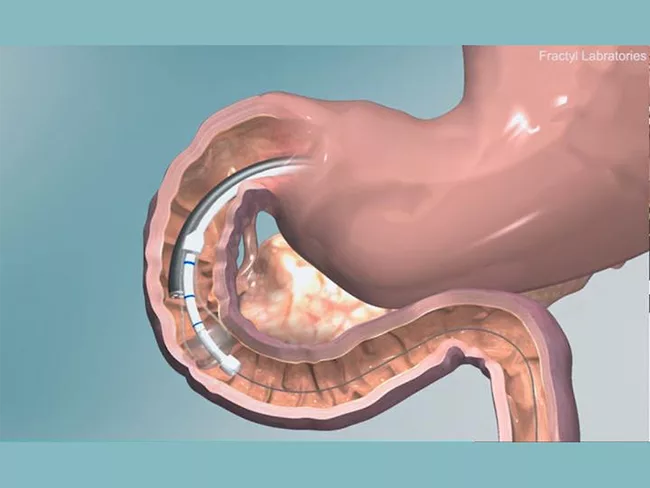
Glucagon-like peptide-1 (GLP-1) receptor agonists clearly help patients shed pounds, but many regain all - or more - of the weight once they discontinue the medications. Fractyl Health Inc. could offer an enduring solution with its Revita procedure. Six-month results from its open-label REVEAL-1 cohort of individuals with obesity who lost 15% or more of their total body weight on a GLP-1 therapy maintained that loss after discontinuing the drugs and undergoing the Revita procedure.
Taking weight off with a glucagon-like peptide-1 (GLP-1) receptor agonist and keeping it off once the drug has been discontinued has been a tall order but Response Pharmaceuticals Inc. is seeing progress. Top-line results from its randomized, double-blind, placebo-controlled, parallel-group phase II study of RDX-002, in those who had already wrapped up a GLP-1 receptor agonist course for reducing obesity, were positive.
At the American Diabetes Association 85th Scientific Sessions in Chicago June 20-23, Fractyl Health Inc. presented results from two studies evaluating very different approaches to treating – and possibly curing – type 2 diabetes.
Far from eliminating the need for weight-loss procedures, glucagon-like peptide-1 receptor agonists could drive more people to seek them out. At least that’s what Fractyl Health Inc. and Bariendo Inc. hope, and they have strong evidence to support their case with a recent meta-analysis showing that individuals discontinuing the popular weight loss medications regain all their weight and more within two years.
Be (not too) still my heart: Kestra Medical Technologies Ltd., maker of a wearable cardioverter defibrillator for patients at high risk of cardiac arrest, filed an S-1 with the U.S. SEC on Feb. 9 to raise $100 million in an IPO. Kestra will be the fourth med-tech company to file for an IPO in 2025, setting a pace well ahead of the last three years. U.s.car
Beta Bionics Inc. kicked off the new year with plans for an initial public offering of 7.5 million shares “as soon as practicable.” Expected to be priced at $14 to $16 per share, the IPO would gross $105 million to $120 million for the insulin delivery device maker.