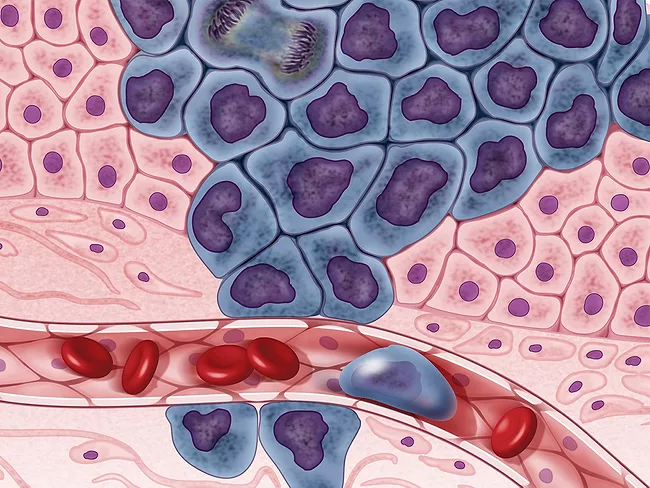
Prior to this year’s Annual Meeting of the American Association for Cancer Research (AACR), it had been 14 years since metastasis had been the subject of a plenary session. So, the Tuesday session on “Evolution of the genome, microenvironment, and host through metastasis” had plenty of new insights to share.
Zinc transporter ZIP6, also known as LIV-1, is a transmembrane protein that is an interesting target for antibody-drug conjugate (ADC) therapy because of its higher expression in tumors and almost no expression in normal tissues.
With the aim of overcoming drug resistance and reducing the toxicities associated with pan-fibroblast growth factor receptor (FGFR) inhibitors, scientists from 3H Pharmaceuticals Co. Ltd. developed a highly selective and potent small-molecule inhibitor of FGFR2, 3HP-2827, to be developed for the treatment of FGFR2‑driven solid tumors.
Multiple myeloma (MM) stands as the second most common hematologic malignancy. Proteasome inhibitors are effective in MM, but many patients develop resistance, which is thought to be caused by mutations in the PSMB5 gene.
Researchers from Abbvie Inc. recently presented preclinical data for ABBV-706, an SEZ6-targeted topoisomerase 1 (TOP1) inhibitor antibody-drug conjugate (ADC), being developed for the treatment of small-cell lung cancer (SCLC) and other SEZ6-expressing cancers.
Proviva Therapeutics Ltd. scientists hypothesized that both the activation of IL-2 receptor (IL-2R) and the blockade of programmed cell death protein 1 (PD-1) are complementary and potentially synergistic as a combination therapy for treating cancer.
HSN-003839 is a ubiquitin carboxyl-terminal hydrolase 21 (USP21) inhibitor discovered by Beijing Pharscin Innobio Co. Ltd. and being developed as a novel anticancer agent.