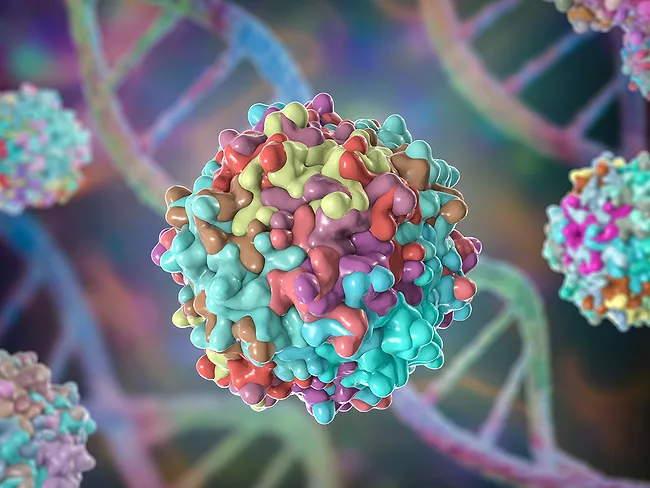
Privately held Dyno Therapeutics Inc. has added another notch to its adeno-associated virus (AAV) vectors development portfolio in a deal with the Roche Group that includes $50 million up front and ultimately could top $1 billion. Dyno will help in developing next-generation AAV vectors, optimized by artificial intelligence, to target neurological diseases.
Privately held Dyno Therapeutics Inc. has added another notch to its adeno-associated virus (AAV) vectors development portfolio in a deal with the Roche Group that includes $50 million up front and ultimately could top $1 billion. Dyno will help in developing next-generation AAV vectors, optimized by artificial intelligence, to target neurological diseases.
Interim phase II data of Wave Life Sciences Ltd.’s oligonucleotide, WVE-N531, revealed “impressive” dystrophin expression, solid safety and the potential for once-monthly dosing for boys with Duchenne muscular dystrophy who are amenable to exon 53 skipping. The findings drove Wave Life’s stock (NASDAQ:WVE) up by 53.4%, or $2.85, to close Sept. 24 at $8.19, after peaking earlier in the day at $8.35, its 52-week high.
While Dyne Therapeutics Inc.’s DYNE-251 demonstrated high levels of dystrophin expression and functional improvement in boys with Duchenne muscular dystrophy who are amenable to exon 51 skipping, investors focused on three serious adverse events related to the drug, driving shares (NASDAQ:DYNE) down by 31% on Sept. 3.
The BioWorld Biopharmaceutical Index climbed 16.31% by the end of July, continuing its lead over both the Nasdaq Biotechnology Index, which rose 10.82%, and the Dow Jones Industrial Average, up 8.37%. This follows an 8.15% gain in the BBI at the close of May, marking a strong performance throughout 2024.
In the first five months of 2024, the BioWorld Neurological Diseases Index (BNDI) saw a 10.35% decline, underperforming both the Nasdaq Biotechnology Index (NBI), which rose by 0.7%, and the Dow Jones Industrial Average (DJIA), which increased by 2.64%. This represents an additional drop for BNDI, which closed February with a 4.1% decline. In contrast, in 2023, the BNDI closed with a 4.36% increase, outperforming the NBI, which rose by 3.74%, but not matching the 13.7% rise seen in the DJIA.
Sarepta Therapeutics Inc. CEO Douglas Ingram said he expects “ferocious” demand for gene therapy Elevidys (delandistrogene moxeparvovec), granted full approval by the U.S. FDA for Duchenne muscular dystrophy (DMD). Shares of the Cambridge, Mass.-based firm closed June 21 at $16.72, up $37.22, or about 30% on the news.
The good news for Sarepta Therapeutics Inc. is bad news for Pfizer Inc. as the phase III study of its mini-dystrophin gene therapy in Duchenne muscular dystrophy (DMD) has missed its primary endpoint. Now Sarepta’s Elevidys (delandistrogene moxeparvovec), a single-dose, adeno-associated virus-based gene transfer therapy for DMD, is barreling toward a June 21 PDUFA date with the U.S. FDA as the near competition shrinks in the rearview mirror.
A boy participating in the phase II Daylight study of Duchenne muscular dystrophy (DMD) “has passed away suddenly,” according to Pfizer Inc. The participant had received fordadistrogene movaparvovec, a mini-dystrophin gene therapy, in early 2023. The fatal serious adverse event was reported May 3 as a cardiac arrest, Pfizer told BioWorld. Pfizer, together with the independent external data monitoring committee, is reviewing the data to understand the potential cause, the company added.
The U.S. FDA has approved Duvyzat (givinostat), from Italfarmaco SpA, for treating Duchenne muscular dystrophy (DMD). It is the first oral, nonsteroidal drug for treating all of DMD’s genetic variants. The oral treatment is approved for those ages 6 and older.