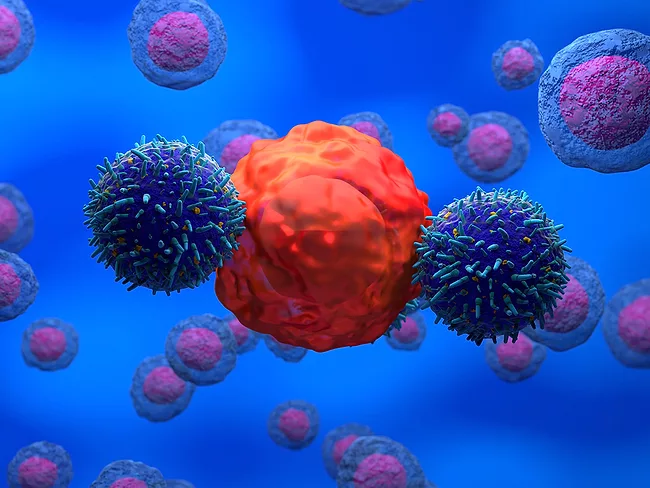
A team of investigators at Icahn School of Medicine at Mount Sinai and collaborating institutions aimed to isolate the on-target activity of CAR T cells to target tumor cells.
T-Curx GmbH has obtained clinical trial approval from the Swiss agency Swissmedic for the company’s nonviral lead CAR T program, TCX-001. The first-in-human phase I study will open in Switzerland, and a submission to the EMA will seek to expand the trial to sites in Germany. The study will enroll adults with relapsed or refractory acute myeloid leukemia (AML) and chronic lymphocytic leukemia (CLL), including patients not eligible for stem cell transplantation.
Therorna Shanghai Co. Ltd. has presented data on TI-0032, an anti-CD19 CAR circular RNA therapeutic delivered by lipid nanoparticles (LNPs) for the treatment of autoimmune and hematological disorders.
CSPC Pharmaceutical Group Ltd. has obtained clinical trial clearance from China’s National Medical Products Administration (NMPA) for SYS-6063, an mRNA-LNP-based dual-target CAR T-cell injection for the treatment of relapsed or refractory systemic lupus erythematosus (SLE).
Waypoint Bio has closed a $20 million series A financing round to support its work developing next-generation in vivo CAR T therapeutics for solid tumors using a platform that integrates AI, computer vision and spatial pooled screening.
At the ongoing European Association for the Study of the Liver 2026 annual meeting in Barcelona, researchers from Oricell Therapeutics Co. Ltd. presented data on a CAR T-cell approach targeting glypican 3 (GPC3) – OriC-902 – for the treatment of GPC3+ hepatocellular carcinoma (HCC).
Umoja Biopharma Inc. performed preclinical studies to evaluate the antitumor activity of UB-VV500, an off-the-shell lentiviral vector CAR T-cell product. It is based on its Vivovec technology and designed to engineer fully human anti-B-cell maturation antigen (BCMA)/G protein-coupled receptor class C group 5 member D (GPRC5D) dual-targeting chimeric antigen receptor (CAR) T cells, for the potential treatment of multiple myeloma (MM).
Hangzhou Qihan Biotech Co. Ltd. has obtained IND clearance from the FDA for QT-019C, a universal allogeneic CAR T-cell therapy for autoimmune diseases. QT-019C cell injection is an off-the-shelf allogeneic CAR T-cell therapy engineered from healthy donor leukapheresis products to stably express two distinct CARs targeting CD19 and BCMA.
The University of Texas MD Anderson Cancer Center has received IND clearance from the FDA to initiate a phase I trial of a novel CAR T-cell therapy, JV-394, for patients with relapsed or refractory CD94-positive T/natural killer (NK) cell lymphomas.
Create Medicines Inc. has closed a $122 million series B funding round to support progression of its pipeline of in vivo CAR therapies across autoimmune disease and oncology. The company’s proprietary mRNA-LNP platform directly engineers T cells, NK cells and myeloid cells inside the body to enable scalable, repeat-dose, off-the-shelf immunotherapies.
 RSS
RSS