BioWorld. Link to homepage.

Clarivate
  • BioWorld
  • BioWorld MedTech
  • BioWorld Asia
  • BioWorld Science
  • Data Snapshots
    • BioWorld
    • BioWorld MedTech
    • Infographics: Dynamic digital data analysis
    • Index insights
    • NME Digest
  • Special reports
    • Infographics: Dynamic digital data analysis
    • Trump administration impacts
    • Under threat: mRNA vaccine research
    • BioWorld at 35
    • Biopharma M&A scorecard
    • BioWorld 2024 review
    • BioWorld MedTech 2024 review
    • BioWorld Science 2024 review
    • Women's health
    • China's GLP-1 landscape
    • PFA re-energizes afib market
    • China CAR T
    • Alzheimer's disease
    • Coronavirus
    • More reports can be found here

BioWorld. Link to homepage.

  • Sign In
  • Sign Out
  • My Account
Subscribe
BioWorld - Friday, December 19, 2025
Home » Topics » Stem cells, BioWorld

Stem cells, BioWorld
Stem cells, BioWorld RSS Feed RSS

Concept art for stem cell implantation

Stem cell therapies show safety in clinical trials in Parkinson's

April 16, 2025
By Mar de Miguel
Stem cell implantation is a step closer to becoming the next strategy against Parkinson's disease. Two clinical trials, one in phase I and the other in phase I/II, have demonstrated their safety and potential to restore dopamine production in the brains of patients with this currently incurable neurodegenerative condition. The number of participants in the study is still small, and further research is needed to demonstrate the clinical benefits of these cell therapies.
Read More
3D illustration of brain cancer

Quiescent, but not quiet, cancer stem cells in glioblastoma relapse

Nov. 13, 2024
By Mar de Miguel
Six main cell types form glioblastomas, the most aggressive brain cancer due to its high rate of recurrence. Of these six, quiescent cancer stem cells are responsible for resistance to therapy and the reappearance of the tumor, according to a study that identified the six groups and highlighted the importance of these stem cells for the design of more effective therapies.
Read More
Hair follicle containing phagocytic stem cells
Dermatologic

Stem cells eat dead cells to ensure tissue integrity

Aug. 27, 2024
By Mar de Miguel
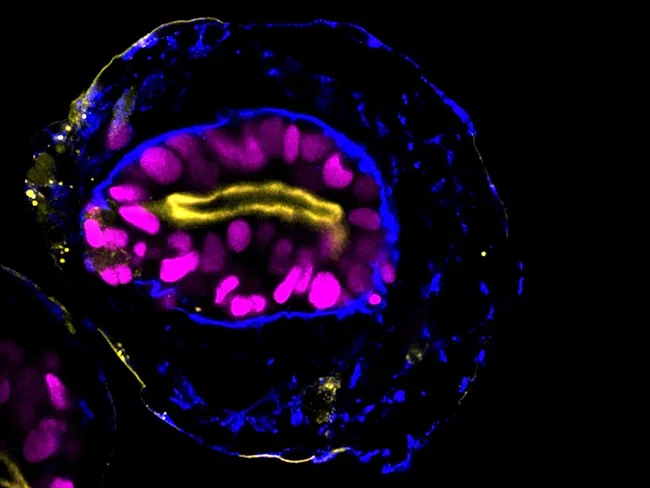
Phagocytosis – eliminating millions of dead cells every day – requires specialized cells such as macrophages, the true professionals, which migrate to engulf waste and dying cells. But they are not the only ones that can perform this task, as scientists at Howard Hughes Medical Institute (HHMI) discovered when they investigated hair follicle stem cells (HFSCs), a tissue in constant regeneration, to clarify how dying cells are detected and cleared in the epithelium and the mesenchyme.
Read More
Photo of jellyfish in aquarium lit by blue light
Aging

Jellyfish genes rejuvenate intestinal stem cells in fruit flies

Aug. 7, 2024
By Tamra Sami
Researchers in Japan were able to transfer genes from jellyfish into common fruit flies and discovered that the transferred gene suppressed an age-related intestinal issue in the flies. The findings suggest that studying genes specific to animals with high regenerative capability like jellyfish may uncover new mechanisms for rejuvenating stem cell function and extending the healthy lifespan of unrelated organisms.
Read More
Stem cells

ISSCR 2024: Expanding niche definition gives insights into stem cells

July 15, 2024
By Anette Breindl
The word “niche” implies a specialized environment. But to Fiona Doetsch, the stem cell niche is anything but. For brain stem cells, “the whole organism is the niche,” Doetsch told the audience at the third plenary session of the International Society for Stem Cell Research (ISSCR) annual meeting in Hamburg this week. It’s a surprising idea at first, given the brain’s protection from many circulating substances via a series of barriers, including the blood-brain barrier and the blood-cerebrospinal fluid barrier.
Read More
Colorful illustration of the heart
Cardiovascular

Human iPSCs restore muscle, function in monkeys with heart failure

May 3, 2024
By Tamra Sami
Japanese researchers have transplanted human induced pluripotent stem cells (iPSCs) in a primate model of myocardial infarction and were able to restore heart muscle and function in monkeys. Developed by Tokyo-based Heartseed Inc., the grafted iPSCs consist of clusters of purified heart muscle cells (cardiomyocyte spheroids) that are injected into the myocardial layer of the heart. Published in Circulation on April 26, 2024, the study showed that the cardiomyocyte spheroids survived long term and showed improved contractile function with low occurrence of post-transplant arrhythmias.
Read More
Images showing the green fluorescence signals in different body parts of the live-birth chimeric monkey.
Drug Design, Drug Delivery & Technologies

1st chimeric monkey born with large embryonic stem cell contribution

Nov. 9, 2023
By Anette Breindl
Investigators at the Chinese Academy of Sciences have generated a chimeric monkey by injecting an embryonic stem cell into the morula, which is an extremely early embryo consisting of 16 to 32 cells. The animal survived for only 10 days, and it is not the first live birth of a chimeric primate. But it is the first such chimera with contributions from an embryonic stem cell, and that stem cell contributed a far higher proportion of cells in the newborn than have been achieved in previous attempts at creating chimeras.
Read More
Day 4 embryoid showing an inner epiblast-like domain that has apico-basal polarity
Drug Design, Drug Delivery & Technologies

New human embryonic models bring hope for insights, but also lots of brouhaha

June 28, 2023
By Mar de Miguel
The development of an embryo in its early stages involves a series of processes in which cells interact and organize to form tissues. In humans, these stages are studied with animal models, stem cells and cell aggregates that mimic natural development phases, or with human embryos, depending on their availability and a strict protocol. Now, in back-to-back papers published online in Nature, scientists from Yale University and the University of Cambridge have two new embryonic models formed from human stem cells to study development after embryo implantation in the uterus.
Read More
Greater horseshoe bats hanging in cave
Infection

Bat cell line reveals unusual molecular relationship with viruses

Feb. 22, 2023
By Helen Albert
An international team of researchers has created two bat stem cell lines that reveal an unusual number of viral sequences in bat cells compared with those of other mammals. Writing in an article posted online Feb. 21, 2023, in Cell, the scientists suggested that the unusual amount of viral genetic material found in the bat stem cells could explain why these mammals are largely unaffected by most viral infections, despite being able to transmit them.
Read More
Comparison of senescent cells in regenerating muscle.
Musculoskeletal

Senescent cells are toxic to their neighbors, prevent muscle regeneration

Dec. 22, 2022
By Mar de Miguel
The first in vivo cell atlas of senescent tissue in skeletal muscle has identified the damaging properties of these cells and explained why they block muscle regeneration. According to a study at Pompeu Fabra University led by scientists from Altos Labs Inc., cell damage caused the senescence of the cells, which secreted toxic substances into the surrounding microenvironment, causing fibrosis and preventing tissue regeneration.
Read More
Previous 1 2 3 Next

Popular Stories

  • Today's news in brief

    BioWorld
    BioWorld briefs for Dec. 18, 2025.
  • Today's news in brief

    BioWorld MedTech
    BioWorld MedTech briefs for Dec. 18, 2025.
  • Acute myeloid leukemia illustration

    Apollo’s APL-4098 shows potent antileukemic effects

    BioWorld Science
    Apollo Therapeutics Ltd. has developed APL-4098, a small-molecule general control nonderepressible 2 (GCN2) inhibitor for the potential treatment of AML.
  • Illustration of brain with electrical activity background

    ABS-1230 controls seizures in KCNT1-driven severe epilepsy

    BioWorld Science
    Mutations in the KCNT1 gene produce gain-of-function effects that lead to overactivation of the potassium channel and consequent disruption of normal neuronal...
  • Left: Anthony Fauci. Right: Transmission electron micrograph of HIV-1 virus particles

    HIV research is close to a cure but far from ending the pandemic

    BioWorld
    Advances in antiretroviral therapy (ART) now allow people living with HIV to lead normal lives with undetectable and nontransmissible levels of the virus in their...
  • BioWorld
    • Today's news
    • Analysis and data insight
    • Clinical
    • Data Snapshots
    • Deals and M&A
    • Financings
    • Newco news
    • Opinion
    • Regulatory
    • Science
  • BioWorld MedTech
    • Today's news
    • Clinical
    • Data Snapshots
    • Deals and M&A
    • Financings
    • Newco news
    • Opinion
    • Regulatory
    • Science
  • BioWorld Asia
    • Today's news
    • Analysis and data insight
    • Australia
    • China
    • Clinical
    • Deals and M&A
    • Financings
    • Newco news
    • Regulatory
    • Science
  • BioWorld Science
    • Today's news
    • Biomarkers
    • Cancer
    • Conferences
    • Endocrine/Metabolic
    • Immune
    • Infection
    • Neurology/Psychiatric
    • NME Digest
    • Patents
  • More
    • About
    • Advertise with BioWorld
    • Archives
    • Article reprints and permissions
    • Contact us
    • Cookie policy
    • Copyright notice
    • Data methodology
    • Infographics: Dynamic digital data analysis
    • Index insights
    • Podcasts
    • Privacy policy
    • Share your news with BioWorld
    • Staff
    • Terms of use
    • Topic alerts
Follow Us

Copyright ©2025. All Rights Reserved. Design, CMS, Hosting & Web Development :: ePublishing