PARIS – The French government reported setting up the “Artificial Intelligence and Cancer” association, a public-private partnership that brings together the French National Cancer Institute (INCA), the Health Data Hub and the Health Industry Alliance for Research and Innovation (ARIIS), along with eight commercial firms. The eight commercial firms, whose identities have not yet been released, are drawn from a large consortium of pharmaceutical and information technology firms and health care insurers, that has been around since 2019.
Happify Inc. launched Ensemble, a prescription digital therapy designed to treat patients with major depressive disorder (MDD) or generalized anxiety disorder (GAD). The app joins several others that target both depression and anxiety, including the eponymous apps made by Woebot Health (Woebot Labs Inc.) and Youper Inc., although it is the only one that requires a prescription in the pack.
Lunit Inc. snagged a $26 million investment from precision oncology company from Guardant Health Inc., closing its series C tranche B funding round. Lunit is planning to use the funds to develop more artificial intelligence (AI) solutions and improve existing ones.
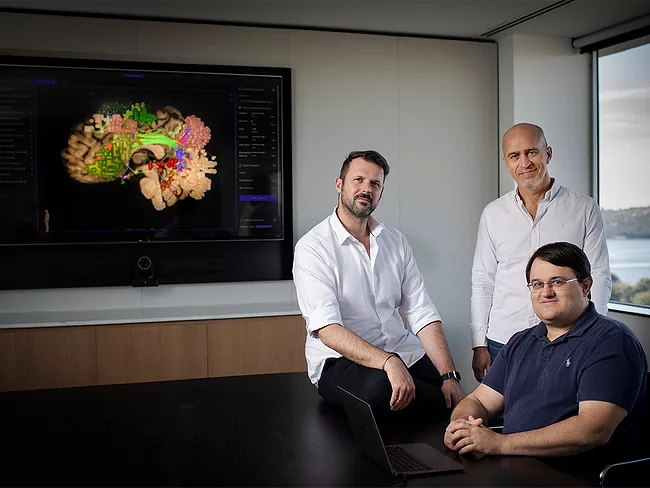
PERTH, Australia – The FDA gave the thumbs up to Omniscient Neurotechnology Ltd.’s Quicktome, the first brain connectomics planning software that provides neurosurgeons with a digital brain mapping platform to visualize and understand a patient's brain networks before performing brain surgery. By visualizing networks that are responsible for complex functions such as language, movement, and cognition, Quicktome assists neurosurgeons in making more informed decisions and reduces surgical uncertainty.
The Hong Kong Polytechnic University (PolyU) has developed new side-hole polymer optical fiber sensors, which can be used in multiple medical treatments without the drawbacks of other optical fibers used in the past. The biocompatible plastic sensors are humidity insensitive, supple and shatter-resistant. This means they can be used in various medical settings, ranging from surgical instrumentation, diagnostics to imaging equipment and sensor-based medical devices.
South Korea plans to create a bio data dam, a step toward generating the necessary industrial ecosystem in the country’s bid to become one of the top seven players in the global medical device market by 2025.
Responding to the growing number of state-sponsored cyber threats to health care and other key sectors and to the compromise of the Microsoft Exchange Server, which was disclosed in March, Canada, the EU, U.K., U.S. and other NATO allies issued statements July 19 laying out expectations and markers for how responsible nations behave in cyberspace and specifically calling out China’s “malicious cyber activity.”
The FDA is applying a good deal of resources toward a framework for regulation of artificial intelligence (AI) and machine learning (ML), but there are several sources of drag on those efforts. According to the FDA's Jana Delfino, one of these is that there is little agreement between regulators on a number of definitions, including the meaning of terms such as "validation," a problem she said must be solved if the field is to advance in a meaningful manner.
Myopia, or near-sightedness, is a growing public health problem, often beginning in childhood. Severe cases can lead to serious complications including cataract, glaucoma and retinal detachment. Now, Dopavision GmbH has raised a €12 million (US$14.2 million) series A round to advance its digital childhood myopia therapeutic aimed at nipping this lifelong problem in the bud.
Orexo AB enrolled the first patient in a pivotal trial of its digital therapeutic Modia plus sublingual buprenorphine/naloxone for treatment of opioid use disorder (OUD). Orexo’s Zubsolv, the combination of buprenorphine and naloxone used in the study, has been employed to help U.S. patients with OUD since 2013.
 RSS
RSS