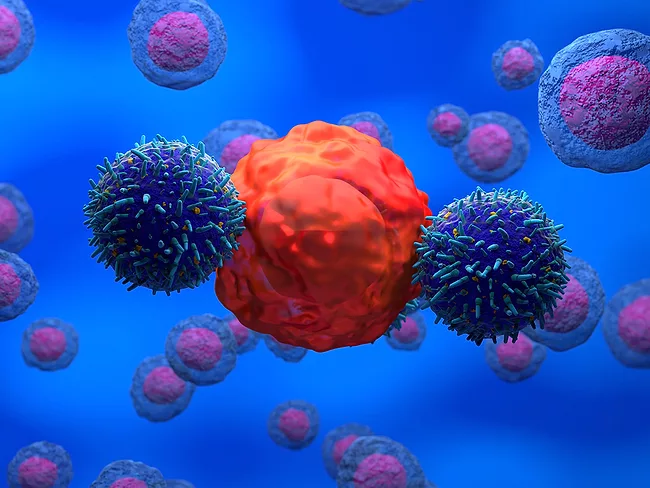
Receptor-interacting protein kinase 1 (RIPK1) helps promote the survival of cancer cells, and degrading it can sensitize tumors to immunotherapy against PD-1. Degrading the entire protein seems to be essential: merely blocking its kinase activity does not sensitize tumors.
A team at Baylor College of Medicine conducted research to identify novel cell-surface cancer/germline antigens (CGAs) expressed in triple-negative breast cancer (TNBC) that could serve as targets for development of CAR T therapies against this disease.
Previous research revealed that nuclear factor of activated T cells 1 (NFAT1) is a novel regulator of the mouse double minute 2 homolog (MDM2) oncogene, which acts by directly binding to the MDM2 P2 promoter and as such, enhancing MDM2 transcription independent of p53. Researchers from the University of Houston and Baylor College of Medicine presented preclinical data for MA-242, a dual inhibitor of MDM2 and NFAT1, being developed for the treatment of cancer.
Celmatix Therapeutics (Celmatix Inc.) has announced a new drug program for endometriosis, with the development of a novel Jun-N-terminal kinase (JNK) inhibitor that targets pain and inflammation. The company’s aim to focus on JNK inhibitors with greater specificity for JNK1 and JNK3 than for JNK2 led it to license lead compounds from Baylor College of Medicine.
Baylor College of Medicine has disclosed proteolysis targeting chimeras (PROTACs) comprising cereblon (CRBN) ligands coupled to Bruton tyrosine kinase (BTK)-, DNA-binding protein Ikaros (IKZF1)- and Zinc finger protein Aiolos (IKZF3)-targeting moieties through a linker.
WD repeat domain 83 opposite strand (WDR83OS) encodes the 106-aa (amino acid) protein Asterix, which is a binding partner for CCDC47. More specifically, Asterix heterodimerizes with CCDC47 to form the protein associated with ER translocon (PAT) complex that specifically chaperones large proteins containing transmembrane domains.
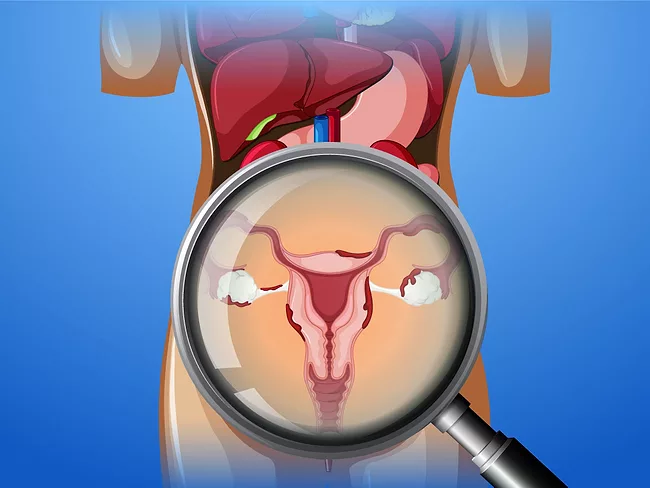
According to World Health Organization data, endometriosis affects about 10% of reproductive-age females globally. That already makes endometriosis a wildly underresearched and underfunded disease in relation to its prevalence. Plus, Rama Kommagani thinks even 10% is an underestimation.
According to World Health Organization data, endometriosis affects about 10% of reproductive-age females globally. That already makes endometriosis a wildly underresearched and underfunded disease in relation to its prevalence. Plus, Rama Kommagani thinks even 10% is an underestimation. “Diagnosis is very underreported, particularly in low- and middle-income countries,” Kommagani, who is an associate professor of pathology at Baylor College of Medicine, told BioWorld.
According to World Health Organization data, endometriosis affects about 10% of reproductive-age females globally. That already makes endometriosis a wildly underresearched and underfunded disease in relation to its prevalence. Plus, Rama Kommagani thinks even 10% is an underestimation. “Diagnosis is very underreported, particularly in low- and middle-income countries,” Kommagani, who is an associate professor of pathology at Baylor College of Medicine, told BioWorld.
Researchers at Baylor College of Medicine and Deliver Therapeutics Inc. have synthesized protein kinase inhibitors reported to be useful for the treatment of cancer and psoriasis.