Prenaital ApS has filed a patent for technology that may identify risks of spontaneous pre-term birth. Spontaneous preterm birth (sPTB) is usually defined as birth occurring before 37 weeks of gestation. The invention relates to a method for predicting potential preterm birth from medical scan data, which may be used in practice by medical professionals for risk analysis and prognosis of potential pathologies.
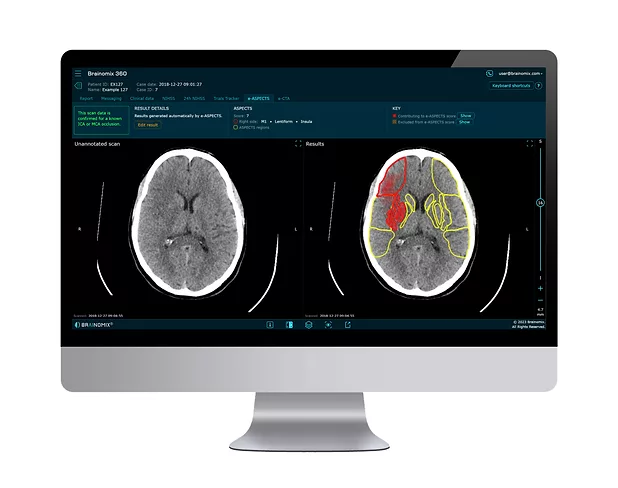
Brainomix Ltd. reported the publication of a prospective real-world study demonstrating that its AI imaging platform, Brainomix 360 Stroke, significantly increased rates of endovascular thrombectomy (EVT) treatment, a minimally invasive surgical procedure for patients with large vessel occlusion stroke, and reduced delays in patient triage and transfer.
Phase Scientific International Ltd. launched China’s largest clinical study for urine-based cervical cancer screening. If successful, the blood-based test could be the first non-invasive test for HPV.
Ultromics Ltd. raised $55 million in a series C financing round to expand its commercial footprint across the U.S. and invest in the development of new AI modules for earlier, more accurate detection of cardiovascular disease, Ross Upton, CEO and founder of Ultromics told BioWorld.
Lunit Inc. reported a new collaboration with Microsoft Corp. July 2 to jointly develop medical AI programs accessible on Microsoft’s Azure cloud platform.
South Korea’s Ministry of Food and Drug Safety on June 9 approved Vuno Inc’s AI-based Med-DeepECG Kidney software as a non-invasive method to screen for kidney dysfunction.
Two French startups, Gleamer SAS and Azmed SAS, received clearance from the U.S. FDA for their AI-powered tools for chest X-rays. They join an increasing number of companies developing software tools to help clinicians detect a range of abnormalities on images, enhancing diagnostic accuracy, reducing delays and improving patient outcomes.
Heartbeam Inc. received U.S. FDA 510(K) clearance for its portable, non-invasive electrocardiogram system that enables on-the-go recording of heart signals. The cable-free, credit card-sized device uses five electrodes to capture signals from three directions and can be used whenever a patient feels symptoms, overcoming the challenge of identifying intermittent arrhythmias, which are often not experienced during scheduled appointments, without requiring patients to wear a device continuously.
The recent $73 million raised by Cradle NV in a series B financing round will allow the company to build out its operations and improve its artificial intelligence-powered protein engineering platform.
For Inocras Inc., the benefits of whole genome sequencing are two-fold. First is its explicit usefulness in diagnosing and treating hard-to-treat diseases like cancer and rare diseases. The second, less apparent, benefit lies in the data generated in the process, and its applications to current and future generations of cancer patients.