The FDA announced a class I recall of the Dragonfly Opstar imaging catheter by Abbott Vascular, of Santa Clara, Calif., due to the loosening of a band marker that may lead to separation from the catheter. The agency said two instances in which the marker has separated from the catheter have been reported, with another three incidents of loosening without separation.
The U.S. Centers for Medicare and Medicaid Services (CMS) posted the much-anticipated draft do-over of the mitral valve repair device coverage memo, and in the process renamed the policy the mitral valve transcatheter edge-to-edge repair (TEER) national coverage memo.
While the disappearing drug-eluting stent seems to have faded from view for the time being, several manufacturers have invested in fabrication of drug-eluting stents with polymers that absorb once the drug of elution has done its work. A new study indicates that patients who have already had a myocardial infarction fare better on stents made with these biodegradable polymers, an outcome that may soon push second-generation DES devices into med-tech history.
CLEVELAND – The list is out, and a dual-acting osteoporosis drug and a device for expanding the use of minimally invasive mitral valve surgery have come out on top.
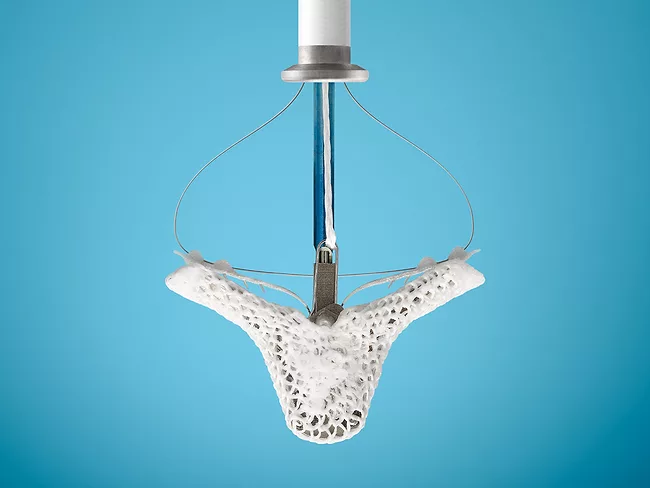
The recent progress in interventional cardiology has largely been driven by the aortic valve, although calcification of the aortic root has proven a difficult hurdle to overcome. A newly published study demonstrates that the Tendyne device by Abbott Vascular Inc., of Santa Clara, Calif., can be readily used not just to treat failing mitral valves, but works well in these patients with severe calcification, an achievement that could quickly vault the transcatheter approach past conventional surgical approaches in this population.