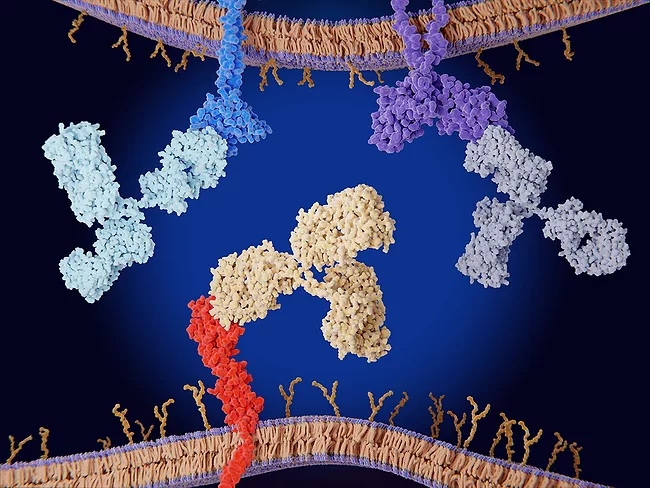
China’s National Medical Products Administration approved Innovent Biologics Inc.’s NDA for Tabosun (ipilimumab N01, IBI-310) in combination with sintilimab as neoadjuvant treatment for stage IIB-III resectable microsatellite instability-high or mismatch repair deficient colon cancer.
China’s National Medical Products Administration approved Innovent Biologics Inc.’s NDA for Tabosun (ipilimumab N01, IBI-310) in combination with sintilimab as neoadjuvant treatment for stage IIB-III resectable microsatellite instability-high or mismatch repair deficient colon cancer.
Chinese pharmaceutical companies are making significant inroads into the global oncology market, particularly with the development and approval of immune checkpoint inhibitors. These treatments, which have shown strong efficacy in various cancer indications, are not only transforming the oncology landscape in China but are also gaining traction in high-value international markets, including the U.S.
Putting in writing what it’s been saying at advisory committee meetings, the U.S. FDA is issuing a draft guidance on multiregional clinical trials for cancer drugs that underscores the need for applicability to the U.S. population and medical practices.
Innovent Biologics Inc. has formed a partnership with Sanofi SA to jointly develop and commercialize two of Sanofi’s oncology candidates in combination with sintilimab in China, namely SAR-408701 (tusamitamab ravtansine) and SAR-444245.
Just in case the U.S. FDA didn’t get the message from its advisory committee about drug applications based solely on clinical trial data from China, a trio of U.S. lawmakers wrote to FDA Commissioner Robert Califf to voice their concerns about the “current ‘East to West’ movement of clinical data” to support the approval of me-too drugs.
Just in case the U.S. FDA didn’t get the message from its advisory committee about drug applications based solely on clinical trial data from China, a trio of U.S. lawmakers wrote to FDA Commissioner Robert Califf to voice their concerns about the “current ‘East to West’ movement of clinical data” to support the approval of me-too drugs.
Innovent Biologics Co. Ltd. and Eli Lilly and Co. are "assessing next steps" for their jointly developed PD-1 inhibitor, sintilimab, following receipt of a complete response letter (CRL) from the U.S. FDA.
Innovent Biologics Co. Ltd. and Eli Lilly and Co. are "assessing next steps" for their jointly developed PD-1 inhibitor, sintilimab, following receipt of a complete response letter (CRL) from the U.S. FDA. The pair sought approval of a BLA for sintilimab plus pemetrexed and platinum chemotherapy for the first-line treatment of people with nonsquamous non-small-cell lung cancer (NSCLC) but found near-unanimous opposition from FDA advisers dissatisfied with China-only trial data submitted in support of the application. The medicine is already approved for multiple indications in China, where it’s marketed as Tyvyt.
In the wake of recent U.S. FDA pushback on an NDA filing by Innovent Biologics Inc. and Eli Lilly and Co. built around ex-U.S. trial data, few companies are likely to attempt such a feat again soon – at least when the source of the data is China alone.