In a letter to the hemophilia community, Pfizer Inc. reported a death due to cerebellar infarction and subsequent cerebral hemorrhage in a long-term extension trial participant taking the New York-based company’s tissue factor pathway inhibitor antagonist Hympavzi (marstacimab).
Metagenomi Inc. has reported new dose-range-finding data from its MGX-001 hemophilia A program. MGX-001 is designed to provide curative, life-long protection from bleeding events and joint damage in adults and children with hemophilia A.
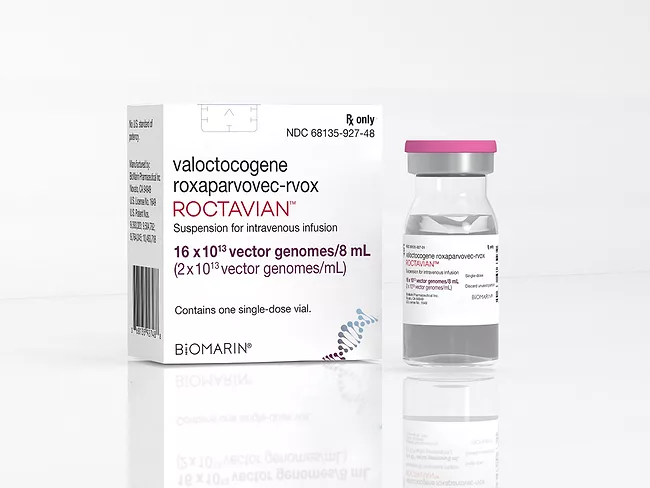
Biomarin Pharmaceutical Inc. plans to divest its pioneering gene therapy for hemophilia, Roctavian (valoctocogene roxaparvovec), and remove what had been considered a potential blockbuster from the portfolio in order to grow the company.
While recent advances in gene therapy have offered unprecedented options for patients with hemophilia, new data presented at the 32nd Annual Congress of the European Society of Gene and Cell Therapy (ESGCT), held in Seville Oct. 7-10, revealed persistent concerns regarding the durability of these treatments and their potential liver toxicity.
While recent advances in gene therapy have offered unprecedented options for patients with hemophilia, new data presented at the 32nd Annual Congress of the European Society of Gene and Cell Therapy (ESGCT), held in Seville Oct. 7-10, revealed persistent concerns regarding the durability of these treatments and their potential liver toxicity.
Novo Nordisk A/S recently presented data regarding their antibody fragment Inno-8 for the potential treatment of hemophilia A. Inno-8 was characterized in vitro alone or in combination with hemostatic agents used for treating hemophilia A.
Bispecific antibodies mimicking coagulation factor VIIIa (FVIIIa) have yielded successful results in the treatment of hemophilia A, but there remain some issues in regard to their production.
Sangamo Therapeutics Inc. is adding a much-needed $18 million up-front payment in a neurology-focused deal with Eli Lilly and Co. that could bring up to an additional $1.4 billion. In return, Lilly gets access to Sangamo’s neurotropic adeno-associated virus (AAV) capsid, STAC-BBB, which has shown early promise in penetrating the blood-brain barrier penetration, for one initial target with the right to add up to four more.
Mouse models for hemophilia A are commonly generated by factor VIII (FVIII) knockout, however, these mice rapidly develop anti-FVIII antibodies during repetitive FVIII administration. To overcome this preclinical research challenge, investigators from Octapharma AG and affiliated organizations developed a new model unable to produce antibodies but otherwise not immunosuppressed.
At the recent annual congress of the European Association for Haemophilia and Allied Disorders, researchers from Novalgen Ltd. presented the discovery and preclinical characterization NVG-444, a potentially first-in-class next-generation FVIII mimetic antibody equipped with autoregulation to reduce prothrombotic risks that is being developed for the treatment of hemophilia A.