Pharma companies are collaborating to boost the power of artificial intelligence (AI) in drug discovery by allowing access to proprietary structural data to train a large language model. Each of the partners is contributing data from several thousand experimentally determined protein:ligand interactions, creating one of the most diverse datasets and the richest chemistry assembled to date for model training.
Pharma companies are collaborating to boost the power of artificial intelligence (AI) in drug discovery by allowing access to proprietary structural data to train a large language model.
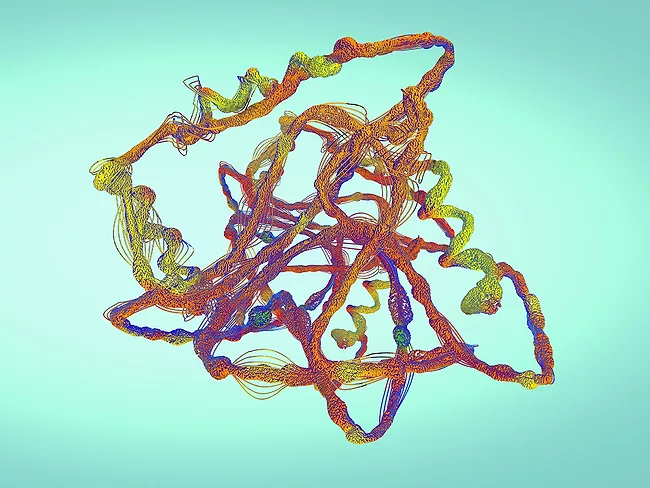
Deep learning tools for protein design can also be used to create molecules that bind to them. Certain peptides, such as intrinsically disordered proteins (IDPs), are challenging to target due to their variable nature. However, scientists from the lab of Nobel laureate David Baker have developed a method to generate binders for IDPs by searching the world’s largest protein database with their AI-powered tool RFdiffusion.
Deep learning tools for protein design can also be used to create molecules that bind to them. Certain peptides, such as intrinsically disordered proteins (IDPs), are challenging to target due to their variable nature. However, scientists from the lab of Nobel laureate David Baker have developed a method to generate binders for IDPs by searching the world’s largest protein database with their AI-powered tool RFdiffusion.
The Alphafold machine learning system for predicting a protein’s structure from its amino acid sequence has been adapted to make it possible to design de novo proteins that fold in a particular way and bind to prespecified target proteins. The sister system, called Alphadesign, works by generating random strings of amino acids, using Alphafold to predict their structure, and then iteratively optimizing the design.
The Alphafold machine learning system for predicting a protein’s structure from its amino acid sequence has been adapted to make it possible to design de novo proteins that fold in a particular way and bind to prespecified target proteins. The sister system, called Alphadesign, works by generating random strings of amino acids, using Alphafold to predict their structure, and then iteratively optimizing the design.
Researchers at the Massachusetts Institute of Technology and Recursion Pharmaceuticals Inc. have released an open-source AI model that can predict the binding strength of small molecules as well as structures of proteins and biomolecular complexes. The model, which is called Boltz-2 and was released by the research team on the developer platform Github on June 6, addresses a major bottleneck in drug discovery with its improved ability to predict binding strengths.
Researchers at the Massachusetts Institute of Technology and Recursion Pharmaceuticals Inc. have released an open-source AI model that can predict the binding strength of small molecules as well as structures of proteins and biomolecular complexes. The model, which is called Boltz-2 and was released by the research team on the developer platform Github on June 6, addresses a major bottleneck in drug discovery with its improved ability to predict binding strengths.
David Baker, Demis Hassabis and John Jumper share the 2024 Nobel Prize in Chemistry for their contributions to the science of protein structure. David Baker was awarded half the prize “for computational protein design,” according to the Royal Swedish Academy of Sciences. Hassabis and Jumper shared the other half “for protein structure prediction.”
David Baker, director of the Institute for Protein Design at the University of Washington School of Medicine, is a pioneer in protein design. His contributions have been recognized with countless awards, and now, a place among the 2024 Clarivate Citation Laureates.