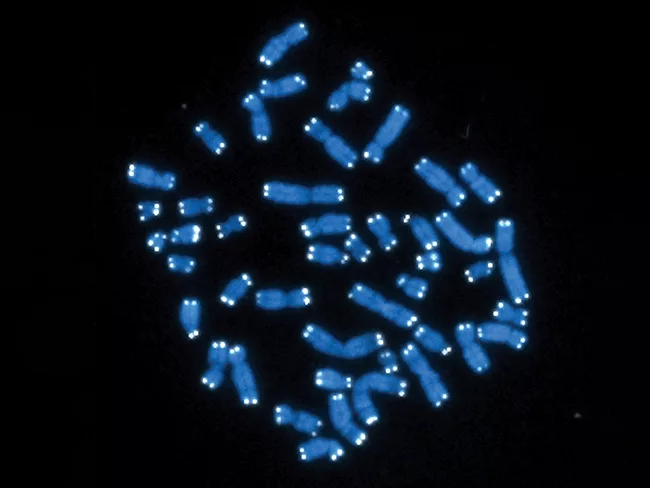
With an initial €8 million (US$8.4 million) in seed funding in the bank, Tessellate Bio has emerged from stealth to tackle cancers that rely on the less well explored synthetic lethality mechanism of alternative lengthening of telomeres.
With an initial €8 million (US$8.4 million) in seed funding in the bank, Tessellate Bio has emerged from stealth to tackle cancers that rely on the less well explored synthetic lethality mechanism of alternative lengthening of telomeres.
Scientists from the University of Lisbon have described how telomeres can establish the maximum damage that a cancer cell can suffer. Above this threshold, the cell would stop dividing and die. The damage comes from the transcription of the telomeres themselves of an RNA molecule called TERRA. When TERRA’s levels increase, the cell can no longer multiply. This mechanism occurs in ALT (alternative lengthening of telomeres) cells, which do not elongate their telomeres through telomerase.
Investigators led by Russell Pieper at University of California, San Francisco have discovered that ALT-associated tumors are hypersensitive to a subgroup of poly [ADP-ribose] polymerase (PARP) inhibitors.