After a phase III stumble, Acadia Pharmaceuticals Inc. will drop development of ACP-101, intranasal carbetocin, to treat hyperphagia in patients with the rare genetic disorder Prader-Willi syndrome. Top-line data from the 12-week, double-blind, randomized phase III study missed its primary endpoint by not producing a statistically significant improvement over placebo.
Multiple datasets are due to roll out soon in the Prader-Willi syndrome (PWS) space, where contenders are trying varied mechanisms of action to tackle the rare genetic disorder characterized by insatiable hunger, or hyperphagia. In the mix are Aardvark Therapeutics Inc., Acadia Pharmaceuticals Inc., Rhythm Pharmaceuticals Inc. and Soleno Therapeutics Inc.
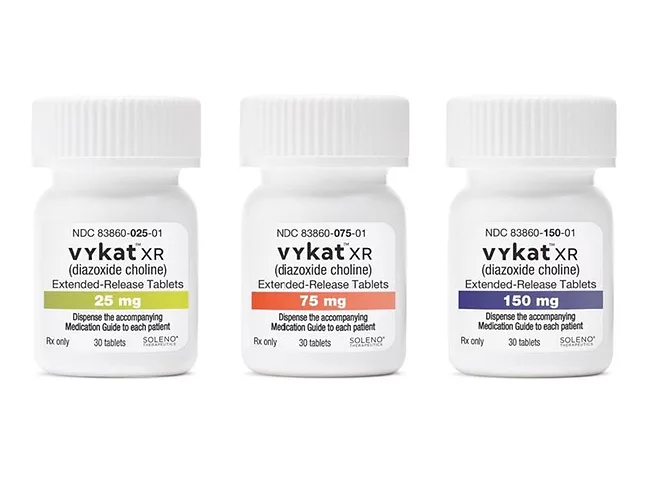
Becoming the first treatment for rare genetic disorder Prader-Willi syndrome, breakthrough therapy drug DCCR (diazoxide choline) gained U.S. FDA approval as Vykat XR the evening before its March 27 PDUFA date, sending shares of developer Soleno Therapeutics Inc. up 38%.
Neuren Pharmaceuticals Ltd.’s NNZ-2591 met the primary endpoints in a phase II trial in children with Pitt Hopkins syndrome, with improvements seen in communication, social interaction, cognition and motor abilities, according to top-line results.
Neuren Pharmaceuticals Ltd.’s NNZ-2591 met the primary endpoints in a phase II trial in children with Pitt Hopkins syndrome, with improvements seen in communication, social interaction, cognition and motor abilities, according to top-line results.
In a show of bipartisan solidarity, members of the U.S. Senate Special Committee on Aging voiced their support Oct. 26 for a new regulatory pathway to quicken access to new drugs for rare diseases that have no approved treatments.
Soleno Therapeutics Inc. (NASDAQ: SLNO) pulled off in a major way its randomized-withdrawal phase III study with DCCR (diazoxide choline) in Prader-Willi syndrome, boosting the shares by $22.37, or 505%, to close Sept. 26 at $26.80. “Our work is not done, but this was a big step,” said CEO Anish Bhatnagar.
A recent population study in Morocco reinforced the importance of early diagnosis in handling – at best physicians can – Prader-Willi syndrome (PWS) and served, at least indirectly, to remind investors of the potentially lucrative space, where the lone drug labeled for the indication is a growth hormone.
Not heeding earlier FDA advice has earned Levo Therapeutics Inc. a complete response letter (CRL) for its NDA seeking approval for intranasal carbetocin (LV-101) in hyperphagia associated with Prader-Willi syndrome (PWS). The CRL followed a 12-1 negative advisory committee vote in November.