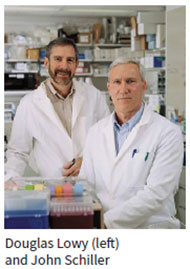
The 2017 Lasker Awards honored the discovery of the mTOR kinase by Michael Hall, the scientific groundwork that led to the development of the first preventive cancer vaccine by Douglas Lowy and John Schiller, and the women's health work done by Planned Parenthood.
In its announcement, which named Michael Hall winner of the 2017 Albert Lasker Basic Medical Research Award, the Lasker Foundation called Hall "a scientist who discovered the nutrient-activated TOR proteins and their central role in the metabolic control of cell growth."

These days, Hall is a highly decorated scientist whose rewards, in addition to the Lasker, include the 2014 Breakthrough Prize in Life Sciences and election to the National Academy of Sciences.
But at the time his team discovered mTOR, the work faced both scientific challenges and the skepticism of the scientific community.
While experimental challenges are par for the course in science, Hall said in a press conference, part of the problem was that the conceptual "mediates a process which we didn't think existed."
At the time Hall started working on how cell growth is controlled, the prevailing notion was that there is no such thing – that cell growth was essentially a process that would occur whenever there were nutrients around.
Hall's research showed that as part of two separate complexes mTOR is critical for sensing nutrient availability and regulating metabolic pathways accordingly. "I think of it as the brain of the cell," Hall said.
And while Hall and his team originally approached the problem as a basic science question, dysregulation of the mTOR pathway is now recognized as a key feature of aging and, consequently, a contributor to many diseases.
As the name of the protein itself – mTOR stands for "mechanistic target of rapamycin" – illustrates, drugging mTOR preceded an understanding of what was being drugged. Rapamycin was identified in 1972 through the screening of soil bacteria, and Rapamune (sirolimus, Pfizer Inc.) was initially approved as an anti-transplant rejection drug.
More recent research has shown that the mTOR kinase is part of two distinct complexes, mTORC1 and mTORC2.
While mTORC1 is activated by feeding, inhibited by stress signals such as DNA damage and hypoxia, and controls metabolic pathways, mTORC2, which controls proliferation, is activated by insulin and PI3 kinase (PI3K).
The current generation of mTOR inhibitors, such as Afinitor (everolimus, Novartis AG), which is FDA-approved for the treatment of five different cancers, inhibit both mTORC1 and mTORC2. Inhibiting both complexes is necessary to block the growth of tumor cells, but comes at the price of high toxicity.
Specifically inhibiting mTORC1 could mimic the effects of calorie restriction on life span, an approach being explored by Startup Navitor Inc. (See BioWorld Today, Dec. 21, 2015.)
"It's been known since 1935 that if you eat less, life span is extended," Hall said. But until scientists showed that feeding rapamycin to experimental animals, including mammals, could mimic the benefits of fasting and extend life span, "the underlying molecular explanation was unknown. . . . It's another good example of how one field of research can spill into another."
A political influence?
Broadly speaking, both the Lasker~DeBakey Clinical Medical Research Award and the Lasker~Bloomberg Public Service Award recognized work that advanced sexual and reproductive health. The Lasker~DeBakey Award honored The National Cancer Institute's Douglas Lowy and John Schiller "whose technological advances enabled the development of human papillomavirus (HPV) vaccines." And the Lasker~Bloomberg Public Service Award was given to Planned Parenthood "for providing essential health services and reproductive care to millions of women for more than a century.
The latter award was seen by some as making a political statement, as the current administration has proposed eliminating funding for Planned Parenthood and all reproductive health organizations in its 2018 budget proposal, and Congress (with a tie-breaking vote from Vice President Mike Pence) voted earlier this year to allow states to withhold federal family planning money from Planned Parenthood.
Whether the current political situation influenced this year's decision or not, the Lasker Foundation has given previous awards in the area of family planning.
In 1991, what was then the Albert Lasker Public Service Award was given to Robin Chandler Duke, "a tireless advocate of family planning, world population stabilization and women's reproductive rights." At the time she received the Lasker, Duke was national chair of the Population Crisis Committee and past president of Planned Parenthood, as well as the National Abortion Rights Action League.
The 2013 Public Service Award went to the Bill and Melinda Gates Foundation. While it was given more generally for their philanthropic efforts in global health, the foundation specifically noted Melinda Gates' "championing the importance of easily available family-planning information and services," noting that "putting contraceptives within reach reduces maternal and newborn deaths, upgrades nutritional status, increases school attendance, and boosts prosperity for families and nations."
And in 1991, the Lasker jury honored another aspect of reproductive choice, when the Clinical Research award went to "Father of 4 Million" Robert Edwards for developing in vitro fertilization, "a technology," according to the Lasker Foundation's announcement, "that has revolutionized the treatment of infertility."