
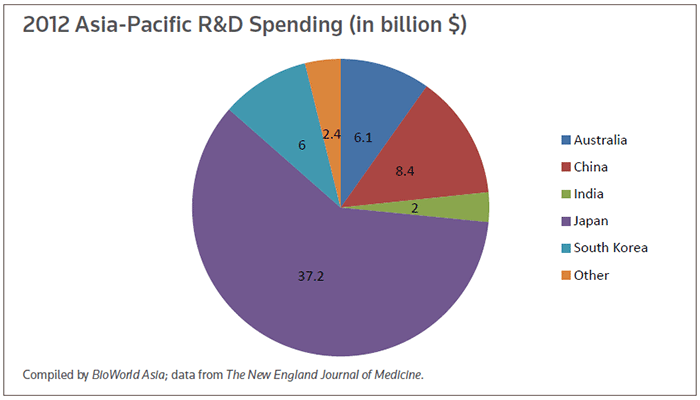
While the Asia-Oceania region, as a whole, continues to increase its investment in biomedical R&D, Japan remains the powerhouse when it comes to innovation, accounting for 60 percent of the region’s R&D spending.
Asia-Oceania countries together spent $62 billion on drug and medical device R&D in 2012 – up nearly 51 percent from the regional total of $41.1 billion in 2007, according to a study in the Jan. 2 issue of The New England Journal of Medicine (NEJM). About 30 percent of the regional investment in 2012 came from public sources such as government agencies, charitable organizations, and educational and research institutions. The other 70 percent was from industry.
As a result of its increased spending, the region was responsible for 23 percent of the global R&D investment in 2012, as compared with 16 percent in 2007. And it contributed to an overall 2.4 percent increase, or $6.3 billion, in global R&D spending – from an inflation-adjusted $262.1 billion in 2007 to $268.4 billion in 2012.
Meanwhile, R&D spending slipped in other areas over the six-year period, even though public sector funding increased in every region, the NEJM study found. Total R&D expenditures fell $12 billion in the U.S. to $119.3 billion in 2012. Europe’s R&D spending was down $1.8 billion to $81.8 billion, and Canada’s investment dropped $700 million to $5.3 billion.
The primary driver for funds shifting to the Asia-Oceania region was an overall drop in R&D productivity. “Large pharma in particular has been shutting down R&D sites in the U.S.,” Justin Chakma, first author on the paper and an analyst with Thomas McNerney and Partners, told BioWorld Asia. Those sites have been relocating to China for market access and government subsidies. To a lesser degree, that migration also has been directed to India for the same reasons. (See BioWorld Today, Jan. 6, 2014.)
A second contributing factor is increasing reliance on biotech companies for R&D activities by big pharma, Chakma said.
JAPAN DOMINATES
Despite industry migration to China and India, much of the increase in Asia’s growth can be attributed to Japan, which had the largest dollar increase in R&D spending from 2007 to 2012.
Home to several brand drugmakers, Japan invested a total of $37.2 billion in biomedical R&D in 2012. That’s $9 billion more than it spent in 2007, when it accounted for 69 percent of the regional R&D. The bulk of that funding came from industry, which spent $27.6 billion on R&D in 2012 – up 32 percent from $20.9 billion in 2007.
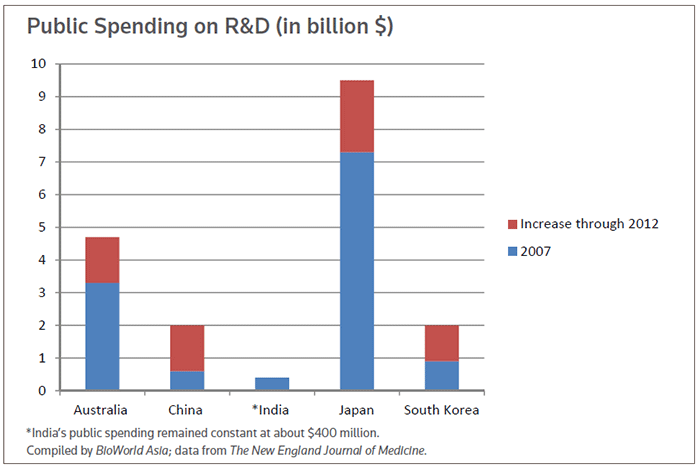
Contributing more than a quarter of Japan’s total R&D spending, the country’s public expenditures grew 30 percent, from $7.3 billion in 2007 to $9.5 billion six years later.
Because of its history of biomedical innovation, Japan dominates the other countries in the region when it comes to R&D. Its 2012 investment was 443 percent higher than China’s, more than 600 percent higher than either Australia’s or South Korea’s, and 1,860 percent higher than India’s.
However, increased spending in the other countries in the region is whittling away at Japan’s dominance. For instance, Japan accounted for more than three-quarters of the industry R&D in the region in 2007. In 2012, its contribution made up about 65 percent of the industry spend.
PROGRESS IN OTHER COUNTRIES
Quadrupling its R&D spending over the six-year period, China jumped past Australia and South Korea to become the second biggest player in the region, investing $8.4 billion in R&D in 2012, up from about $2 billion in 2007. Public spending in China accounted for about 24 percent of the total in 2012, with industry pitching in $6.3 billion. Six years earlier, public spending of about $600 million was 30 percent of the total; industry invested nearly $1.5 billion that year.

Australia, which was No. 2 in the region in 2007, was running neck-and-neck with South Korea for the No. 3 spot in 2012. Australia’s total R&D expenditure in 2012 was $6.1 billion, compared with $6 billion in South Korea. But given its 71 percent growth in total investment and reliance on industry contributions, South Korea may have since surpassed Australia, where R&D expenditures grew about 39 percent over the six-year period.
Unlike the other countries in the region, the majority of Australia’s R&D spending comes from public sources. In 2012, public spending of $4.7 billion accounted for about 77 percent of the R&D investment in the country. That was up from 2007, when public spending of $3.3 billion comprised 75 percent of the total $4.4 billion expenditure.
South Korea, on the other hand, is increasingly fueling its R&D with industry funding. In 2007, industry spending of $2.6 billion made up 74 percent of the country’s total R&D investment of $3.5 billion. But by 2012, the $4.9 billion in industry funding was nearly 82 percent of South Korea’s total.
Known more for its generics industry than innovation, India had only $2 billion in total R&D spending in 2012, up from $1.4 billion in 2007. With public funding remaining steady at $400 million, the increase came solely from industry.