
The mood going into the start of the 32nd annual J.P. Morgan Healthcare Conference in San Francisco will be decidedly upbeat. How could it not be? The industry is just coming off one of its best performances in decades with many of the blue chip public biotech companies recording triple digit percentage gains in their share values.
The statistics for 2013 don’t really do full justice to the incredible year that the biopharma sector has just enjoyed. However, they do speak volumes.
The BioWorld Blue Chip Index, for example, a price-weighted index that includes 21 of the top biotechnology companies by market cap, recorded a 76.25 percent increase in value for the year. The group outpaced the general markets by a wide margin with the performance of the Dow Jones Industrial average and Nasdaq Composite index closing out the year up 22 percent and 33 percent respectively. (See BioWorld Blue Chip Index. below.)
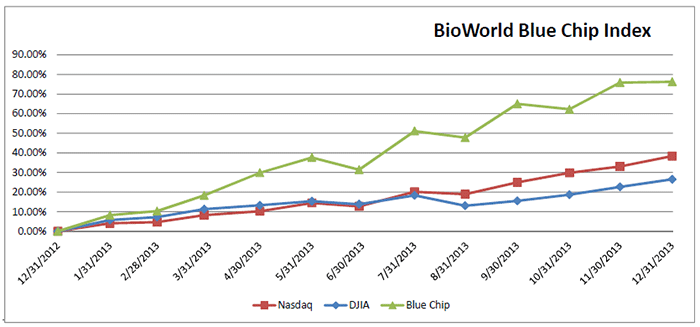
It was a great 12 months for companies in the group. Leading the pack was the 282 percent gain in the share value of antisense technology developer Isis Pharmaceuticals Inc. Another top performer is Jazz Pharmaceuticals plc, which saw its share value vault by more than 137 percent in 2013. The company capped off the year with its announcement that it is acquiring Gentium SpA for about $1 billion in cash. (See BioWorld Today, Dec. 23, 2013.)
Gilead Sciences Inc., with its market cap breaking through the $100 billion mark in October, doubled its share price closing up 104 percent. Investors have been impressed with the company’s performance as it continued to deliver strong earnings from its HIV franchise. (See BioWorld Today, Oct. 31, 2013.)
The BioWorld Growth Index, which includes companies with market caps in the range of $1 billion to $3 billion and a résumé that typically includes a strong drug pipeline and partnered products in late-stage clinical trials, performed even better than the Blue Chip Index with an annual growth of 108 percent. (See BioWorld Growth Index, below.)
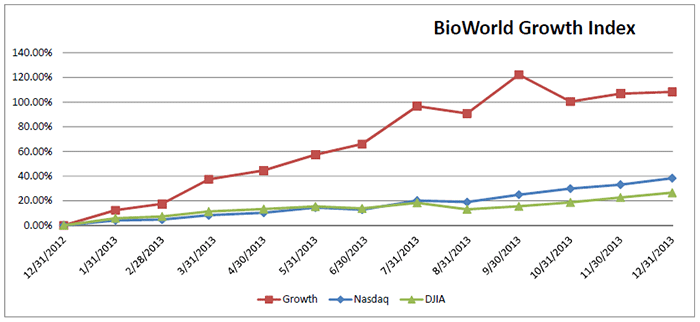
Acadia Pharmaceuticals Inc. topped the group with an exceptional 437 percent hike in its share price. Investors and analysts alike were impressed by the pace of progress of the company’s leading products led by pimavanserin for Parkinson’s disease psychosis (PDP). (See BioWorld Today, April 12, 2013.)
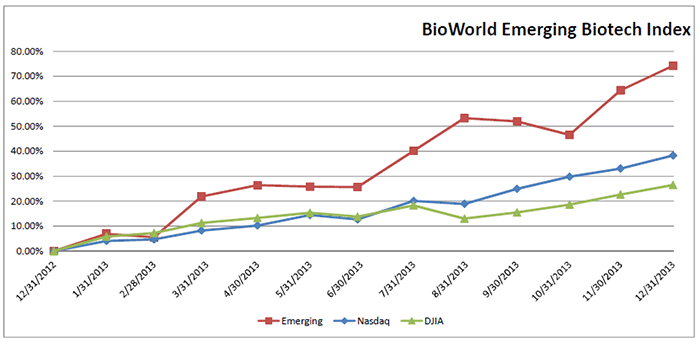
The BioWorld Emerging Biotech Index tracks small-cap companies; it is a diverse group, with some companies following a business model that embraces innovation as well as in-licensing products that are market-ready. Many have lead products in early or mid-stage development.
Although wild swings in the stock prices of companies in the group are not uncommon, the Index performed extremely well growing a significant 74 percent. (See BioWorld Emerging Company Index, below.)
BIGGEST GAINER
The biggest gainer was Anacor Pharmaceuticals Inc., of Palo Alto, Calif., whose shares increased a whopping 222 percent by year-end. The company is developing small-molecule therapeutics derived from a boron chemistry platform. Its most advanced product candidate is tavaborole – a topical antifungal for the treatment of onychomycosis. A new drug application for the product was accepted for filing by the FDA with a PDUFA goal date of July 29, 2014. (See BioWorld Today, Sept. 9, 2013.)
On a wider scale, the BioWorld Stock Report, which tracks the stock prices of the 259 biotechnology companies developing therapeutics listed on U.S. exchanges, reinforces the incredible year for these firms. Collectively their share prices closed up an average of 54 percent. Among the group of companies, 68 percent recorded positive gains in their share price.
With public biopharmaceutical companies seeing their share prices go on a tear, coupled with a favorable financial climate, it was not surprising that they were able to take advantage and complete public and other financings. According to BioWorld Insight analysis approximately $18.2 billion was raised from these transactions last year, a 28 percent increase over the $14.25 billion generated in 2012.
Public offerings, including the massive $3 billion from initial public offerings, accounted for almost $12.3 billion of the 2013 total, up 44 percent from $8.5 billion in 2012.
Interestingly, excluding IPOs, the 130 deals involving follow-on financings averaged about $72 million per transaction showing that companies did not “shoot for fences” in their fundraising aspirations, but generated only what they needed to drive their operations near-term.
The largest deal involved South San Francisco-based Onyx Pharmaceuticals Inc., prior to its acquisition by Amgen Inc. for a purchase price of $10.4 billion. In January 2013, the company raised $358.6 million.
Not surprisingly the final total of money raised by biotechs in 2013 was up 22 percent over the $18.1 billion raised in 2012.
Of the $22.1 raised by biotechs globally, 14 percent of the total was contributed by IPOs thanks to a wide open window, which saw 38 companies focused on developing therapeutics successfully complete their initial public offerings (IPO) on the U.S. markets in the year and collectively raise approximately $3 billion in the process. The total certainly swamped the 11 U.S. IPOs completed in 2012 and put an exclamation point on the favorable capital markets, which helped to ensure that the window stayed firmly open.
Also, the newly minted public companies provided their investors with strong post-IPO performances. As the market closed its books on 2013, the share prices of 37 IPO-companies (Omthera Pharmaceuticals Inc. also went public but was acquired by Astrazeneca plc) were up by an average of 56 percent, and only eight companies were recording negative performances from their initial IPO price.
“IPO activity for venture-backed companies continues to improve,” noted John Taylor, head of research for the National Venture Capital Association, in a statement about the IPO activity in general. “The biotech sector is especially notable because it made up over half of the 2013 IPOs, which is more than the previous five years combined. The on-ramp provision of the JOBS Act is likely a significant contributor to this shift and the venture industry overall remains hopeful that IPO and M&A levels will further strengthen as the bulging pipeline of mature companies awaits favorable market conditions.”
CAN BIOTECH REPEAT?
In next week’s issue we will be providing the industry’s “temperature” after absorbing all that we see and hear at the J.P. Morgan Healthcare Conference. It is likely to be “red hot” again for 2014 and going into the meeting analysts seem to agree.
Leerink Partners (formerly Leerink Swann), for example, believes health care will outperform the broader market again with 2H14 stronger than 1H14.
“While the unsuccessful launch of the federal healthcare.gov website has raised uncertainty near term, we see a biopharma industry with attractive new products and late-stage drug candidates, a powerful multi-year investable theme in immuno-oncology, and innovation across the industry. We believe the health care sector presents an attractive combination of proprietary products and durable demand, and remains under-owned given its share of the US economy,” the report said.
Wells Fargo analyst Brian Abrahams and colleagues are of a similar mind saying that, “many of the attractive fundamentals that led to recent biotech appreciation, including high intrinsic growth, considerable pipeline depth, and reduced development risk, should remain intact in 2014.”
For our part, we see our indices providing a repeat performance this year. Also, watch out for marquee M&A’s. Big pharma has plenty of cash, as do many major biotech companies. Going forward the health care environment still remains an “unknown” and so it would make sense for companies to beef up their product portfolios as insurance against an uncertain environment of slowing growth in health care costs as the Affordable Healthcare Act begins to take effect.
Maybe the first major acquisition will be announced (or hinted at) this week. Certainly we will be paying close attention.