
BB&T Contributing Editor
JERUSALEM – Israel showcased its med-tech and biotech companies, technologies and industry support organizations to an audience of about 3,000 people, of which 500 were from 35 countries, with 160 attendees from the U.S., 70 from France and 30 from both the U.K. and Korea. The 110 Israeli exhibitors included the country’s 24 technological incubators. The network of incubators was created by the technology transfer departments of all the major Israeli universities, research institutes and hospitals. They enable entrepreneurs with innovative concepts to translate their ideas into commercial products and to establish their own company. To date, 13 incubators have been privatized and transformed from non-profit organizations into for-profit companies. About 60% of new projects in these incubators are in the biomedical sector.
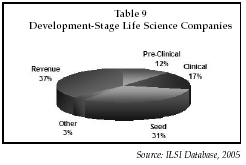
The Israel Life Science Industry (ILSI) organization was formed in 2005 to develop policies and activities that promote Israel’s life science industry domestically and abroad. Israel is home to a young, growing and energetic life science industry that boasts 630 companies of which 77% were founded during the past decade. The life science industry is heavily biased toward the medical device field, which represents 51% of the companies. There are 250 service providers for the life science sector, including venture capital firms, clinical research organization, patent and legal organizations. Of Israel’s development-stage life science companies, 37% are revenue-generating and 31% are at the seed stage (see Table 9).
Source: ILSI Database, 2005
Joint programs with U.S., European firms
The BIRD (Binational Industrial R&D) Foundation is a key catalyst in fostering collaborations between Israeli and U..S. companies by funding 50% of each company’s R&D expenses on a risk-sharing basis. Repayments are due only if commercial revenues are generated as a direct result of the project.
Matimop, known as the Israeli Industry Center for R&D, also serves as the national center for generating joint industrial R&D projects between Israeli and foreign enterprises through multinational cooperative programs that are supported by the Office of the Chief Scientist of the Ministry of Industry, Trade and Labor. Matimop is the Israeli liaison for the European EUREKA program, which promotes technological collaboration among European enterprises.
Israel is flourishing as a source of medical innovation. This reality was best captured in a presentation by Scott Gottlieb, deputy commissioner for medical and scientific affairs at the FDA, who noted that Israel is the world’s second-leading source of biomedical innovations after the state of California.
Presentations and exhibits by Israeli companies represented a cross-section of products and technologies in virtually all biomedical fields.
Drug-delivery technologies
E-Pill Pharma (Caesarea) is developing an electrical stimulating pill for the oral delivery of macromolecules. It is based on the principle that electrical stimulation of the gastrointestinal tract changes the permeation of the tissue and allows molecules to pass through it and into the bloodstream.
The technology and product have been tested in various animal models using different drug and marker molecules. Human trials are ongoing.
SteadyMed (Ramat Gan) has developed the PatchPump, a disposable device that employs a novel battery cell that gradually expands in a stable manner under electronic control. The cell exerts pressure against a drug in a reservoir or vial to provide controlled drug release. A needle at the bottom of the pump is used for subcutaneous drug delivery.
A range of PatchPump models can be produced to meet the specific requirement of each drug. A feasibility study of the pump concept has been completed and a working model has been made. The pump weighs only 2 grams empty and can be worn anywhere on the body. The company is seeking a strategic partner to continue its development and expects the initial application of the PatchPump to be for pain control.
NiliMedix (Haifa) develops durable (long-term use) and disposable insulin pumps. The pumps are based on discrete pressure compensation technology using pressure and temperature sensors that are monitored by microprocessors.
The use of MEMS and microinjection technologies assures high repeatability and accuracy, along with small dimensions and low production costs. The durable pumps are expected to be launched later this year and the disposable pumps in 2007.
NanoCyte (Zemach) is developing an immediate active release topical drug delivery platform technology that is suitable for peptides and proteins. It utilizes an extract from aquatic invertebrates that yields microcapsules containing coiled microscopic nanotubes.
Upon activation, a pressure of 200 atmospheres develops within the microcapsules, which results in unfolding of the nanotubes, penetration of the skin and drug delivery. Pre-clinical and human safety testing have been completed and a product application is being developed with an undisclosed U.S. partner.
NanoPass Technologies (Haifa) has developed the MicronJet, which uses its MicroPyramid technology for the shallow intradermal delivery of vaccines and large molecules. Intradermal delivery was shown by others in large clinical trials to provide dose sparing of vaccines of up to 400%, compared with conventional delivery, due to an enhanced immune response.
The MicronJet device is made from silicon wafers. It has micro-needles that are sufficiently sharp and minute to allow penetration of shallow skin in a painless manner. NanoPass is collaborating with GlaxoSmithKline (London) in the development of a vaccine using the MicronJet device.
The company also is developing the NanoEnhancer device, a microprojection stimulator for improving the absorbance of cosmetic creams and dermal fillers. It uses vibrating silicon microprojections and is designed for the anti-aging market.
TransPharma (Yehud) has developed the ViaDerm system for the transdermal delivery of peptides and proteins. The technology is based on very precise cell ablation using radiofrequency energy that creates microchannels across the stratum corneum and into the upper dermis.
The safety and efficacy of the ViaDerm delivery system were demonstrated in a series of clinical studies which showed that therapeutic levels of the active materials were delivered with bioavailability of up to 60%. Drug profiles in the blood following transdermal delivery resembled those of subcutaneous injection.
Baby’s Breath (Or Akiva) is currently seeking 510(k) approval for BabyAir, a hood that is used to deliver inhaled medications to infants, whether awake or asleep, without physical contact. Clinical trials have shown that it is more effective than traditional masks, allowing infants to recover faster because they receive and absorb the optimum dose of medication. It is the first of several inhalation devices that the company plans to introduce to the market for patients with respiratory problems.
Orthopedics
PreSRV (Yokneam) is part of the Naiot Business Incubator owned by Ofer Hi-Tech (Tel Aviv). Its Atlas Femoral Head Preserving Prosthesis is a hip replacement device that changes the method of treatment for femoral neck fractures.
It is designed to preserve the natural cartilage and femoral head and their fit with an undamaged acetabulum, thereby achieving reduced pain, improved mobility and extending joint longevity. Animal studies have been completed and a human clinical trial is planned to begin soon.
OrthoMediTec (Migdal HaEmek) was established in 2005 and specializes in orthopedic trauma devices. Its first product is WaisFix, a proximal femoral fracture fixation device inserted through a minimally invasive procedure. The WaisFix combines an internal cage and an external non-rigid fixator.
The device was ergonomically designed so that patients can sit as well as lie in a supine position. Clinical trials will be conducted at the Carmel Medical Center in Haifa.
OrthoMechanics (Misgav) has developed a family of orthopedic implants that enables faster and simpler therapies with decreased side effects and reduced costs. Its AnchorShaft spatial hip screw for hip fracture fixation forms a symmetrical anti-rotation support system.
It can attach to any femoral stem piece to provide improved fixation inside the femoral head. The AnchorShaft nail for internal fracture fixation employs an innovative mechanical design that makes the most of the limited space constraints inside the nail. It provides internal locking and unlocking in both long bone and femoral neck fixations.
Expandis (Hof Hacarmel) has developed a minimally invasive vertebral fracture reconstruction and fixation device that is in clinical trials. The technology is applicable to other fracture repair applications as well.
Cardiovascular products
BioControl Medical (Yehud) is developing the CardioFit vagal stimulation system for use in patients with acute ischemia or previous myocardial infarction. It delivers heartbeat-synchronous stimulation that is adjusted to the patient’s heart rate using an embedded microprocessor.
A tri-polar nerve stimulation electrode allows selective stimulation of small-diameter fibers. Successful procedures were performed on the first four patients with the implanted CardioFit system. Preliminary findings suggest that chronic electrical stimulation of the vagus nerve in patients with advanced heart failure is safe and may be a useful treatment for chronic heart failure.
Earlier this year, American Medical Systems (Minnetonka, Minnesota) acquired an exclusive license for BioControl’s implantable electrical stimulation technology for use in urology, gynecology and other health applications. The initial application of this technology will be for the treatment of urge incontinence and interstitial cystitis.
F.D. Cardio (Tel Aviv) has developed a novel catheter technology for advancing and maneuvering catheters and stent delivery systems from their distal therapeutic end, for use in interventional cardiology, neurology and other medical interventional procedures. Currently, pushing force is applied by the physician to the rear end of the catheter from outside the patient’s body.
Using the company’s Front Drive (F.D.) catheters, the physician can apply force to the distal end to advance and steer the catheter to reach and treat blood vessel lesions and sites that are currently unreachable. In addition, the front drive mechanism improves the fine positioning and torque of the catheter and thereby enables the physician to more easily place the catheter. F.D. Cardio is in its final stages of development and optimization prior to initiating clinical trials.
Levram Medical Systems (Haifa) is developing an implantable Physiological Cardiac Assist Device (PCAD) for cardiac rehabilitation of diastolic or both diastolic and systolic heart failure via a minimally interventional procedure. The device will support blood circulation and simultaneously enhance cardiac residual functioning as an alternative to current mechanical assist devices.
It is connected to the left ventricle by a single tube and features a bidirectional diaphragmatic pump equivalent to the replacement of 20% to 30% of heart muscle. It is controlled by the cardiac muscle and works with it a synchronized manner, leading to muscular rehabilitation with a potential for long-term cardiac recovery.
Levram aims to position its PCAD as a cost-effective treatment for a large segment of Class III and early Class IV heart failure patients for whom present treatments are ineffective.
Lavi Cardiovascular (Misgav) has developed a non-invasive and cost-effective technology for early detection of endothelial dysfunction, an underlying factor in the progression of atherosclerosis, by detecting pulse signals in two consecutive points on the artery. The device detects changes in the endothelium and presents easily understandable results to detect and monitor cardiovascular disease. The device also measures carotid endothelial function for pre-symptomatic stroke risk.
Early detection of endothelial dysfunction enables physicians to advise at-risk, yet symptomatic, patients to make the necessary lifestyle changes required to slow down or halt the progression to more serious, life-threatening diseases, primarily coronary artery disease and ischemic stroke. A prototype of the device has been clinically tested and showed positive results.
Ariomedica (Tel Aviv) is developing a minimally invasive atherectomy device, designated ARIO (Apparatus for Removing Intra-luminal Occlusions), for the excision of atherosclerotic plaque from peripheral arteries. Improving peripheral blood flow will enable limb salvage and improved quality of life and longevity.
The ARIO device is comprised of a disposable catheter carrying a cutting head that is advanced over the wire towards the occlusion and a control console. The unique features of the product are the blade design and mechanics that allow for the safe and effective removal of plaque from occluded arteries, and the aspiration mechanism for immediate removal of debris.
NeuroSonix (Or Yehuda) focuses on intra-procedural embolism, one of the major complications of cardiac surgery as well as catheter-based procedures. It uses acoustic energy to non-invasively control the flow of embolic material flowing inside the arteries, by diverting it away from vessels supplying blood to the brain, thus avoiding ischemic injury to brain tissue.
The technology is based on the acoustic radiation force exerted by traveling acoustic waves on solid particles as well as gaseous bubbles.
The company’s first device, EmBlocker, is in clinical trials. It is designed to provide cerebral embolic protection during open-chest cardiac surgical procedures such as coronary bypass, heart repair or replacement.
The second device to be developed is a protection collar for providing cerebral embolic protection during minimally invasive cardiac surgery and cath lab procedures.
Y Med (Zoran, Israel/San Diego) was founded in April 2004 to develop and market intravascular side branch protection technology for cardiac applications and a focused forced dilatation balloon catheter for peripheral applications.
The catheter-based technology is the combination of an integrated fixed-wire balloon with monorail deliverability. Its sidekick device provides side branch protection and features an ultra-low profile (5 Fr-compatible) with a highly torqueable system enabling an operator to validate stent orientation during deployment. Its VascuTrak balloon dilatation system also features an ultra-low profile (4 Fr-compatible) and is highly torqueable for improved deliverability.
Urological products
Endogun Medical Systems (Kiryat Shemona) is developing the EndoFast family of devices used to attach or reinforce tissues by fastening and supporting devices. EndoFast connects tissues and the body’s internal organs with ribbons or other implants, using small anchors that are inserted by the device into the tissue.
The company has produced devices for use in minimally invasive procedures in urology, urogynecology and additional surgical specialties, and has applied for FDA marketing approval for its EndoFast Reliant system for urogynecological treatments.
Endogun is embarking on European clinical trials towards entry into the European market during 2007.
MedDynamix (Zichron Ya’akov) markets the Urinflo line of products, which incorporate its patented dynamic flow-sensing technology, which enables automatic, real-time fluid monitoring. Its Urinflo 2000 and 3000 systems provide continuous urine monitoring and include a potable digital display. The Urinflo 5000 series automatically integrates continuous urine data with patient monitors and hospital information systems.
The company’s Urinflo automated urine monitors are sold in the U.S., Europe, Canada, China and Israel. Its next-generation product line will convert fluid management into fluid balance management and predictive care.
FlexiProbe (Ramat Gan) has developed a flexible intravaginal probe for the ambulatory treatment of female urinary incontinence. It consists of a probe that is made from silicone and shaped so as to provide efficient and safe electrical stimulation for strengthening of the pelvic floor muscles.
Women can use the FlexiProbe at home without the supervision of a medical practitioner.