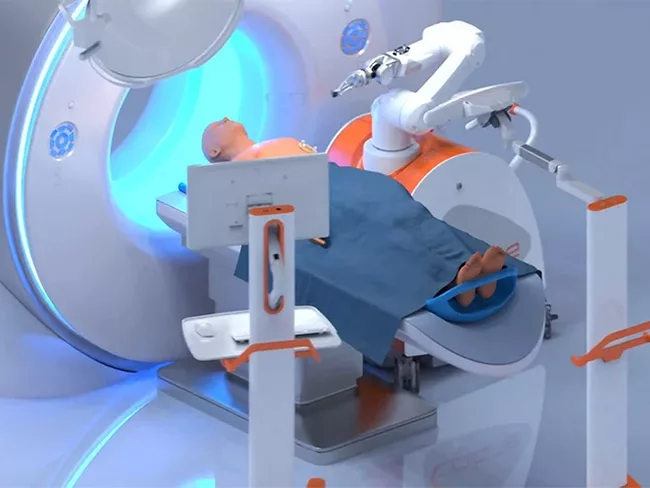
Quantum Surgical SAS has obtained an extension to the FDA authorization covering its Epione robot, which can now treat abdominal cancers. “This decision now allows physicians to treat all abdominal tumors at an early stage and will ramp implementation of our Epione robotics solution in the U.S.,” said Bertin Nahum, CEO and co-founder of Quantum Surgical. Marketed in Europe and the U.S., the Epione robot has already been used to treat more than 150 patients with liver or kidney cancer.
Veracyte Inc. reported that its Prosigna breast cancer assay significantly reduced the use of chemotherapy in patients with high-risk, early-stage disease at the European Society for Medical Oncology 2023 in Berlin this week. The findings came from the EMIT study, a prospective, multi-year, population-based study in women in Norway that is assessing the impact of the Prosigna test on treatment decisions and outcomes.
A new urine test from Convergent Genomics Inc. correctly predicts bladder cancer as early as 12 years before clinical symptoms occur, new data presented at the 2023 American Urological Association annual meeting shows. The Uroamp test, which can be administered at home and in point-of-care settings, could increase survival rates and help to reduce health care costs.
The U.S. Preventive Services Task Force (USPSTF) is proposing to lower the age of onset of regular breast cancer screening to 40 years, a massive jump of 10 years over the current recommended age of 50 years. While this is just a draft proposal, analysts who track the medical device industry say that medical imaging manufacturers, such as Marlborough, Mass.-based Hologic Inc., could see a significant uptick in demand for their systems, a much-needed boost as the drop in demand incurred by the COVID-19 pandemic comes to an end.
China’s NMPA gave the nod to Roche Diagnostics (Shanghai) Ltd.’s anti-preferentially expressed antigen in melanoma (PRAME) (EPR 20330) that could help to speed up melanoma diagnosis and improve survival rates.
China’s NMPA gave the nod to Roche Diagnostics (Shanghai) Ltd.’s anti-preferentially expressed antigen in melanoma (PRAME) (EPR 20330) that could help to speed up melanoma diagnosis and improve survival rates.
Function Oncology Inc. emerged from stealth on April 12 with the announcement of a $28 million series A financing that will continue support development of its CRISPR-enabled platform to profile cancer in patient-specific detail. The platform goes beyond next-generation sequencing to measure gene function, potentially allowing identification of new therapeutic targets and better matching of available therapies to vulnerabilities in an individual’s tumors.
Okwin Inc. is leading a consortium of hospitals and pathology labs from across France as part of a €33 million (US$36 million) project to develop and deploy new digital pathology artificial intelligence (AI) tools to improve cancer care. The project, called Portrait, is backed by the French government, and the hope is that by producing more efficient and accessible diagnostic tools, clinicians will be able to better tailor treatments to individual patients at an earlier stage of the disease.
The Biden administration has released the National Cancer Plan, a framework that expands and builds on the Cancer Moonshot program which came into being in 2016. The National Cancer Plan includes a strategies section that calls for development of new methods for detecting cancer and new imaging technologies for early cancer detection, just two provisions that would seem to portend good times ahead for companies that manufacture these products.