With yet another deadline looming for passage of spending bills for the U.S. federal budget, Congress has drafted an omnibus spending bill that would extend coverage of Medicare telehealth services. The problem with the legislation in the eyes of many stakeholders is that the Verifying Accurate Leading-edge IVCT Development (VALID) Act is not part of the package that must be passed by Dec. 23, an omission that leaves lab-developed tests (LDTs) in a nether world of regulatory ambiguity.
Election day has come and gone in the U.S., but the question of which party will control Congress remains unanswered, signaling that the country is as divided as ever politically and ideologically. While Democrats and Republicans may agree on problems in the life sciences sector, they often disagree on how to address them.
The U.S. Government Accountability Office (GAO) recently published a report on the pandemic-driven expansion of telehealth for Medicare beneficiaries, and pointed to some privacy and security risks of which patients may be unaware. However, GAO also noted that the CMS does not yet have a good handle on the rate of telehealth fraud and has not yet collected reliable data on telehealth outcomes, two gaps that will have to be filled if Congress is to comfortably vote to make permanent some of these pandemic-driven telehealth policies.
A committee of the U.S. House of Representatives is moving forward with a bill that would extend Medicare telehealth provisions for two years after the end of the COVID-19 public health emergency, but the legislation lacks features to deal with fraud and abuse.
The U.S. Department of Justice (DOJ) reported an indictment of a physician in Paducah, Kentucky for causing the filing of false claims to the Medicare program with the help of telehealth. The physician is liable for only $560,000 in penalties, but the announcement again underscores the department’s crackdown on telehealth fraud, regardless of the dollar value of the fraud.
In the post COVID world, digital transformation is at the forefront of every company’s agenda, but which innovations can fuel the next era of health care? At the ongoing Biomed Israel conference in Tel Aviv, Anat Naschitz founder and CEO of 9xchange and co-founder of Orbimed Israel, lead a digital health track exploring the technologies aiming to reconstruct the future of health care.
The spike in U.S.-based telehealth visits during the COVID-19 pandemic was greeted with cheers among advocates of the technology, but the Government Accountability Office (GAO) has advised the Centers for Medicare & Medicaid Services (CMS) to take a closer look at the benefits of telehealth for Medicaid beneficiaries.
The COVID-19 pandemic shone a bright light on the need for and utility of telehealth, which in turn prompted the U.S. Centers for Medicare & Medicaid Services (CMS) to temporarily expand telehealth coverage. Some of those coverage policies are set to expire when the public health emergency ends, and a group of stakeholders, including the American College of Cardiology, are urging Congress to pass legislation that would make some of these benefits permanent, a potential boon for many telehealth entities.
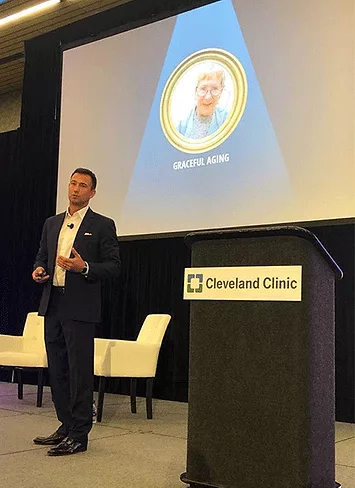
CLEVELAND – Monday featured a big announcement during the 2019 Medical Innovation Summit, with the Cleveland Clinic and American Well revealing that they are partnering to create a joint venture (JV) focused on telehealth.
CLEVELAND – Monday featured a big announcement during the 2019 Medical Innovation Summit, with the Cleveland Clinic and American Well revealing that they are partnering to create a joint venture (JV) focused on telehealth. The venture, dubbed The Clinic for now, was conceived "in order to achieve our joint vision and our ambitions in how to revise the delivery of care and to be at the forefront of it," said Semih Sen, chief business development officer, Cleveland Clinic, as part of a keynote delivered by Roy Schoenberg, president and CEO of Boston-based American Well.