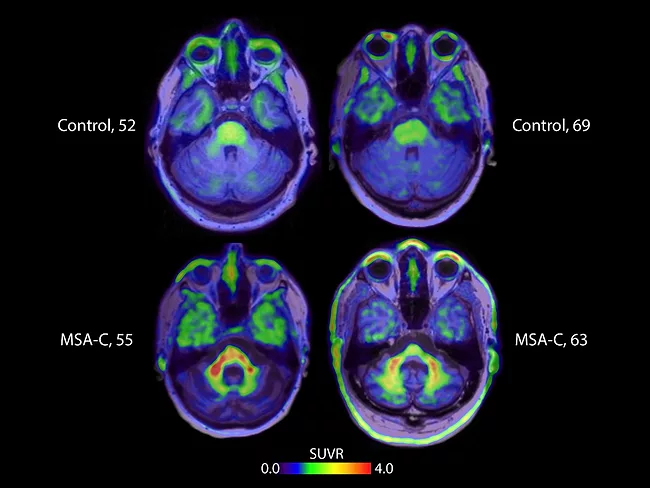
Researchers from Massachusetts General Hospital recently detailed the discovery of [11C]SY-08, a new PET radiotracer that detects aggregated α-synuclein (α-Syn) fibrils in individuals with neurological disorders such as Parkinson’s disease, multiple system atrophy and dementia with Lewy bodies.
“I am not a fortune teller, nor am I a gambler. I will make no bets,” Lorraine Kalia told the audience at the 2023 International Congress of Parkinson’s Disease and Movement Disorders. “But I am optimistic.” At the meeting, which is being held in Copenhagen this week, Kalia, who is a scientist at Toronto Western Hospital’s Krembil Brain Institute and at the University of Toronto’s Tanz Centre for Research in Neurodegenerative Diseases, was giving an overview of “Emerging targets in the clinic” in a plenary session on “Therapeutic strategies for the future.”
AC Immune SA has patented 4h-imidazo[1,5-b]pyrazole derivatives and labeled compounds targeting α-synuclein (SNCA). They are reported to be useful for diagnosis of multiple system atrophy, Parkinson’s dementia, Lewy body dementia, Alzheimer’s and Parkinson’s disease, among others.
A biomarker found in spinal fluid can detect Parkinson’s disease in individuals with the disease and may flag those at risk years before symptoms develop, a study published in The Lancet Neurology found. The breakthrough, which could enable diagnosis of the disease for the first time in patients who do not exhibit a movement disorder, was achieved by an international coalition of scientists led by the Michael J. Fox Foundation (MJFF) as part of its landmark clinical study, the Parkinson’s Progression Markers Initiative (PPMI).
Seelos Therapeutics Inc. has announced in vivo data demonstrating that a single dose of SLS-004 downregulated the production of α-synuclein in an established α-synuclein overexpressing animal model of Parkinson's disease.
Alterity Therapeutics Ltd. has begun phase II trials with its lead candidate, ATH-434, in multiple system atrophy, a rare and highly debilitating Parkinsonian disorder.
Abbvie Inc. is stepping away from a 2016 deal with Bioarctic AB to develop alpha-synuclein antibodies for treating Parkinson’s disease, originally valued at up to $775 million. Bioarctic said it plans to stay the course without its big-pocketed partner. Bioarctic’s stock (Stockholm:BIOA-B) fell 14.6% to SEK90 (US$9.40) on April 20.
At the AD/PD 2022 international conference on Alzheimer’s and Parkinson’s Diseases, AC Immune SA presented images showing its positron emission tomography (PET) tracer detecting pathological alpha-synuclein (a-syn) in human subjects’ brains. The abnormal accumulation of a-syn, a natively unfolded and soluble presynaptic protein, is a neuropathological feature of neurodegenerative disorders.
Several pharma companies think that targeting a rogue protein known as alpha-synuclein could be the key to halting or reversing neurodegeneration in Parkinson’s disease – but has the industry learned from a string of failures in Alzheimer’s? In the space of a few weeks, Novartis AG and Sanofi AS have signed major deals for molecules targeting misfolded alpha-synuclein, the rogue protein thought to be the root cause of Parkinson’s disease.