Researchers from Peking University and Bristar Immunotech Ltd. recently presented the development of a synthetic T-cell receptor and antigen receptor-T (STAR-T) cell therapy targeting leukocyte immunoglobulin-like receptor B4 (LILRB4) for acute myeloid leukemia (AML).
T-Curx GmbH has obtained clinical trial approval from the Swiss agency Swissmedic for the company’s nonviral lead CAR T program, TCX-001. The first-in-human phase I study will open in Switzerland, and a submission to the EMA will seek to expand the trial to sites in Germany. The study will enroll adults with relapsed or refractory acute myeloid leukemia (AML) and chronic lymphocytic leukemia (CLL), including patients not eligible for stem cell transplantation.
Amphista Therapeutics Ltd. has obtained IND clearance from the FDA for AMX-883, an orally bioavailable degrader of BRD9, for the treatment of acute myeloid leukemia (AML). A phase I trial in patients with relapsed or refractory AML and high-risk myelodysplastic syndrome is expected to begin in the second half of this year.
DNA methylation, catalyzed by DNMT enzymes, is a central epigenetic mechanism frequently disrupted in cancer, where aberrant hypermethylation contributes to tumor suppressor gene silencing. Researchers from Nankai University reported the discovery and preclinical characterization of [I], a selective DNMT1 degrader in models of acute myeloid leukemia (AML).
The MTHFD enzyme family is central to one-carbon metabolism, with MTHFD2 showing cancer-selective overexpression linked to poor prognosis. Emerging data also identify MTHFD1 as a therapeutic vulnerability in select tumors, supporting MTHFD-targeted drug development.
More effective treatments are needed for patients with myelodysplastic syndrome (MDS), a heterogeneous group of myeloid disorders that frequently progress to acute myeloid leukemia (AML). In a recent publication, Debiopharm SA and The Ohio State University demonstrate that MDS cells express CD37 and that both AML and MDS cells exhibit efficient internalization of this receptor. Debio-1562M, under development at Debiopharm, is a next-generation antibody-drug conjugate (ADC) targeting CD37.
Delta-Fly Pharma Inc. is pressing ahead with discussions with the FDA for its lead acute myeloid leukemia (AML) candidate, radgocitabine (DFP-10917), despite a phase III miss on its primary endpoint, instead leaning on earlier-stage efficacy signals and emerging combination data to support a potential path toward conditional approval.
A new study tracking the genomic evolution of chronic myeloproliferative neoplasms has shown that progression to myelofibrosis or acute myeloid leukemia is encoded in mutations that occur years before the transformation is clinically evident.
Delta-Fly Pharma Inc. is pressing ahead with discussions with the FDA for its lead acute myeloid leukemia (AML) candidate, radgocitabine (DFP-10917), despite a phase III miss on its primary endpoint, instead leaning on earlier-stage efficacy signals and emerging combination data to support a potential path toward conditional approval.

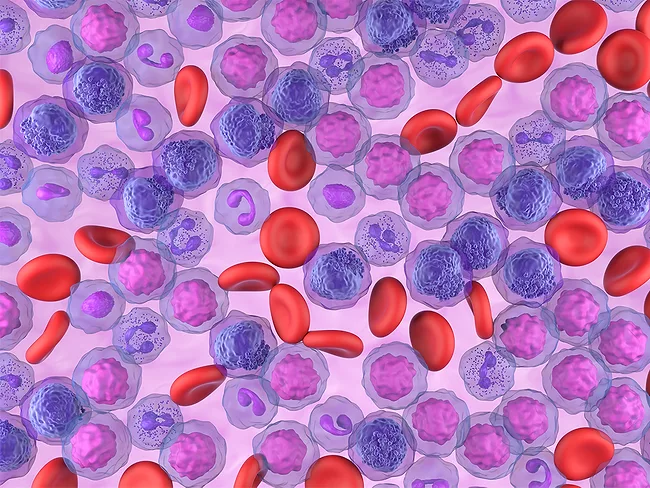


.webp?height=488&t=1670008838&width=650 "Acute myeloid leukemia")


