Medtronic plc acted on the increase in M&A and expansion of its investment ecosystem touted at the J.P. Morgan Healthcare Conference earlier this month with a $90 million infusion into Brisbane, Australia-based Anteris Technologies Global Corp. The investment had been contingent on a public offering of stock by Anteris, which it completed on Jan. 22. Together, the new funds for the biomimetic heart valve company totaled $320 million.
Abbott Laboratories reported fourth quarter sales below expectations before the market opened on Jan. 22, sending the stock down nearly 12% from the prior day's closing. The biggest hits came from contraction in the nutrition group along with continued disruption in the diagnostics unit from volume-based procurement in China. Medical devices suffered from market share loss in electrophysiology and slower than expected uptake of continuous glucose monitors. The pharma group performed as anticipated, posting 7% growth.
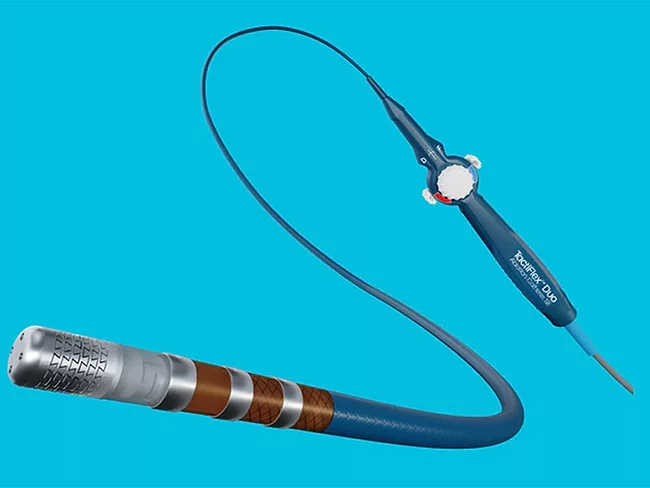
Abbott Laboratories received CE mark in Europe for the Tactiflex Duo ablation catheter to treat patients with atrial fibrillation. The first commercial cases using Tactiflex Duo, a dual energy device, were completed in the EU this week.
Boston Scientific Corp. plans to acquire Valencia Technologies Corp. in the first half of 2026 in a move that will expand its urology portfolio. Valencia makes the Ecoin system, an implantable tibial nerve stimulator (ITNS) designed to treat urge urinary incontinence (UUI). The companies did not disclose terms of the deal, which is not expected to have a material impact on 2026 earnings per share.
Investors poured a further $13 million into Vicentra BV for Kaleido, its insulin patch pump system, taking the total raised in the company’s series D financing round to $98 million. The funds come amid significant changes across diabetes technology, particularly the acceleration of patch pumps. Kaleido is one of the smallest, lightest, and most precise insulin patch pumps available.
Over the last year, diabetes technology saw significant changes, including the acceleration of patch pumps, ever-smaller continuous glucose monitors (CGM), implanted CGMs and increased interest in devices that measure additional chemicals in blood without needles.
In 2025, the momentum behind robotic-assisted surgical systems continued to accelerate on the back of increasing demand for minimally invasive procedures. In many parts of the world, these technologies are reshaping surgical procedures by improving precision and efficiency through high resolution imaging, AI and refined instrument control. This is resulting in fewer complications, faster recovery and improved patient outcomes.
The U.S. FDA recently cleared Medtronic plc’s Hugo robotic-assisted surgery system and CMR Surgical Ltd.’s Versius Plus system, adding new options to the U.S. market to meet rising demand for robotic procedures. While Intuitive Surgical Inc. currently dominates the soft tissue surgical robotics space, these new entrants will provide hospitals and health care systems with greater choices when it comes to purchasing systems and expanding systems.
Intuitive Surgical Inc. strengthened its position as the market leader in robotic-assisted surgery in 2025 on the back of increasing demand for minimally invasive procedures. Intuitive’s da Vinci system is seeing robust growth in procedures and installations, fueling increased revenues.
Two years after the U.S. FDA approved the first pulsed field ablation system, Abbott Laboratories finally got the regulatory nod for its Volt PFA system. Abbott follows Medtronic plc, Boston Scientific Corp., Johnson & Johnson and Kardium Inc. in receiving approval for its approval for use of its PFA device to treat atrial fibrillation.