Evolveimmune Therapeutics Inc. has announced a translational research collaboration with Memorial Sloan Kettering Cancer Center (MSK) to investigate the expression of a new tumor target – UL binding protein 2 (ULBP2) – in muscle-invasive bladder cancer.
Memorial Hospital for Cancer and Allied Diseases and Memorial Sloan Kettering Cancer Center have jointly developed new nonsteroid selective androgen receptor modulators (SARMs) and radiolabeled compounds reported to be useful for the diagnosis and treatment of cancer.
Researchers from Memorial Sloan Kettering Cancer Center and affiliated organizations revealed findings from the preclinical evaluation of 1H5, a novel monoclonal antibody (mAb) candidate that inhibits the NOTCH signaling pathway and is being developed for the treatment of high-grade gliomas (HGGs).
DAN-222 is a polymeric nanoparticle covalently conjugated with the topoisomerase I inhibitor camptothecin, which has previously demonstrated promising clinical activity in heavily pretreated patients with breast cancer (NCT05261269).
Six main cell types form glioblastomas, the most aggressive brain cancer due to its high rate of recurrence. Of these six, quiescent cancer stem cells are responsible for resistance to therapy and the reappearance of the tumor, according to a study that identified the six groups and highlighted the importance of these stem cells for the design of more effective therapies.
Six main cell types form glioblastomas (GBM), the most aggressive brain cancer due to its high rate of recurrence. Of these six, quiescent cancer stem cells are responsible for resistance to therapy and the reappearance of the tumor, according to a study that identified the six groups and highlighted the importance of these stem cells for the design of more effective therapies.
Memorial Sloan Kettering Cancer Center has patented eponemycin analogues acting as proteasome inhibitors and thus potentially useful for the treatment of cancer.
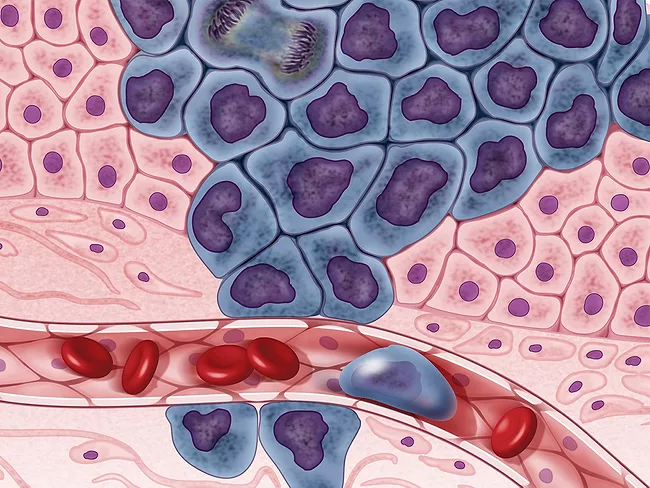
Prior to this year’s Annual Meeting of the American Association for Cancer Research (AACR), it had been 14 years since metastasis had been the subject of a plenary session. So, the Tuesday session on “Evolution of the genome, microenvironment, and host through metastasis” had plenty of new insights to share.
Prior to this year’s Annual Meeting of the American Association for Cancer Research (AACR), it had been 14 years since metastasis had been the subject of a plenary session. So, the Tuesday session on “Evolution of the genome, microenvironment, and host through metastasis” had plenty of new insights to share.
Bruton tyrosine kinase (BTK) enzyme inhibitors used to treat B-cell cancers, including chronic lymphocytic leukemia and non-Hodgkin lymphoma, also produce resistance by causing mutations in the protein. Now, a study on the BTK degrader NX-2127 showed the compound could be effective in eliminating BTK regardless of its mutations.