Med-tech firms have gnashed their teeth for decades over the use of the term “recall,” given that some recalls are mere corrections to product labels while others entail a full product withdrawal. The U.S. FDA recently provided a glossary of terms under the heading of recall – a move that comes short of industry’s preference that the term be jettisoned altogether.
In early validation of widespread predictions of a robust year for M&A activity, Boston Scientific Corp. signed a definitive agreement to acquire the 74% of Bolt Medical Inc. it doesn’t already own for $443 million up front and up to $221 million in contingent milestone payments.
Strategics tend to invest in med-tech companies they are looking to acquire or could be acquired. Furthermore, companies like Medtronic plc and Royal Philips NV, which have venture arms, will continue to invest even through challenging times.
Merit Medical Systems Inc. reported it is buying the lead management assets of Cook Medical Inc. for $210 million in cash. The Cook products consist of lead extraction devices and other lead management products.
Angiodynamics Inc. received CE mark approval for its Auryon atherectomy system which treats peripheral artery disease, including critical limb ischemia and in-stent restenosis. The regulatory clearance expands the company’s global reach as it sees increasing revenues from sales of the device.
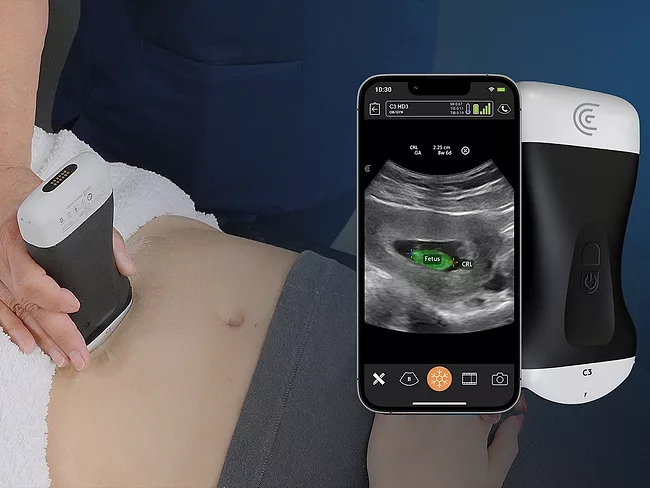
Clarius Mobile Health Corp. received U.S. FDA clearance for the Clarius OB artificial intelligence biometric measurement tool, which is designed to improve access to accurate prenatal monitoring in low-resource regions. The system automatically estimates fetal age, weight and growth intervals critical to assessing fetal health and early identification of potential issues and multiple pregnancies.
Vyaire Medical Inc., of Mettawa, Ill., reported a class I recall of its Twin Tubes devices, which are used in the collection of air samples during cardiopulmonary exercise testing. The recall was prompted by the risk that the device nozzle will separate during patient use and potentially result in choking, although the FDA said there have been no reports of adverse events in connection with the problem.
Royal Philips NV has come to terms over class-action litigation in which plaintiffs alleged that particulate matter in continuous positive airway pressure (CPAP) machines has proven harmful to their health, bringing the matter to a $1.1 billion conclusion. Despite the 10-figure sum, news of the April 29 settlement sent the company’s share prices up by roughly a third in early morning trading, suggesting that investors had already baked their expectations of the settlement into their thinking about the company’s future.
Royal Philips NV may feel it has had enough recent interaction with the U.S. FDA, but the company is now in receipt of a warning letter from the agency over a facility located in Suzhou, China. The FDA was none too fond of the facility’s handling of a contract manufactured data cable used in CT systems because of malfunctions that may have delayed diagnostic imaging procedures, representing yet another regulatory distraction for a company that recently cleared a long-running conflict with the FDA over CPAP machines.
The U.S. FDA and Department of Justice have announced a consent decree entered into district court that enjoins Philips Respironics LLC North America from manufacturing and distributing respiratory devices from three company facilities in the state of Pennsylvania.